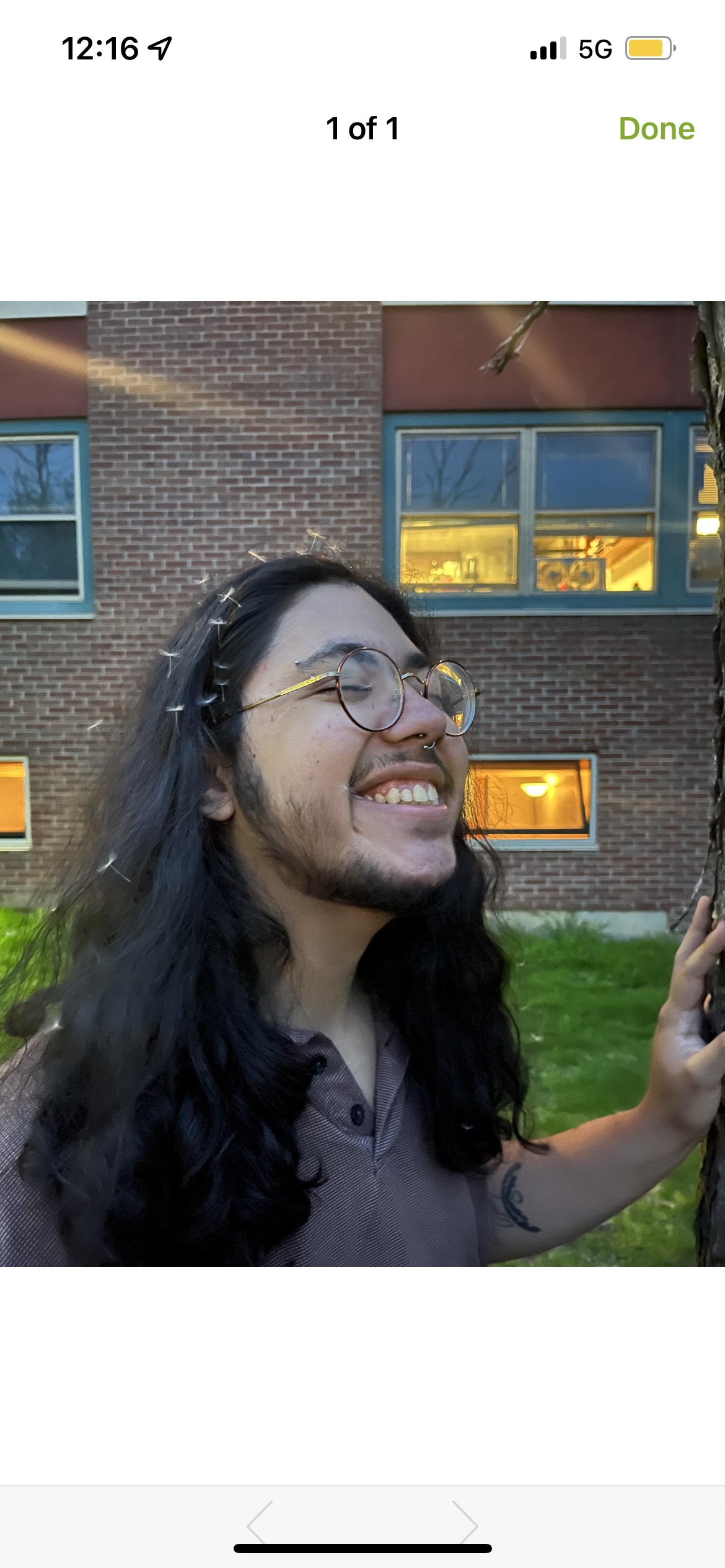
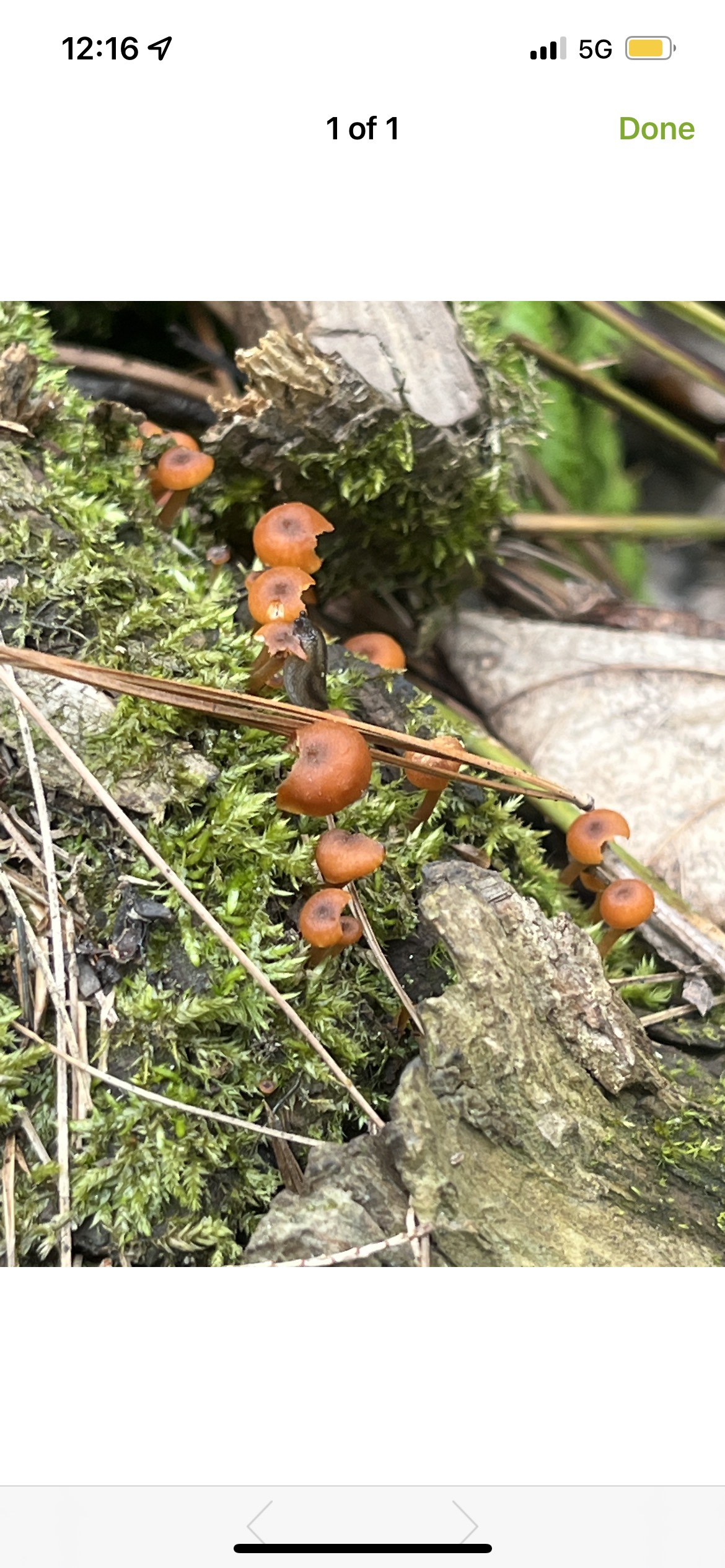
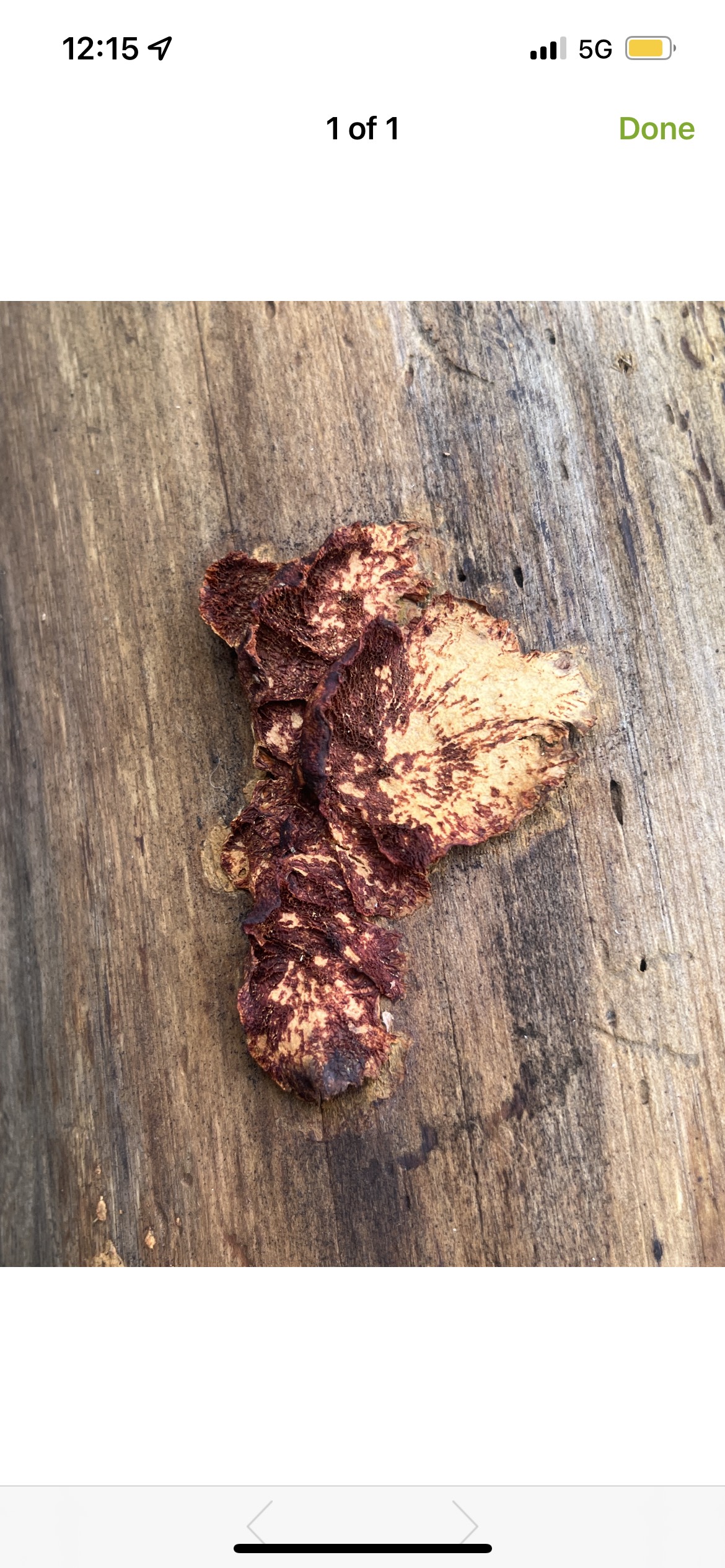
During the City Nature Challenge in Burlington, I took the time to thoroughly explore the surrounding areas in search of species for my contribution to the BioBlitz. All of my pictures were from around the grounds of UVM and Centennial Woods, which I feel I have a greater understanding of. I spent hours in Centennial Woods with friends the Saturday of the challenge, digging in the stream, walking among the trees, and bent over the floodplains. I uploaded 367 observations of 82 species, which I thought would be enough to win, but alas. A few of my favorite observations were a bunch of mushrooms, dandelion seeds in my friend’s hair, The competitive aspect of the BioBlitz kept me pulling out my phone at any given moment. I was really surprised at how many species our city found and what were the most common. I also was really blown away at the diversity of the cities from other parts of the world. It really makes me want to visit and understand why their cities have so much more diversity than ours!
How has your site changed over time? Phenologically, and also maybe larger human-caused or storm-caused changes.
Over time, the overall ‘look’ of my phenology spot has not really changed, but there are small differences from the beginning of the year to now. For example, the amount of mushrooms on the log has undulated all year, being eaten and frozen off and growing anew all year. Watching them grow has been so interesting! Also, the path has become more worn down recently as the weather gets warmer and people start to hike and walk their dogs there more often.
What are the major and minor landmarks you’ve become familiar with?
The most major landmark of my spot is obviously the fallen log with the mushrooms growing on it. It’s so large that even small changes are very visible. Some smaller landmarks are the patch of ferns, the tree with holes in it, and the path leading to the rest of Centennial Woods.
In what ways do nature and culture intertwine here?
Nature and culture intertwine here in the form of recreation. People mostly use Centennial Woods for walking, biking, and hiking, and this brings people in from all over Burlington and UVM. Many people walk through in groups as I sit in my phenology spot, and the people watching is almost as interesting as the spot itself.
Do you consider yourself a part of your place? Why or why not?
I would say that I don’t consider myself a part of my spot because every time that I left my spot for breaks, when I came back, it still continued on. I think that it would be a little bit egotistical to say that just because I’ve spent a few moments there that I am now an inextricable part of my phenology spot. My spot is going to continue after I’m gone, and it existed and thrived before my time. This is a comforting fact; that the forest will continue without me.
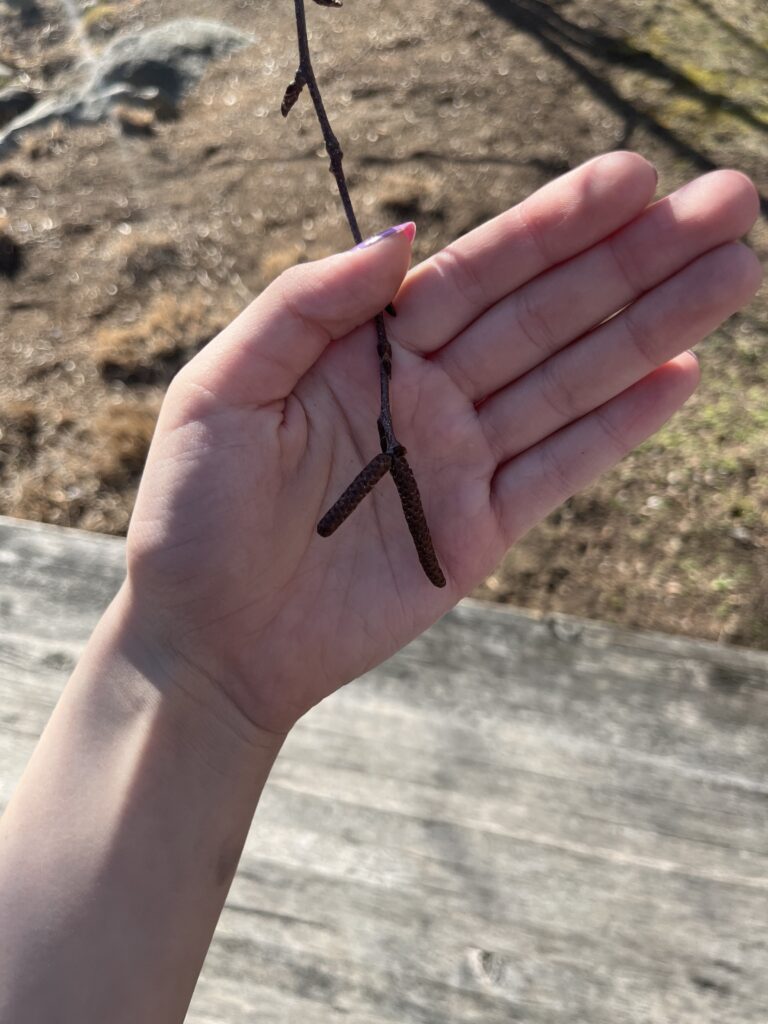
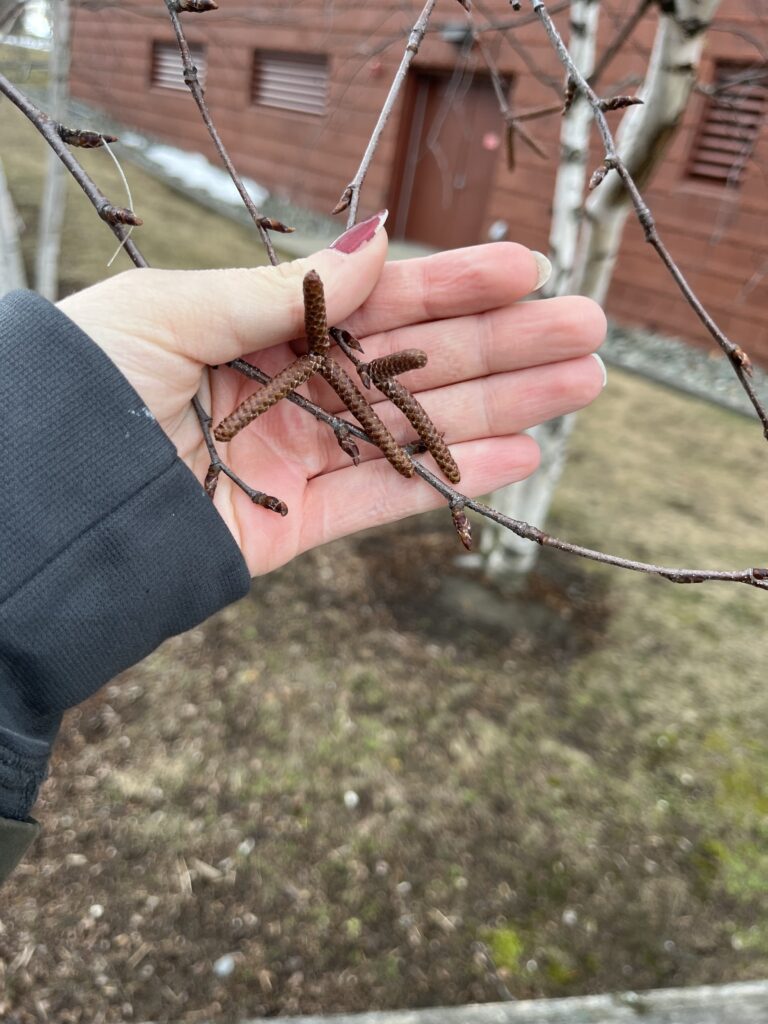
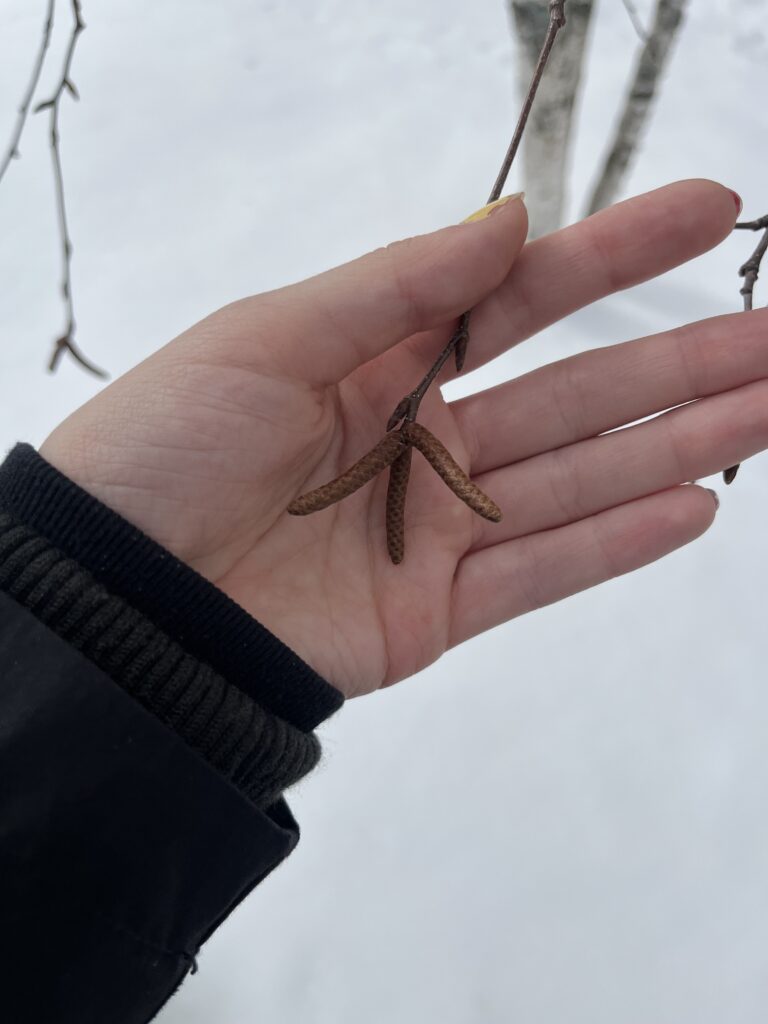
This week, I didn’t notice many more changes to my tree. There were relatively the same amount of buds, and none of them had sprouted yet. I’m hoping with the relatively warm weather we’re getting lately, they’ll start to open soon! It did seem as if the tree was a bit fuller with branches and twigs, which hopefully means it should be coming out of its dormant state soon.
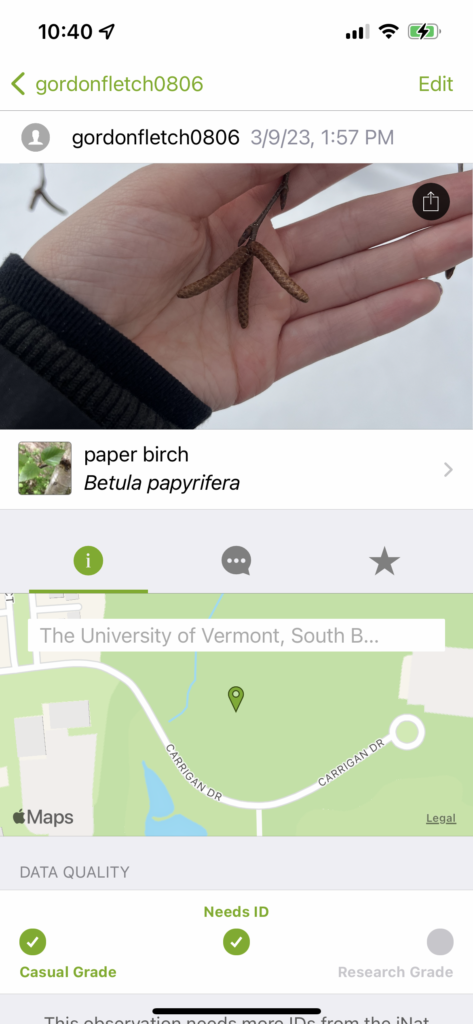
I revisited my paper birch tree today, and it’s doing great! While none of the buds have burst yet, there are way more than there were last time, and the ones that were there previously are much bigger! Instead of 1 or 2 being at the end of the branches, there are 2-4. I look forward to seeing the tree once it starts to sprout its leaves and what that will look like!
The tree that I found around my phenology spot and chose to talk about was a middle-stage Paper Birch that was in the process of budding new leaves. Yellow Birch and River Birch have smaller buds that are more like buds you would expect from a deciduous tree, while Silver Birches have much larger buds that are extremely pinecone-like. These medium sized charismatic pinecone-like buds are hard to miss, especially paired with the unique white, peeling bark, and we definitely have a Paper Birch on our hands! I can’t wait to come back after spring break and see if it’s budded at all!
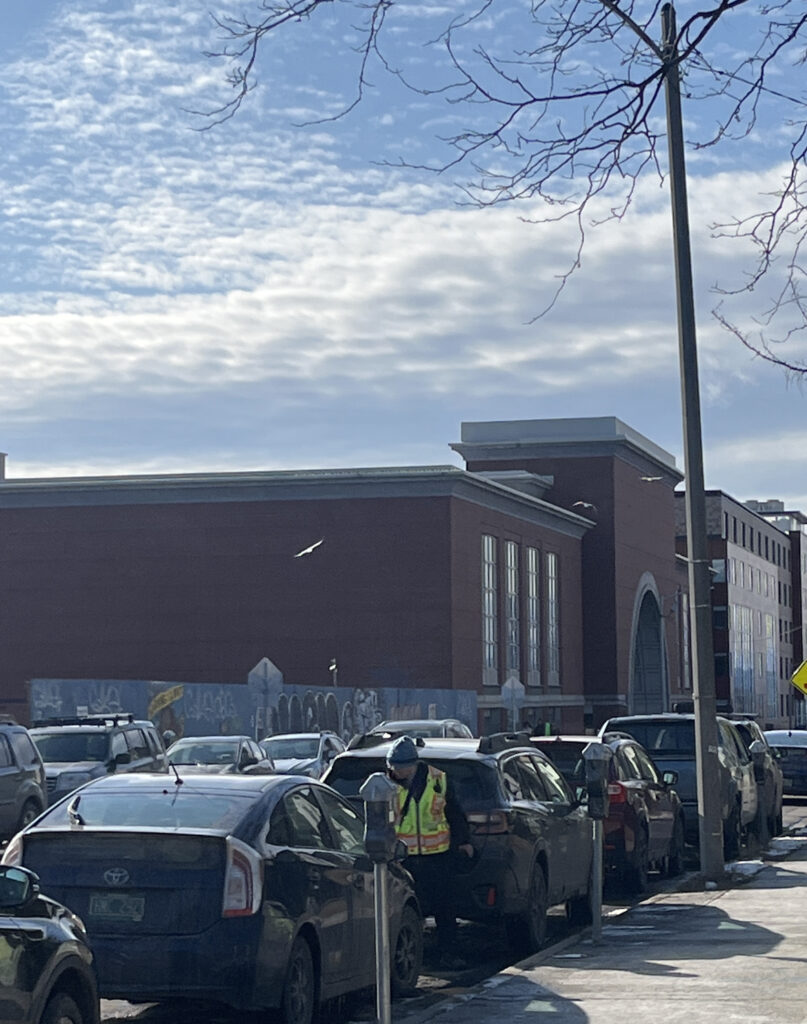
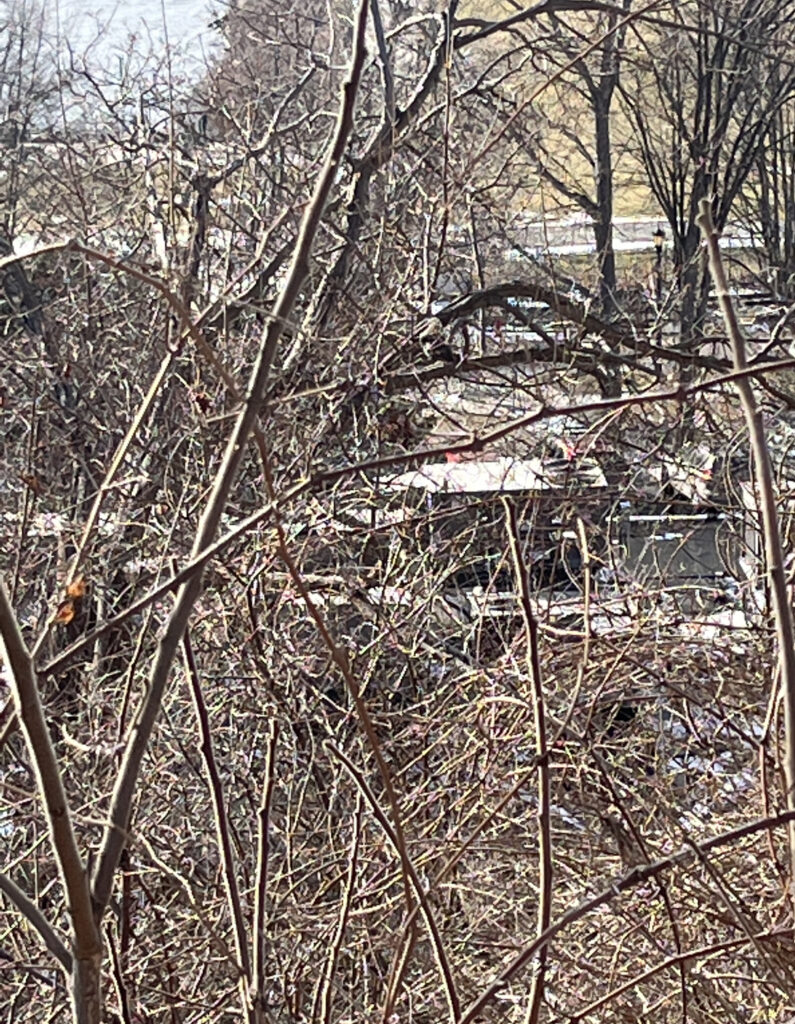
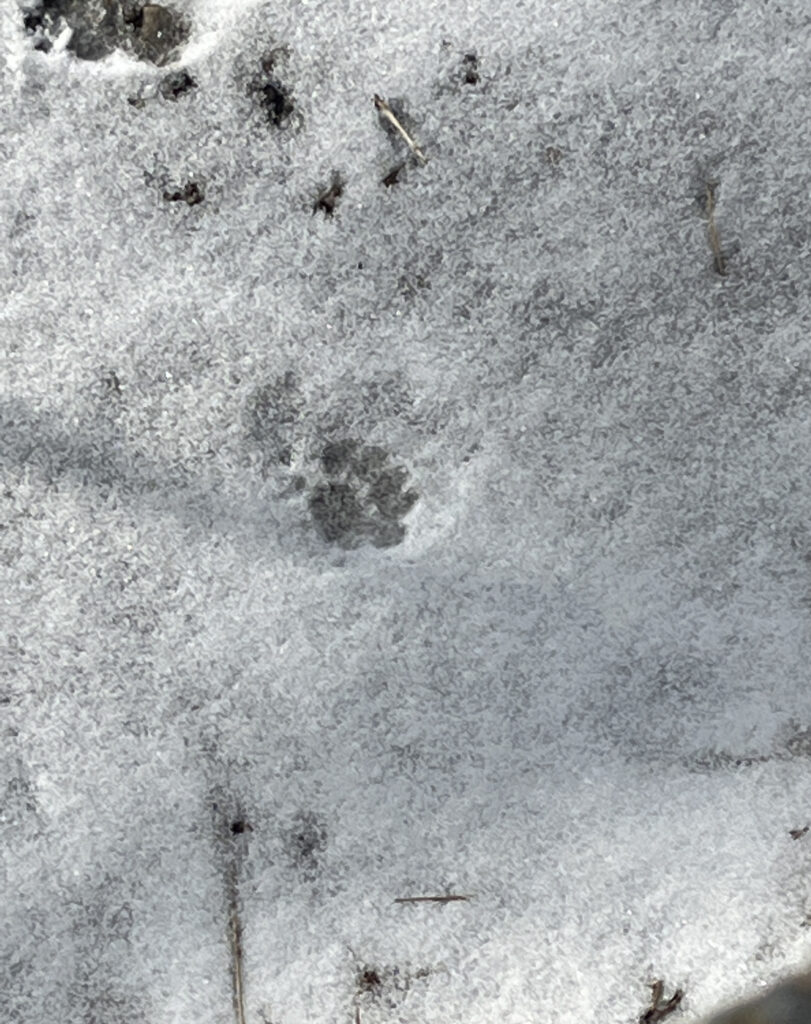
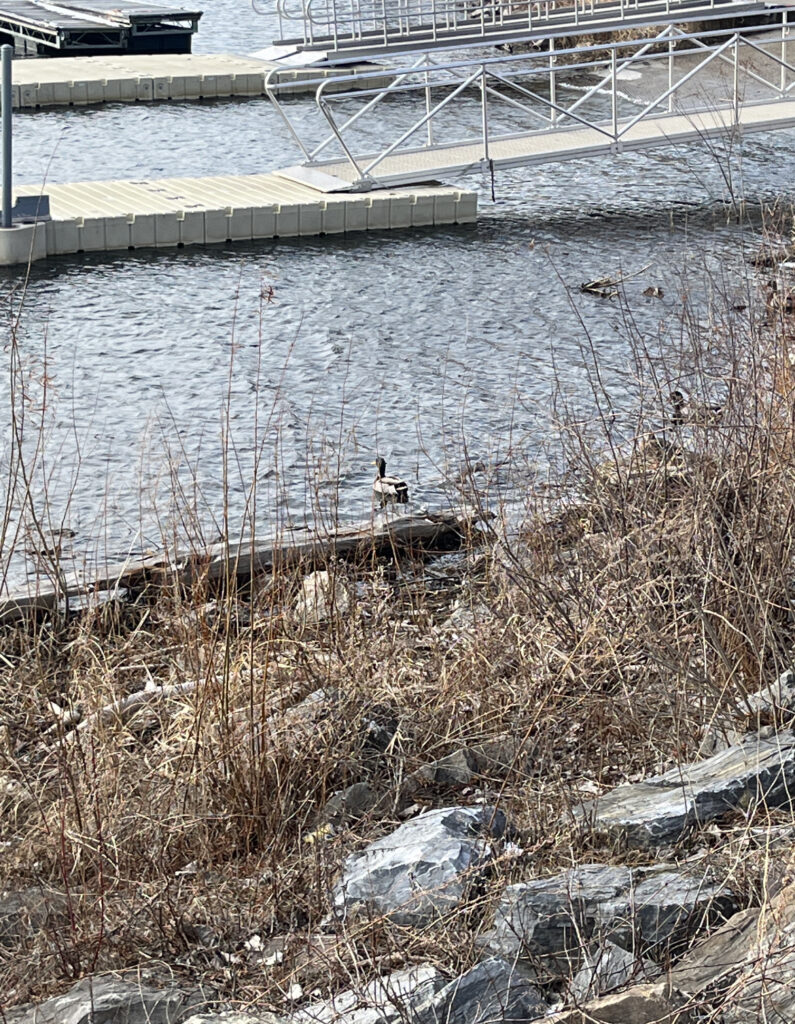
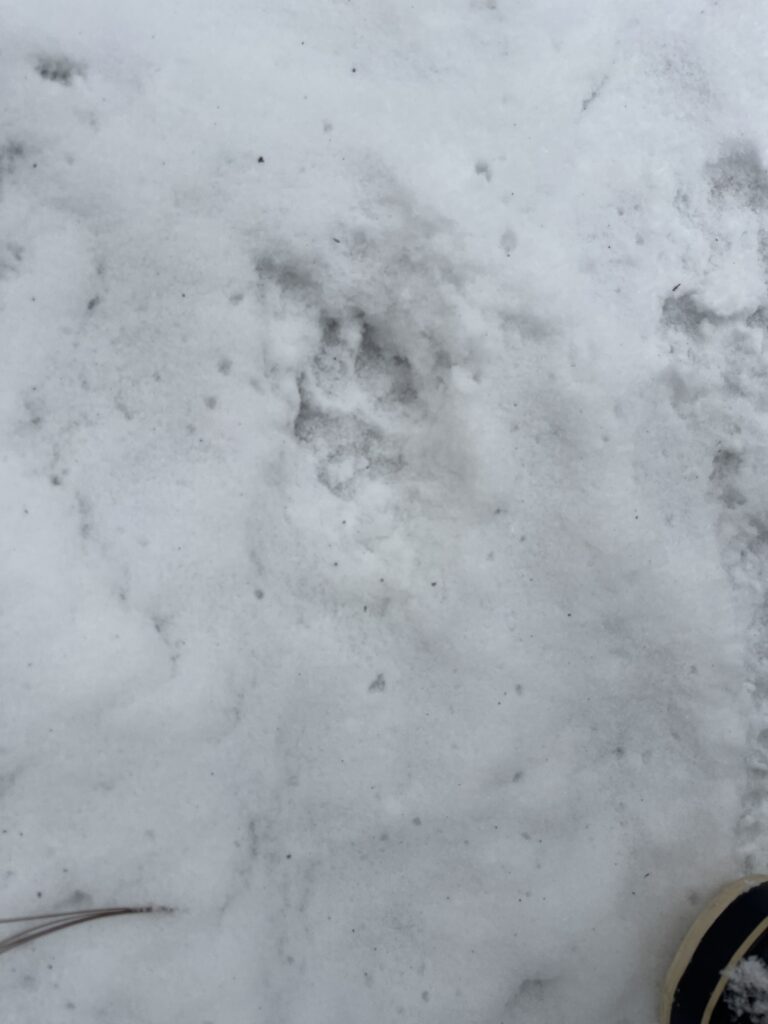
╰┈➤ To make our observations, me and my friend decided to walk down from Church Street to the Lake Champlain Waterfront and see what we could find. We hypothesized that we wouldn’t see much diverse wildlife because of the time and place, but we actually saw a few common animals in the city! Firstly, as we were walking by Burlington High School, we saw a flock of Herring Gulls flying overhead (Figure 1). Afterwards, we went to the lookout spot at the edge of the city that overlooks Lake Champlain and the mountains. We were hoping to see Champ from here, but we did spot a grey squirrel (Figure 2) and what looked to be the pawprints of a fisher or maybe a domestic cat that had stepped in the same track twice (Figure 3). I say this because this track looks like it has five toes, which would rule out a canine or feline, but it didn’t seem like there were other 5-toed tracks around, and it seemed to have a leading toe. Once we made it all the way to the waterfront, we saw a bunch of mallard ducks by the Echo Center, about 4 males and 2 females swimming and nesting (Figure 4). We recorded all of our findings on iNaturalist as we saw them and I overall really liked the experience, especially when you get to hear feedback on your pictures!
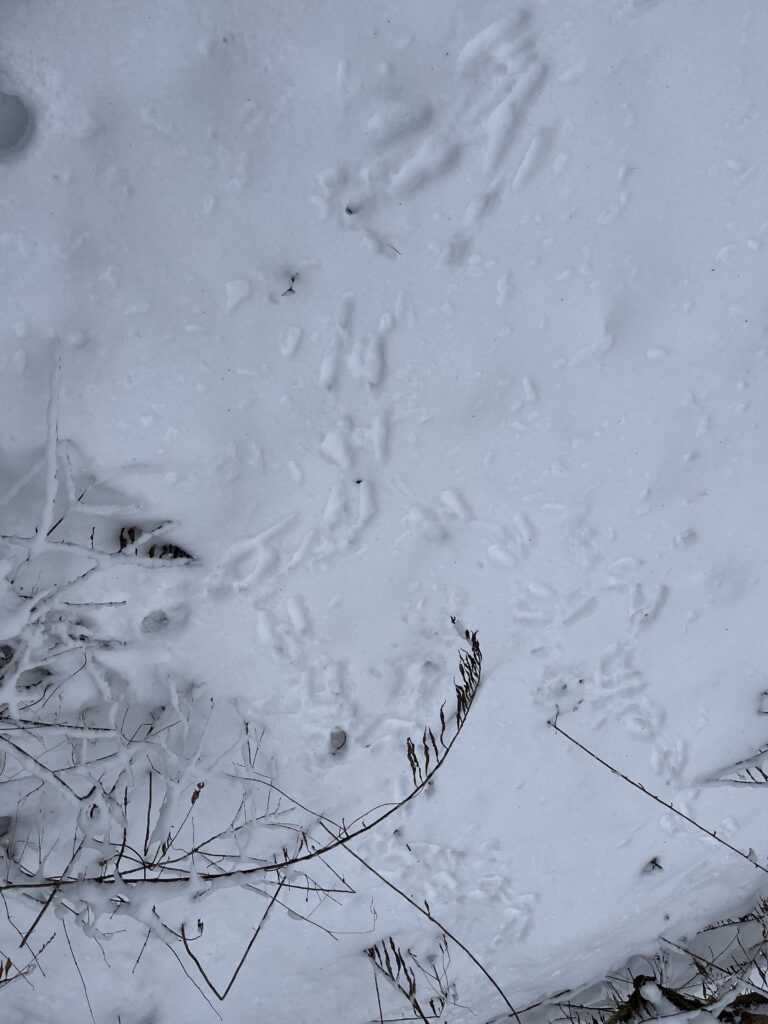
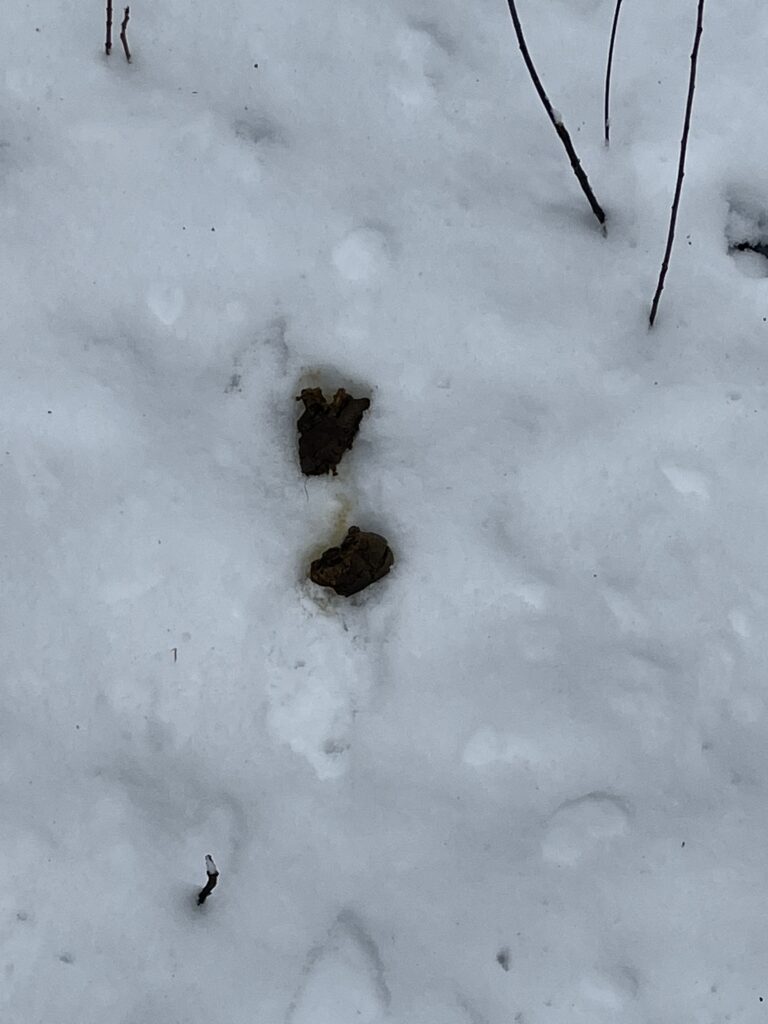
╰┈➤ At first glance, the signs of wildlife in my area are nonexistent, however upon close inspection, it is actually revealed that many animals have visited this spot! There is an abundance of small tracks that could be made by miscellaneous rodents and dog pawprints (Figure 1). Most notably there were rabbit tracks (Figure 2) and some kind of scat that I identified could’ve been a fox but was most likely a small dog (Figure 3). The most exciting change for me was the little bites taken out of the mushrooms growing on the side of the logs, most likely snacked on by deer and squirrels (Figure 4).
Figure 1
Figure 2
Figure 3
Figure 4
✩ Phenological Changes ✩
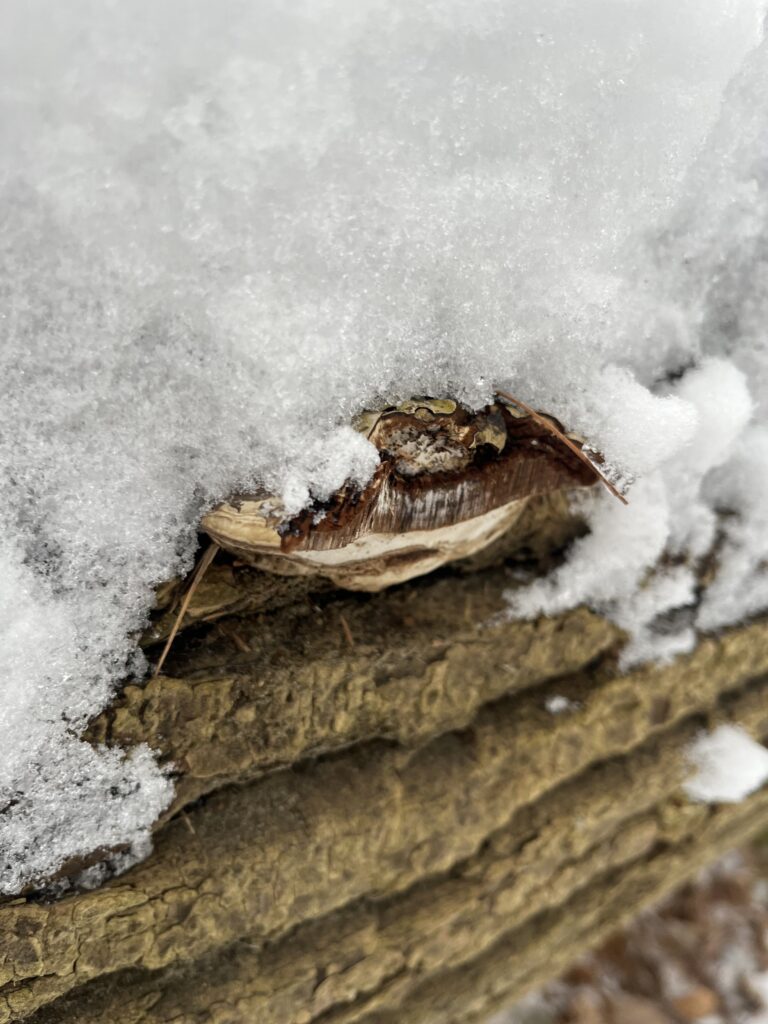
╰┈➤ Snow!! So much snow! This isn’t the first time that I’ve been to my spot with snow on the ground, but this is definitely the most exciting. There was enough snow that it completely covered the leaf litter and actually masked some of the logs (and made me trip a few times). It was piled about 4 inches tall on the main fallen log, the epicenter of my phenological spot. There were also no leaves on the trees except for a few conifers hanging onto their needles. Surprisingly, some green ferns still poked through the snow, but I doubt they will hang on for much longer. I am also shocked that the mushrooms are still around. The ones on the ground have long since died or been eaten, but the Artist’s Bracket mushrooms on the log are still going strong, although they are a little chewed up. I’m guessing this is because they’re somewhat shielded from the elements by clinging to the side of the log and away from the freezing, wet ground. (Figure 5)
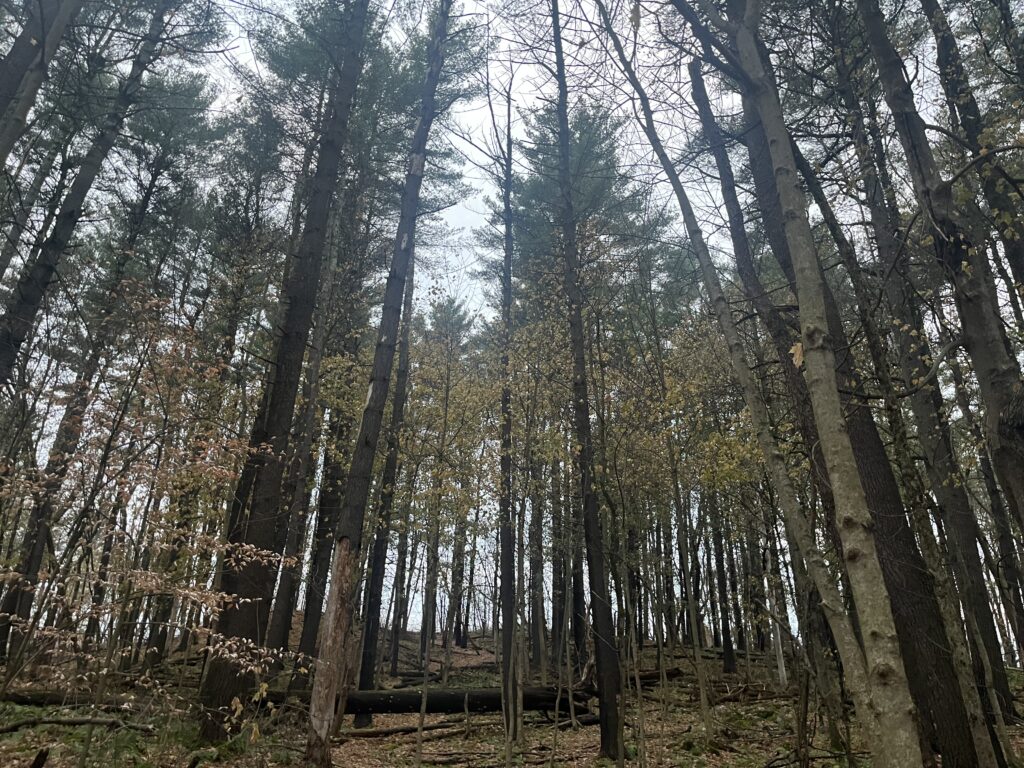
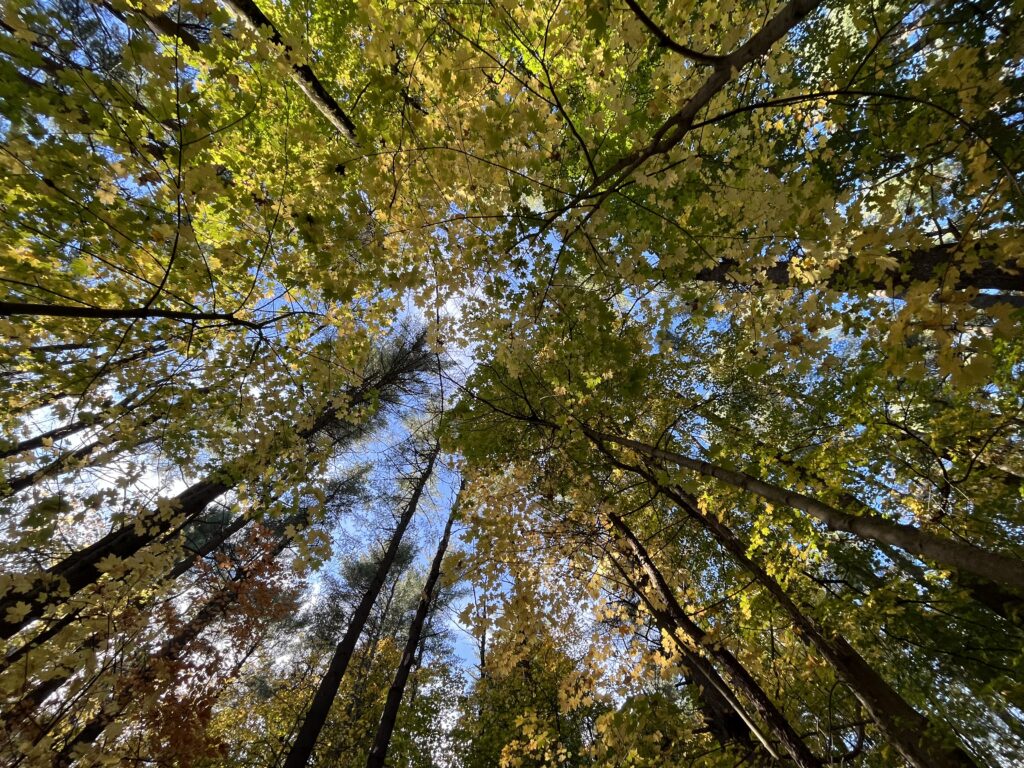
╰┈➤ While the areas surrounding my spot are incredibly barren save for the coniferous trees, ferns, and clinging grasses, my spot is still hanging on in the early days of December! In Figure 1, the succession of the forest is shown extremely clearly; the surrounding young red maples have sparsely dispersed yellow leaves and the others have mostly completely lost their leaves, which joins the wet and decaying leaf litter. Said leaf litter is being patted down by rain and snow and will eventually create a lovely O layer for the soil and act as insulation for many burrowing animals. The tallest trees are the eastern white pines that, of course, still have their leaves.
Figure 1
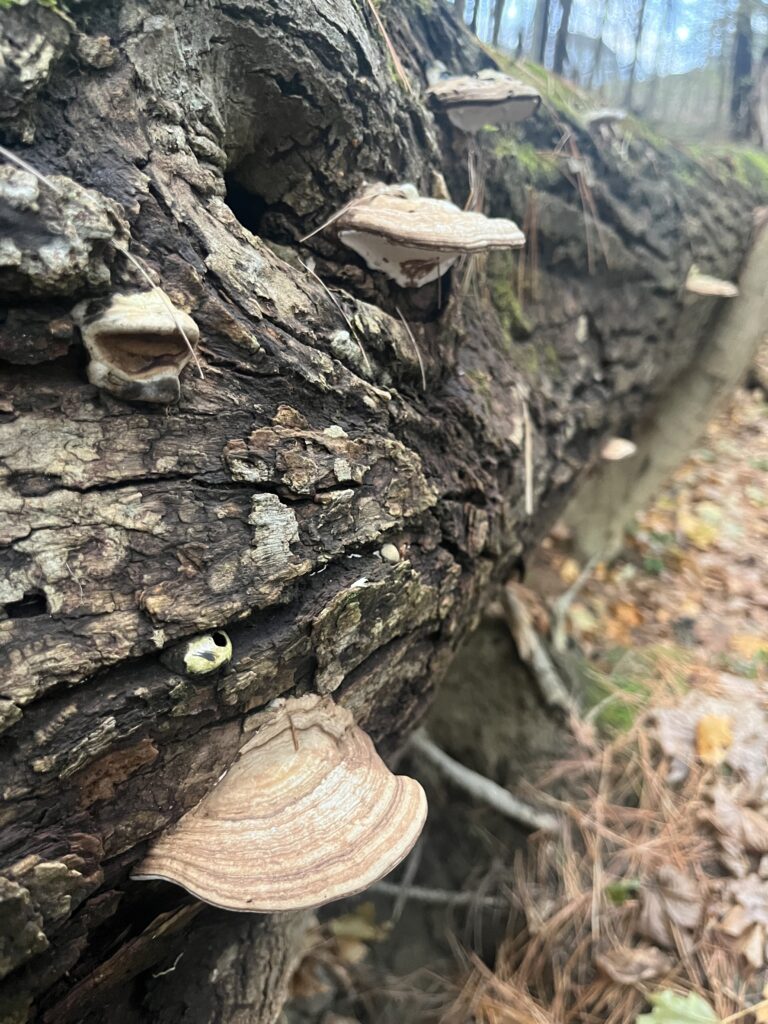
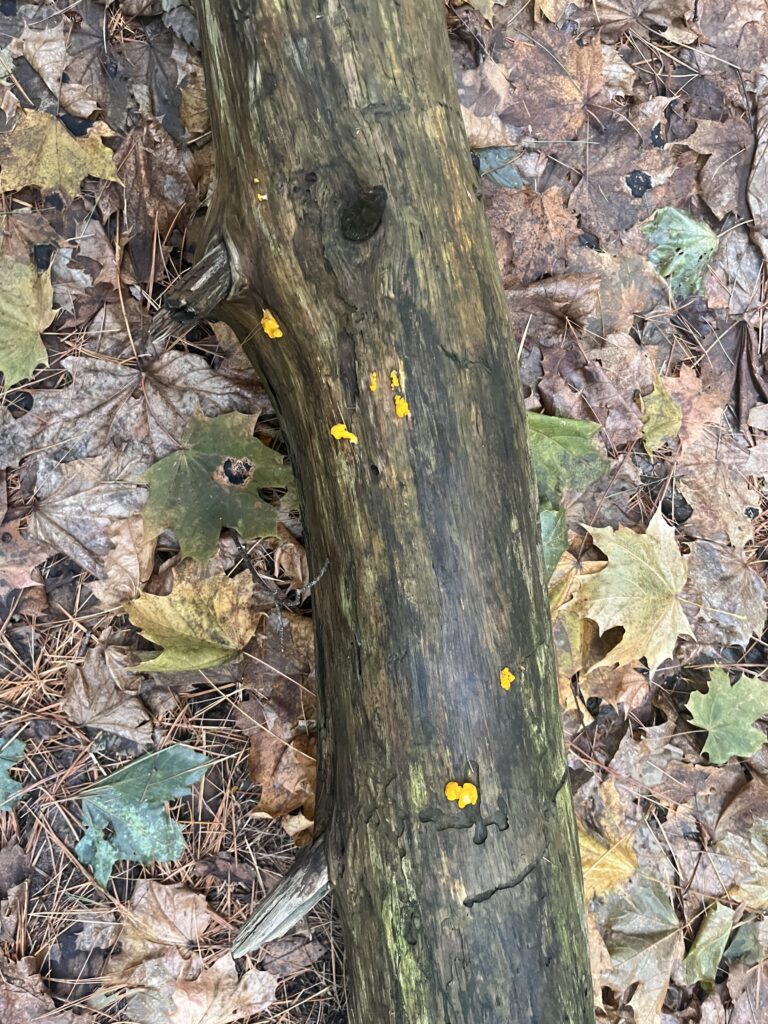
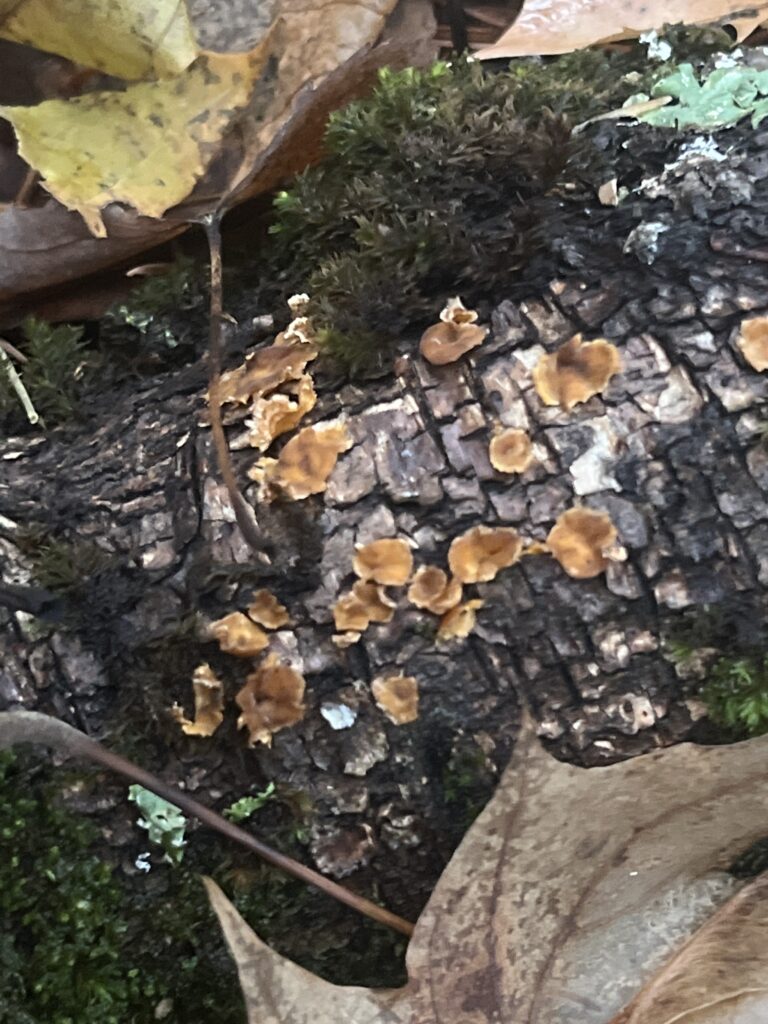
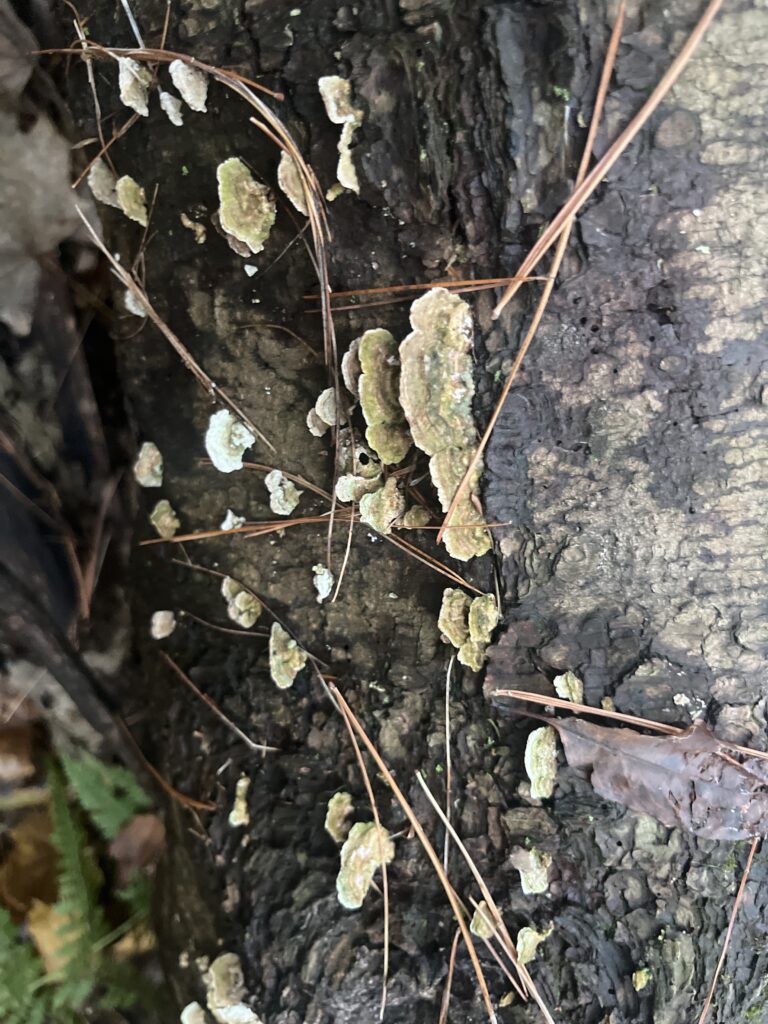
╰┈➤ Something unexpected that took place in my spot over the weeks of my absence was a boom in mushroom growth! While the ones on the ground have been stamped out by the leaf litter that blocks their view of sunlight, the ones on the numerous fallen and decomposing logs are taking the elements in stride! I would have thought it’d be getting too cold for mushroom season, but these mushrooms are hardy (Figure 2). I also finally got iNaturalist to work in my spot, and identified the genus of three of the most popular mushrooms in my area, which are Genus Ganoderma (most likely Artist Bracket, Figure 2), Genus Dacrymyces (Figure 3), Genus Stereum (Figure 4) and Genus Trichaptum (Figure 5).
Figure 2, Artist Bracket
Figure 3, Genus Dacrymyces
Figure 4, Genus Stereum
Figure 5, Genus Trichaptum
✩ Animal Presence ✩
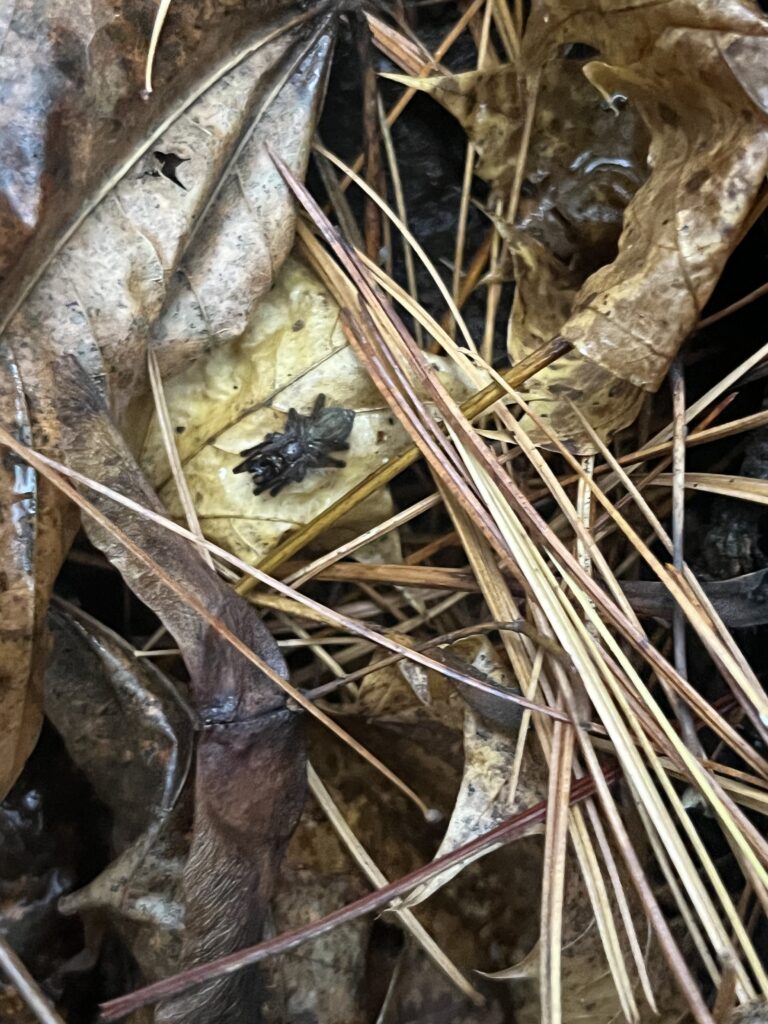
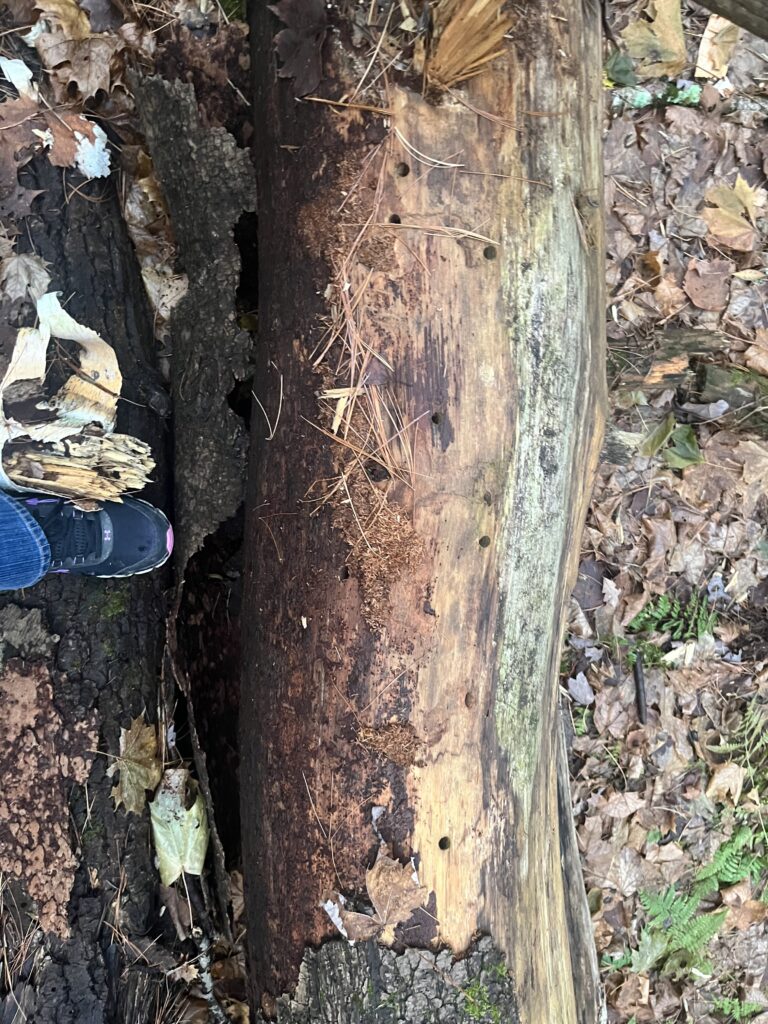
╰┈➤In Figure 6, one of the former inhabitants of the leaf litter, a wolf spider, is shown curled up on its back, most likely having succumbed to the elements. I’m sure there were tons of other bugs that had done the same in the log in the center of my area. The only other hints of animal presence were the new insect bores in the fallen logs, shown in Figure 7, that are most likely the homes of multiple bugs looking for shelter and food in the decaying log.
Figure 6, Wolf Spider
Figure 7, Insect Bores
✩ What Aspects Did I Enjoy The Most? ✩
╰┈➤ I believe that what I enjoyed the most about this project was visiting a place in nature as if it was an old friend. I got to observe the small changes that my place went through and improve not only my knowledge of my place and the surrounding area but also my relationship with the earth and sense of place. It helped me create a meaningful connection to the environment that I will never forget, and I can’t wait to continue returning to my place to check up on it!
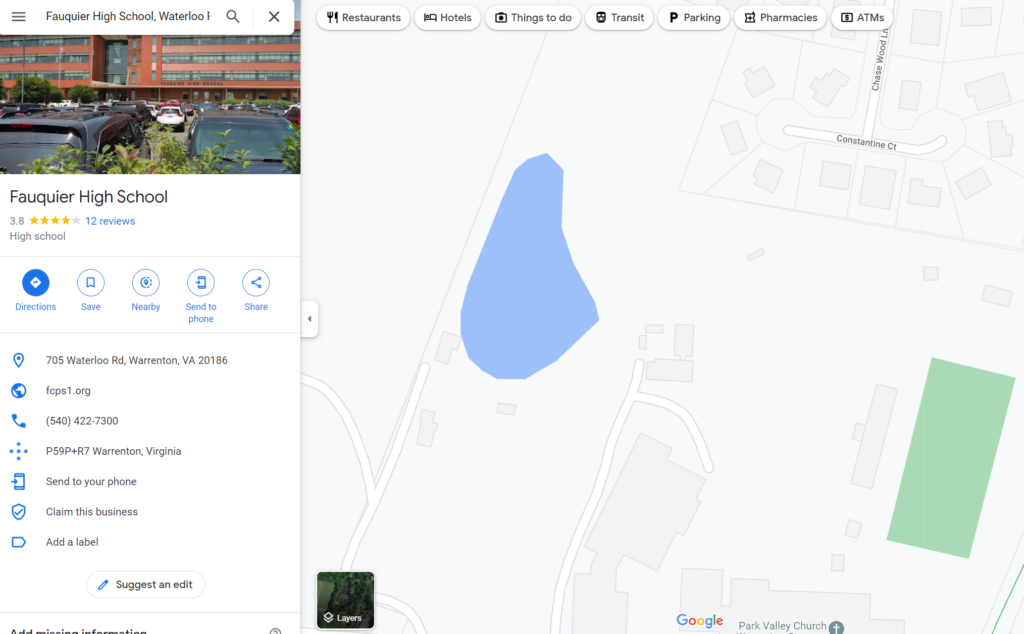
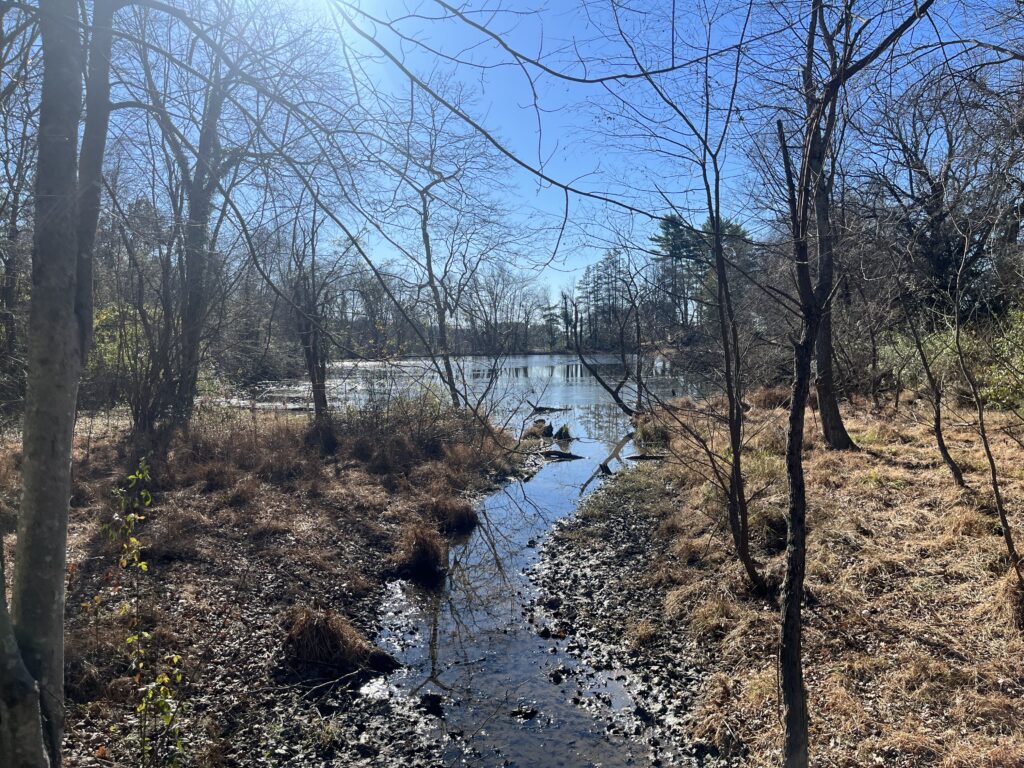
╰┈➤ Today, me and my friends walked to the woods behind our school where we spent a lot of our teenage hooligan years. We walked to the lake to observe the phenology and I was surprised that it was incredibly different! Firstly, the non-coniferous trees still had leaves; no stick season in Virginia! The shrubbery, while dead and dry, was still clinging. There was a different composition of trees, the dominant species was Northern Red Oak, and there were few maples, whereas in Vermont you can’t go two steps without seeing a maple. There were also a few ducks, I think Ring-Necked ducks, which I haven’t seen before; usually it was Mallards or the pair of swans that were the focus of my friend’s photography project last year. Additionally, the lake was frozen 3 inches deep, which usually doesn’t happen. However, by the time we were leaving, the ice had begun to melt. I assume that when the temperatures dip at night and the sun isn’t out, the lake begins to freeze, but then it unfreezes every morning. When I come back for Winter break, I plan to see how much more it’s frozen!
╰┈➤My friend, who did a project on the lake for a class in high school, commented that the lake was extremely impaired due to proximity to the school and the town, which reminded me of my phenology spot in Vermont. She also said that the lake is on track to become a bog, which is a natural process but is not helped by the previous factors.
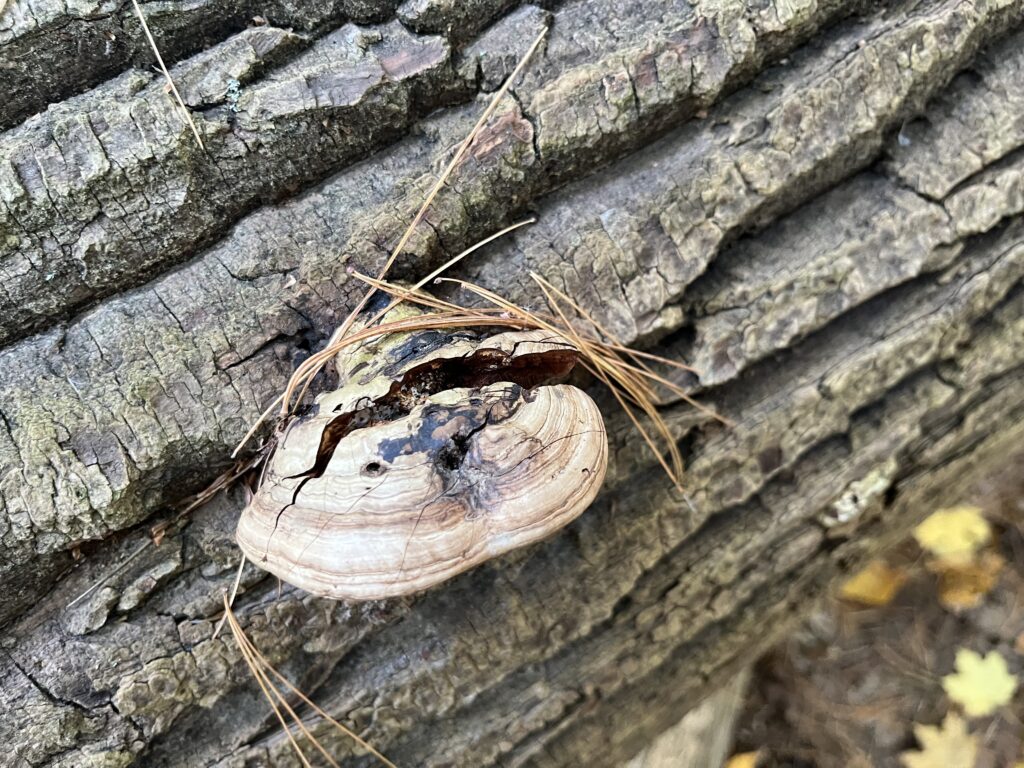
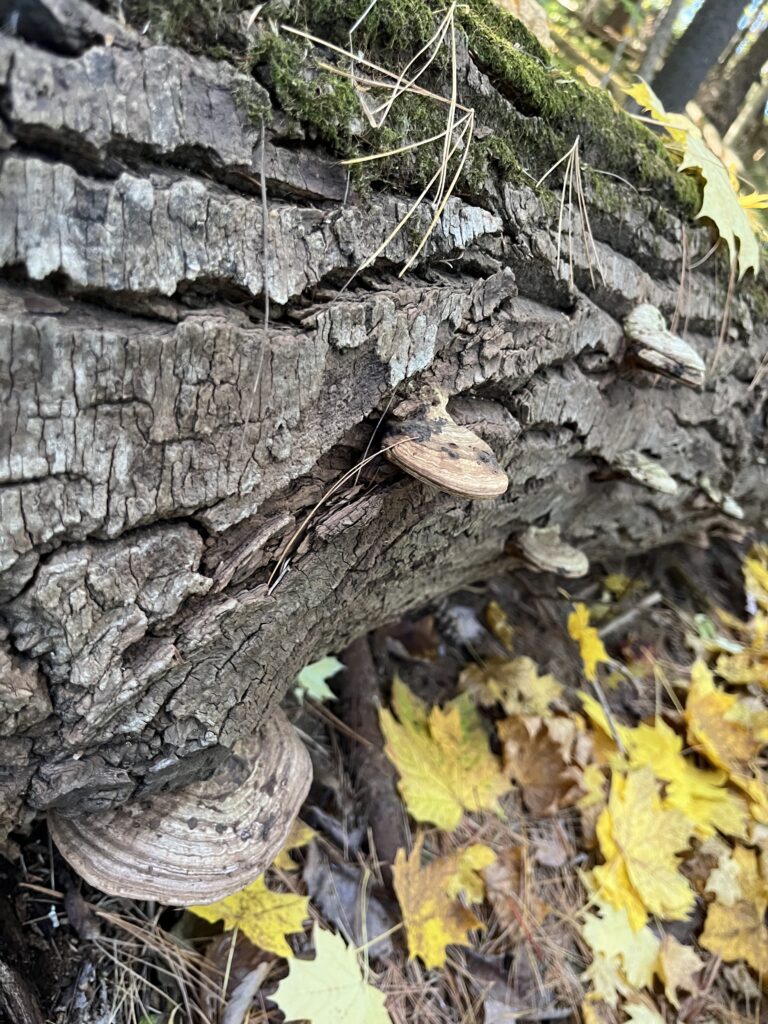
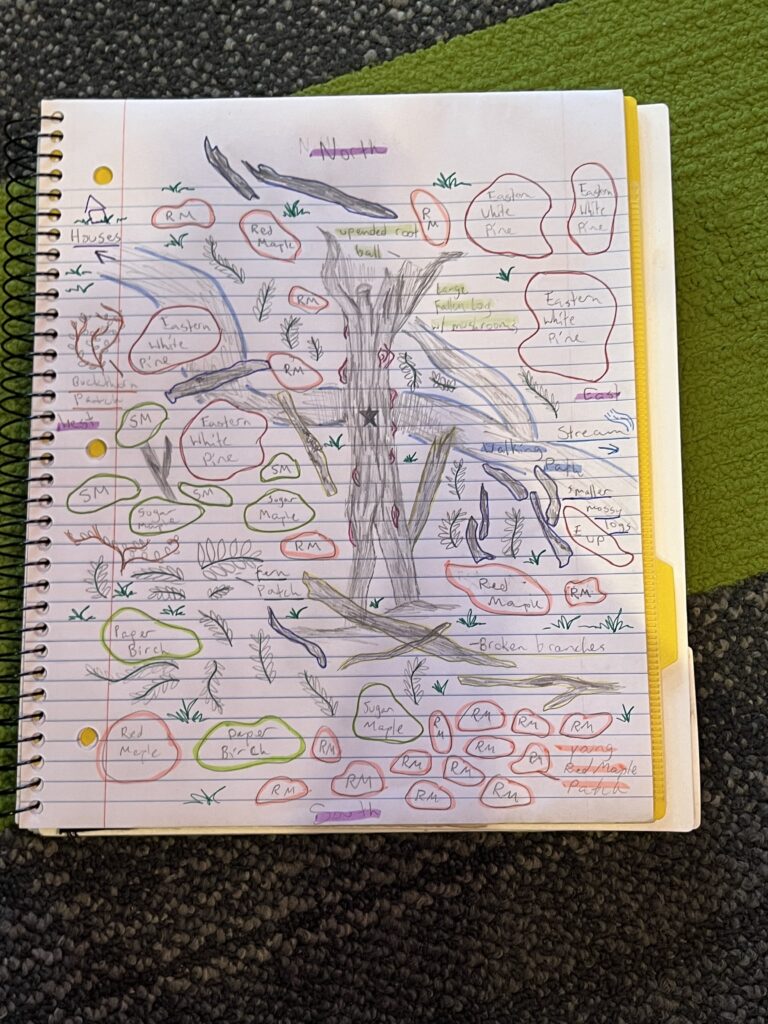
╰┈➤ Today, between classes at 2 PM, I walked to my phenology spot and climbed the large mushroom log in the middle of my spot to do my observations. The main thing I noticed after being on campus all week (especially after Halloweekend) was the silence. My spot is far enough away that I can’t hear the stream, the campus, or the road, so the only noises are barking dogs from the houses up the hills, birds, and leaves falling on crunchy leaf litter. Said leaves were mostly red and sugar maples and pine needles, although stick season is not yet in full swing in my spot. The red maple leaves are a bright canary yellow and actively falling, which exposes the Eastern White Pines in the overstory and gives the ferns and buckthorns of the understory more sunlight. When perched on the large log, there is an undercurrent of the smell of moist rot from the dead tree, which almost makes you wary of sitting on it. There were also almost double the amount of mushrooms on the side of the log (Figure 2), but they seem to be cracking (Figure 1), maybe because of the colder temperatures. Next time I go to the forest, I’d like to have iNaturalist installed on my phone so I can see what type of mushrooms these are!
Figure 1
Figure 2
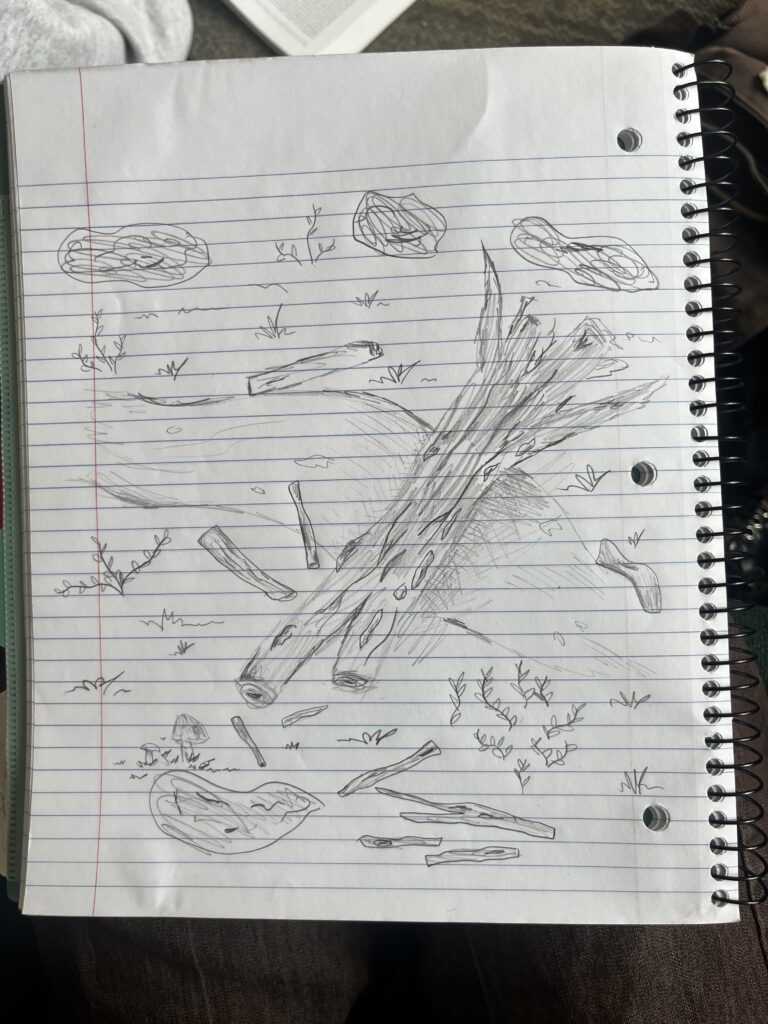
✩ Birds-Eye Map ✩
Figure 3, Birds Eye View of my spot ✩ represents sit spot
✩ Changes I’ve Noticed ✩
╰┈➤ The changes in my spot are not as stark as those around campus because of the forest composition which is mainly Red and Sugar Maples, Paper Birch, ferns, and Eastern White Pine, which don’t drop their leaves as readily as the surrounding oaks. There is a smattering of yellowing maple leaves on the ground covering the already fallen pine needles, which both weren’t as present the last time I visited. Also, the mushrooms that I was so excited to monitor seem to be growing more readily, but they will probably start to shy away from the colder temperature soon.
Hello all! I'm Fletcher Gordon (he/they), a freshman at UVM studying Wildlife and Fisheries Biology. I'm from Nowhereville, Virginia and am very happy to be in Vermont! Can't wait to learn more about it through this project!!