
Spring is in full swing at Rock Point. The rebirth of life is evident through its ecology. Budding and sprouting plants can be seen everywhere.

Some plants have blossomed earlier than others, and this is evident in the above photo. I am not sure what species of plant this is, but they must have an earlier growing season than some other plants at Rock Point. The green leaves are vibrant against the grayish-brown of the plants that have yet to react to spring.

Figure 2 displays buds that probably popped up very recently before my visit. These buds may belong to a red maple because they are rounded, opposite, and dark red. The bark is also a dark reddish brown, matching the criteria for a red maple. Buds like these were common throughout Rock Point.

Figure 3 shows a stage of budding soon after the stage displayed in Figure 2. The leaves are oval shaped with serrated edges, like the leaves of a paper birch. The bark is also grey like a paper birch’s would be. This is evidence that the weather recently has been optimal for trees to grow their buds and go even further for their buds to begin opening. You can tell how young these leaves are because the leaves still have some red from when they were buds; a mature paper birch will have green leaves.
With the rebirth of nature also comes an increase of people enjoying the outdoors. People enjoy the warm weather they have not experienced in months and bask in the fresh, warm air. Because of this, there were many more people walking along the trail at Rock Point than there have been in my previous visits this semester. I believe an increase in foot traffic is why I had trouble spotting wildlife at my phenology spot. In the past, I have noticed rabbits, squirrels, and chipmunks scurrying across the forest floor and climbing up trees. During this April visit, I did not notice any creatures in Rock Point at all. They may be intimidated by the increase in people coming to their homes. Despite this, there was evidence of wildlife via birds. Sea gulls and ducks were seen sitting on the water and flying across the lake.

Above are two seagulls sitting on Lake Champlain along North Beach, right next to Rock Point. While this is not necessarily in Rock Point, the lake is so close that the water birds of Lake Champlain interact with the ecology of Rock Point. Birds are a strong indication of spring being underway because when birds are here, it means the weather is warm enough for them to migrate back from their winter vacation somewhere warm. Song birds’ calls could be heard while in the woods, but I did not capture any photos of visible ones.
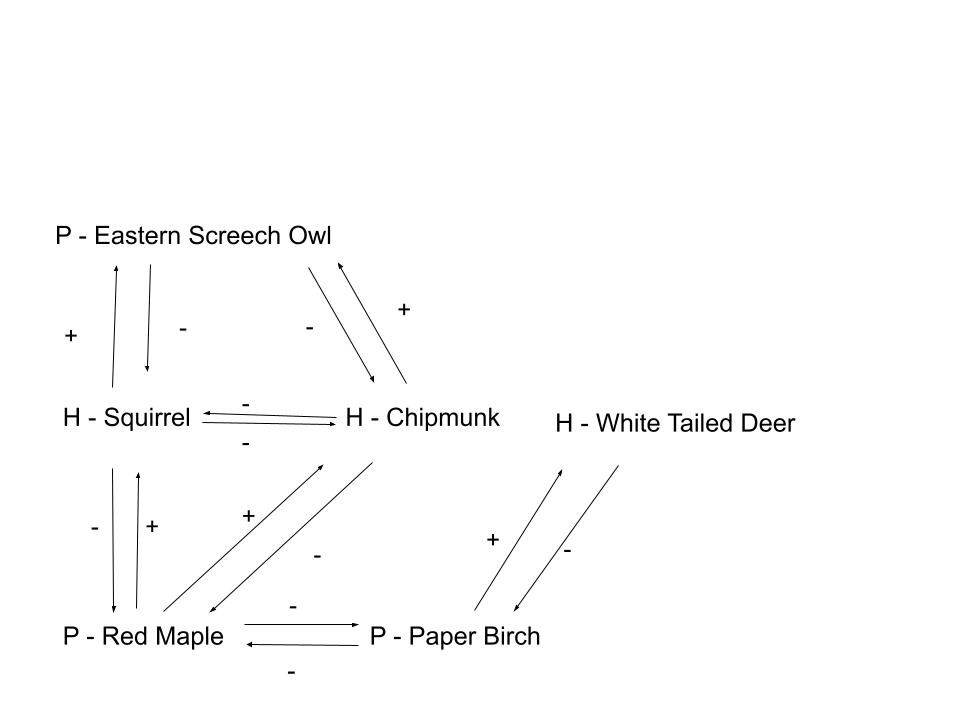
Above is a species interaction diagram of a possible scenario from the wildlife found at Rock Point. I personally have never observed a white tailed deer or eastern screech owl in the woods of Rock Point, but I have seen deer tracks during the winter, and I spotted a screech owl in the Jericho Woods, so I am assuming they could be found at Rock Point as well. The red maple and paper birch are seen in competition because they are competing for the same resources to grow (sunlight, water, etc.). White tailed deer eat the leaves of woody plants, and for the purposes of this diagram, they are benefiting from the leaves from the paper birch. Squirrels (specifically when they are babies and small enough for an owl to pick up) and chipmunks are competing for acorns sources from red maples, and both of these rodents can be eaten by eastern screech owls, which are birds of prey.