Archive for April, 2025


Overtime, I have seen my phenology place develop in nearly all seasons. I have seen its leaves crinkle into little orange tissue paper, the barren arms of the trees left after the absense of the leaves, and the small buds reappearing now. I have seen my phenology place, and much of Centennial Woods for that matter, in a new light each and every season, and I feel immensely grateful to do so. Without this assignment, and the urging to go into the woods and observe how the area is growing and developing, I may not have paid such close attention, or gone in there at all.

Now, though, I have become increasingly familiar with the area in and surrounding my site. For one, I have become able to know what to expect when I walk the trails, and I can name many of the most common plants simply by glancing at them. I also have been able to start identifying more trees just by their bark, which was a seemingly impossible feat at the beginning of the year for me. The Eastern White Pine and Eastern Hemlock forest has become dappled with landmarks for me, such as the root I sit by and hold onto when journaling, or the rope swing nearby. The bridge crossing the small stream and the areas in which I know wildflowers will soon pop up, they’ve all become landmarks to me. I feel so honored to have lived in this area long enough to see the seasons pass, and nature sigh into a deep sleep and reawaken again.

Culture and nature intertwine in Centennial Woods. For one, this is one of the only extremely accessible natural areas near the Atheletic Campus, which is where I live. Going to this space regularly, I see people who live near me, and I built small bonds just greeting them in the woods. I also see classes doing projects in the woods often, which builds connection and purpose which people feel towards Centennial, and nature in general. I see many touches of human connection and creativity inside Centennial Woods as well. On one occasion, I was walking up near the rope swing, closest to the woods facing Trinity, and I saw people building wooden structures near the swing so that people could better jump off, and the next time I was there, the wooden pile had turned into a small fire pit. This area is undergoing constant revision and natural cycles, and I find that each time that I go, and the more closely intertwined I become with my site, the more I feel I understand the land.

I feel inexplicably tied to this land now. I have visited my site with so many of my friends, shared so many conversations as well as silent moments. I feel I can sink into my area, and that at any point when life gets overwhelming or aggitating, I know there is an area in which I can feel true peace, and escape the overly-industrialized campus for just a little while. Centennial Woods, and my site in particular, always make me feel immensely rejuvinated, and in turn, I feel intertwined with it. In loving my site, I return to it again and again, seeking in it solace, peace, and also reciprocity.
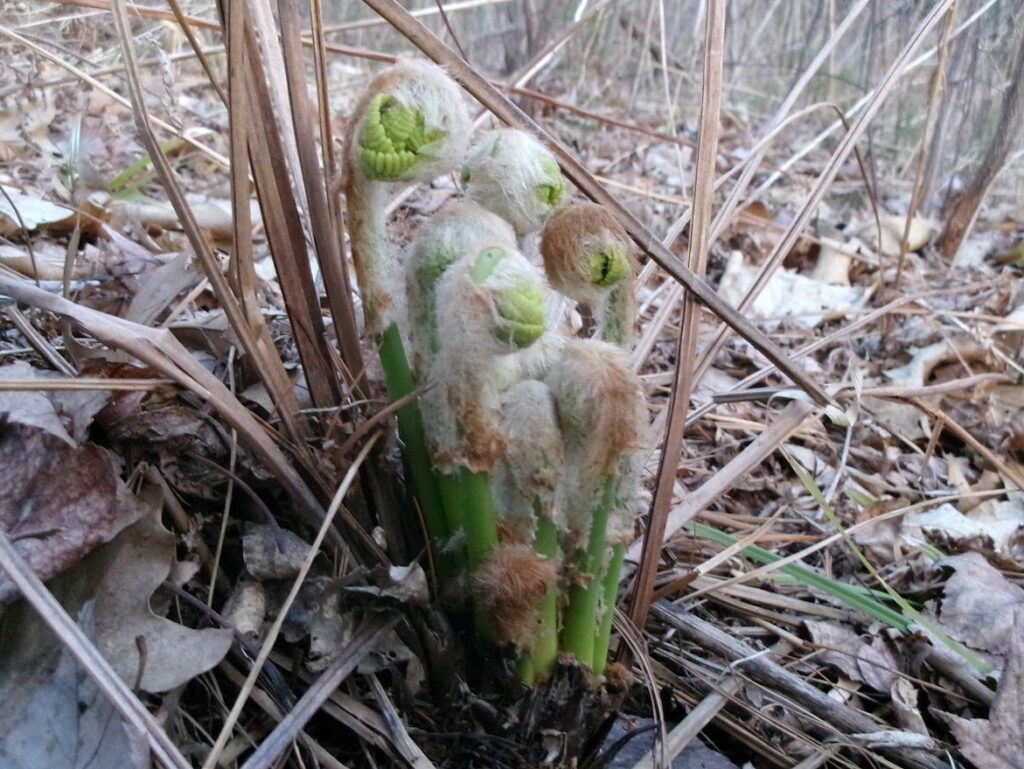
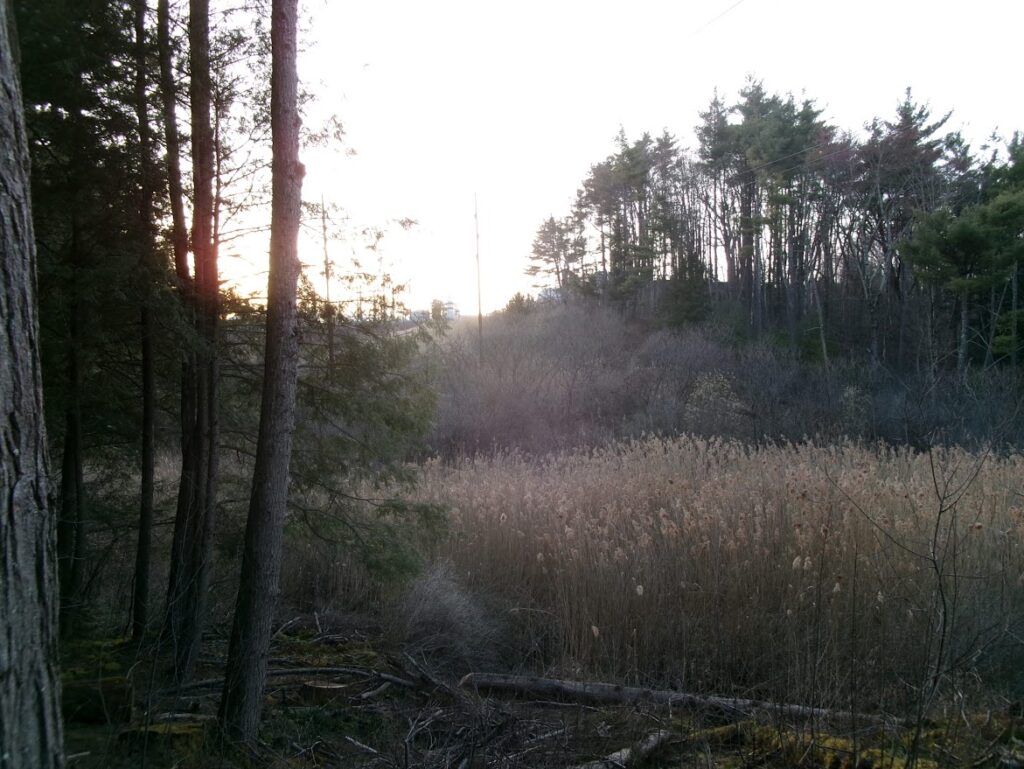
Across the four days of the BioBlitz Challenge, I explored a multitude of areas surrounding the Greater Burlington area. Most of these areas were within Centennial Woods, where I frequented for a few days in a row to see how the development of different species changed across the few days that I visited them. I used iNaturalist to identify many of these plants, and I would say I discovered around a dozen or so. After I had identified these dozen plants, I returned each day to check how they were doing, and many of them, being ferns, showed vast and rampant growth. One plant that I found that was particularly eye-catching was the illusive cinnamon fern, which was strangely fluffy when I first saw it (pictured below).

As other areas began reporting findings in their area, I found it interesting how much farther many other cities are in their spring than Vermont is. I have never lived quite this far North, and it’s staggering to see photos from home and southern cities where spring is in full bloom, where we occassionally (and still might) have snow spells. Seeing the vast array of flowers and vegetation from other areas in comparison to ours just coming out, I realized just how unique of an ecosystem we foster here in Burlington.

On April 1st, my little group and I emarked on our journey to find the trees. It was pretty sunny, but the wind was biting whenever we moved into the shade. The weather has been sporadic to put it lightly, and in a matter of weeks, Burlington has gone from seemingly enteirng spring, to getting around 8 inches of snow, and now, being decievingly sunny again. Because of the weird weather, flowers are beginning to come up, but snow is also fairly present on the ground. In general, across all 5 trees, we saw little difference from what they looked like at the dead of winter. In some cases, like the white oak, many leaves were still hanging from the tree, but no new progress had started since the start of the spring season. I have a feeling that as the weather continues to brighten (slowly but surely) the buds will begin to break, and the leaves will begin to unfurl.

In order to collect this phenology information, we utilized Nature’s Notebook, created by the National Phenology Network. NPN’s website is extremely informative, and upon paroozing their website I found an article in the News and Publications sections enitled “A more complete picture of the timing of spring”. This article served as a supplement to my knowledge of when spring begins, and how the collective observations of those using Nature’s Notebook, across 15 years of culmination, aid in predicting and determining the progression of spring starting later or earlier than usual. These findings may also have multifaceted usage, as they may serve as predictors for how fast climate change is impacting the land and natural phenological processes around us, as well as the specific patterns it is targeting. Websites and institutions like NPN and iNaturalist are extremely valuable public resources to aid in these scientific inquiries, aiding not only in the support of passion for the outdoors, but also using the Public’s findings to interpret and analyze how we can best save the natural world.

Skip to toolbar