
For my final exercise in the phenology blog, I did one last 15-minute sit-sketch in the same spot as the last sit-sketch, right on the gravel bank between the two splits of the stream.
The first thing I noticed during the sit-sketch was how much louder it was compared to the winter. Birds were singing the entire time, as was the trickling of the stream, and the leaves and tall grass rustled in the wind where before they were patted down by the layers of snow. Birds flew overhead and the trend of brown in the forest, reinforced by the many still bare deciduous trees and mud covering any and all rock is broken up by patches of vibrant green budding plants and conifers, while green herbaceous plants rise up out of the dirt. a particularly shallow and rocky point in the stream didn’t deter fish from traveling across it, so periodically I could hear the splashes of fish breaking surface as they maneuvered across the stream.
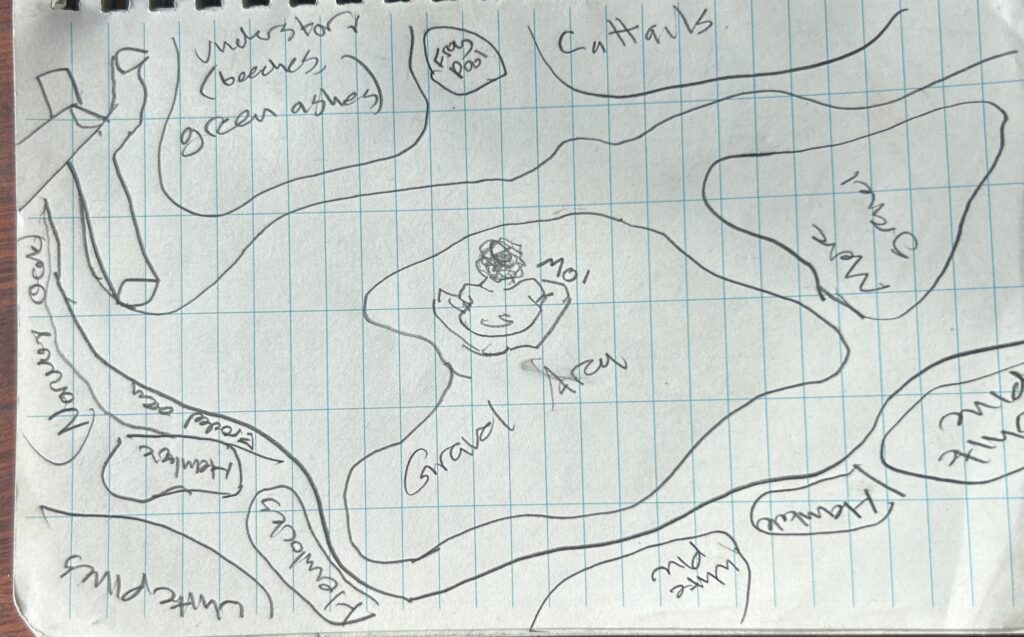
Aside from phenological changes, my site has changed minimally over time. The stream still runs through it in the same way, the old log still acts as a bridge over the stream (locatable in the top-left of the sit-sketch and photographed multiple times across this blog) and the tree makeup is still the same. One minor change is blue cones have been erected around some trees, however they are outside of the selected phenological area and were likely set up by UVM for some kind of research or conservation purposes. The small pool containing frogs is also new, that did not exist last fall or winter. Aside from that, the area is largely the same.
The two major landmarks of the area are 1: the collapsed tree-bridge, and 2: the gravel bank. Both act as focal points of the area. The majority of animal activity was observed around these areas, and the aesthetics of the two landmarks is part of what drove me to choose this area as my phenology spot.
Nature and culture mostly intertwine here by way of the use of Centennial Woods itself: It is a walking path. The main Centennial Woods path curves right around the phenology spot, and the tree-bridge allows easy access (for the well-balanced) into the spot. The spot is great for forest bathing, as it’s easy to get lost in the sounds of the local area and away from the nearby bustle of Burlington. Whenever I am at this spot, there is always a few people passing by either on their evening jogs or just to enjoy the nature.
I would say I’m not a major part of this place, but perhaps rather an observer, at least directly. I don’t come often and I don’t play any role in the ecosystem of the area. However, as a Burlington resident, the effects the surrounding development of Burlington has on this area is therefore an effect I have on the area. So, I suppose I am indirectly a part of this space.