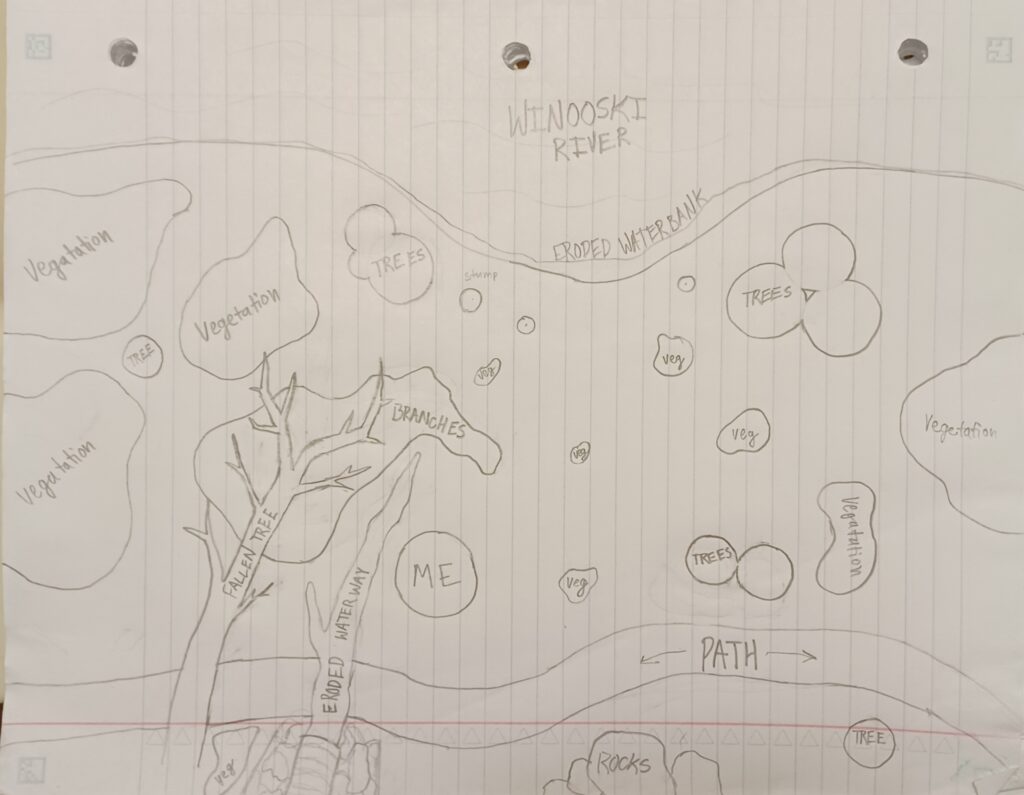
I decided to revisit Salmon Hole on a warm fall day, with medium wind speeds and the first snow of the season having occurred a couple days before my visit. As I began walking to my phenology spot, the changes in the landscape and foliage were obvious; nearly all the leaves on the surrounding trees had fallen off, and most of the vegetation covering the ground had disappeared. As Vermont approaches the end of fall, and the beginning of winter, the changes in the environment are in full motion. While sitting quietly in the center of my spot, I noticed a severe lack of animal presence; I saw several ducks floating down the river, the sound of crows overhead, and a singular Downy Woodpecker. I was unable to locate any squirrels, beavers, etc., however, which shows that just as us humans are pulling out our winter coats, many animals are retreating into hibernation or constructing their warm, cozy winter dens.
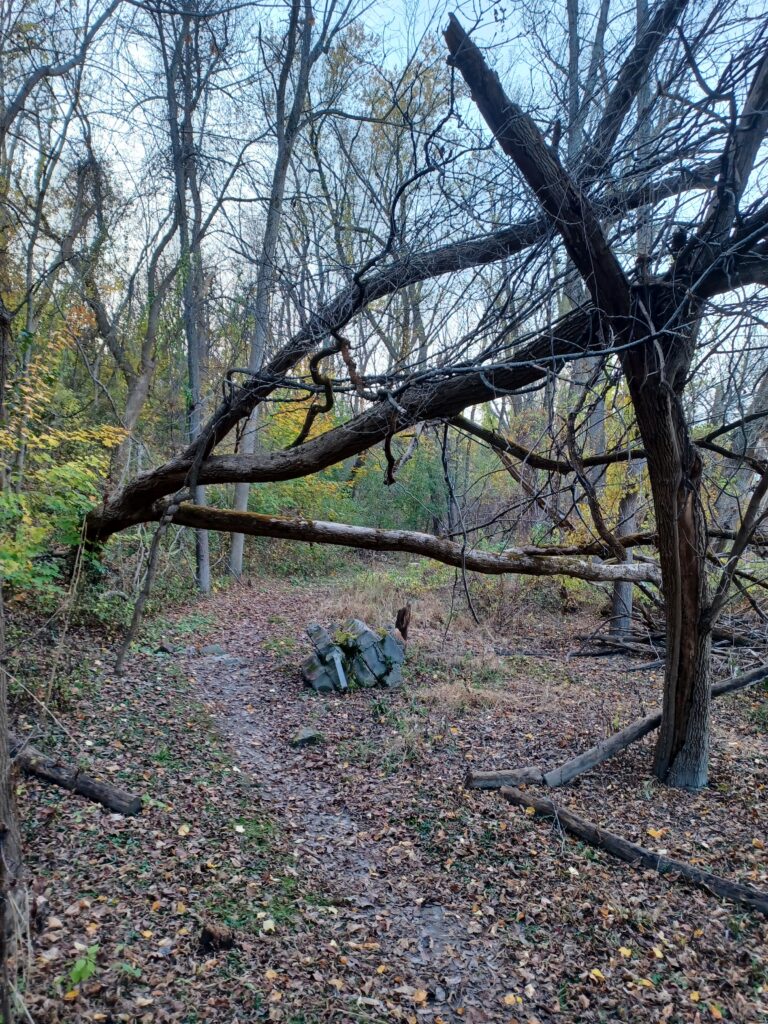
One tree species seemed to outlast the others in foliage, and that was the Norway Maple. Several other plant species also seemed to be unaffected by the approach of winter, mostly non-native/invasive species such as Oriental Bittersweet, Garlic Mustard, Buckthorn, and Goldenrod. The ground also seemed to have become muddier/clay dense since my previous visit, and several spots in the area have become uneven due to (what seems to be) erosion from our recent rain events.
Below is a bird’s-eye-view of my spot at Salmon Hole, of which displays the layout of several natural features of the environment. The patches of vegetation illustrated below is nearly all invasive species/weeds that have yet to die off before winter. It also highlights the stream bank at my spot, of which has also clearly undergone further erosion since my last visit.