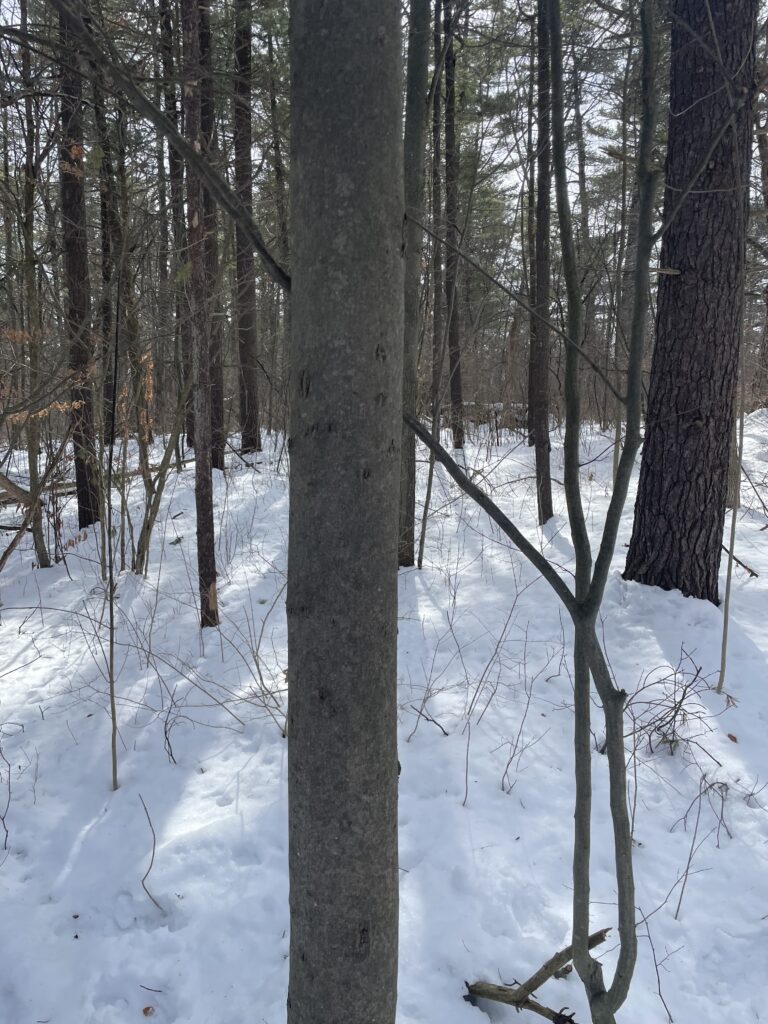
Hello friends! It’s your favorite NR002 student, back again with another blog assignment. This week, we were tasked with exploring our phenology sites (or anywhere within the Burlington city limits, I chose my phenology site). During this exploration, we were asked to identify a tree from one of our focal species. This could’ve been a Red Maple, Northern Red Oak, Paper Birch, or an American Beech.
I was initially unsure of which tree I was going to find, but as soon as I stepped into the central clearing of my site, I saw a really gorgeous (and almost textbook) American Beech tree. The smooth bark, along with the larger size of the tree (coupled with the slender, non-imposing stature), is almost convincing enough to be sure of the species, but we were warned to check that it wasn’t an impostor tree. Given that many trees can lose their leaves in the winter (which – funnily enough – American Beeches hold on to for an uncharacteristically long time), there are a few trees that can look remarkably similar to each other.
The possible impostor for an American Beech is a young maple tree. Given that they exhibit the smoother bark that can be found on an American Beech. The largest hallmark with which one can tell them apart is in size. While barkless maples usually don’t exceed 20-30 feet in height, this American Beech was around 50-60, as (hopefully) is illustrated in the pictures below.
Additionally, we were asked to describe whether or not the tree was “flowering.” As we begin to enter a new Spring, many trees (especially maples) will begin to sprout new leaves. Early signs of this can be noted in the ends of twigs. Given that the American Beech holds onto its leaves for a while (as mentioned earlier), they actually take a really long time to begin flowering, so there are no sights of new growth yet. The picture of a twig (taken from my awful phone camera) should help to highlight this. Take note of the light coloration and flat (non-cigar shaped) ends. As far as the process of uploading to iNaturalist goes, it was as efficient and as painless as last time!
I will revisit this tree in a few weeks and make note of any changes. Until then, keep exploring!