My Experience-October
Sitting, my legs dangling off this concrete relic of war, I experience a juxtaposition of separate worlds. The artifact of destruction underneath me is surrounded by a circle of trees, calming down, shedding their leaves, and preparing for dropping temperatures and shortening days. The contrast of bunker, built in preparation for an offensive attack overseas, and the trees building defenses in preparation for a war against winter, is representative of the differences of humans and nature. Humans find power in destruction, while nature finds power in growth.
This concept is further expressed at The Bunker through a new war, the war of native and non-native species. After this area was left abandoned, presumably after World War One, the first plant species to emerge from the unfertile soil were most likely hardy invasives. These plants, especially honeysuckle and crabapple, were able to grow without competition in the previously heavily trafficked, barren soil. Since these plants can grow faster, use less nutrients, and have a longer growing season (as witnessed by the invasives being the only plants on The Bunker itself still having leaves) than plants native to the area, they have been able to control The Bunker and win the war.
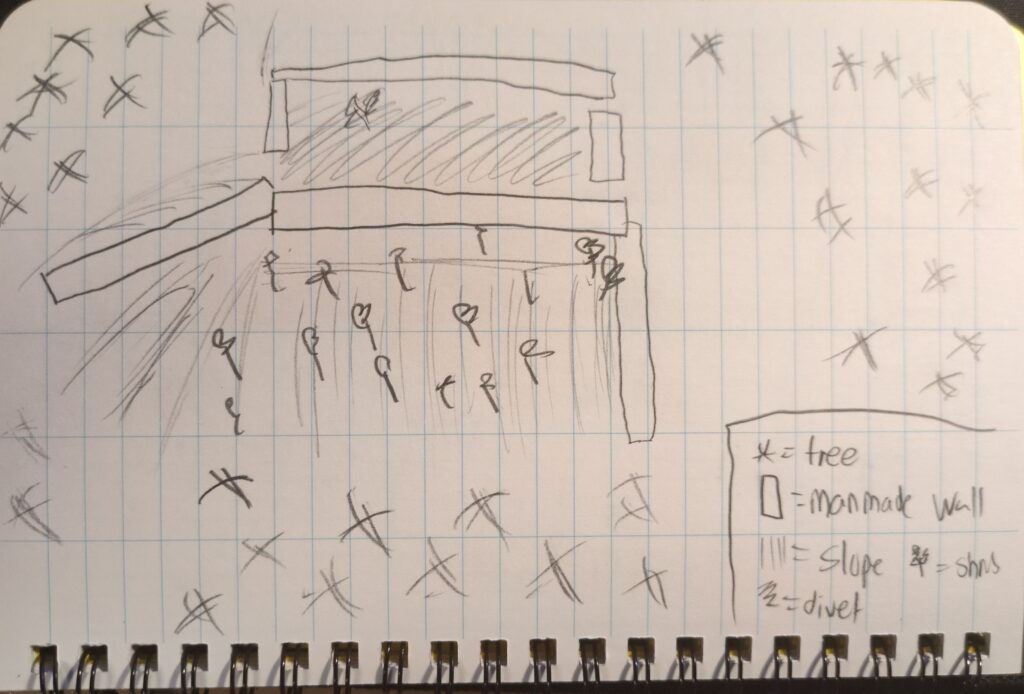
Caption:
All of the shaded sections of the sketch mark the man-made sections of lifted dirt that make up The Bunker. Surrounding The Bunker is a circle of trees, with only invasive shrubs sustaining on The Bunker itself.