May 5th
For the Burlington BioBlitz, I went into Centennial Woods, as well as spotting several species around campus. My experience using iNaturalist was good, I found it easy to use and helpful in identifying plants I didn’t know. I tried to document a variety of species – I submitted observations of a tree that I didn’t recognize, lichen, moss, two bird species (a Black-Capped Chickadee and a House Finch), and a Gray Squirrel taking some seeds from the bird feeders at the trail crossing in Centennial.
It was interesting to look at reports of observations from other cities and see that many of the places in the leaderboard were extremely large metropolitan areas. Most of the cities on the leaderboard are in the US, but I was surprised to see Cape Town and Hong Kong doing well. It looks as though the city of La Paz, in Bolivia, is going to win, with over 81,000 observations.
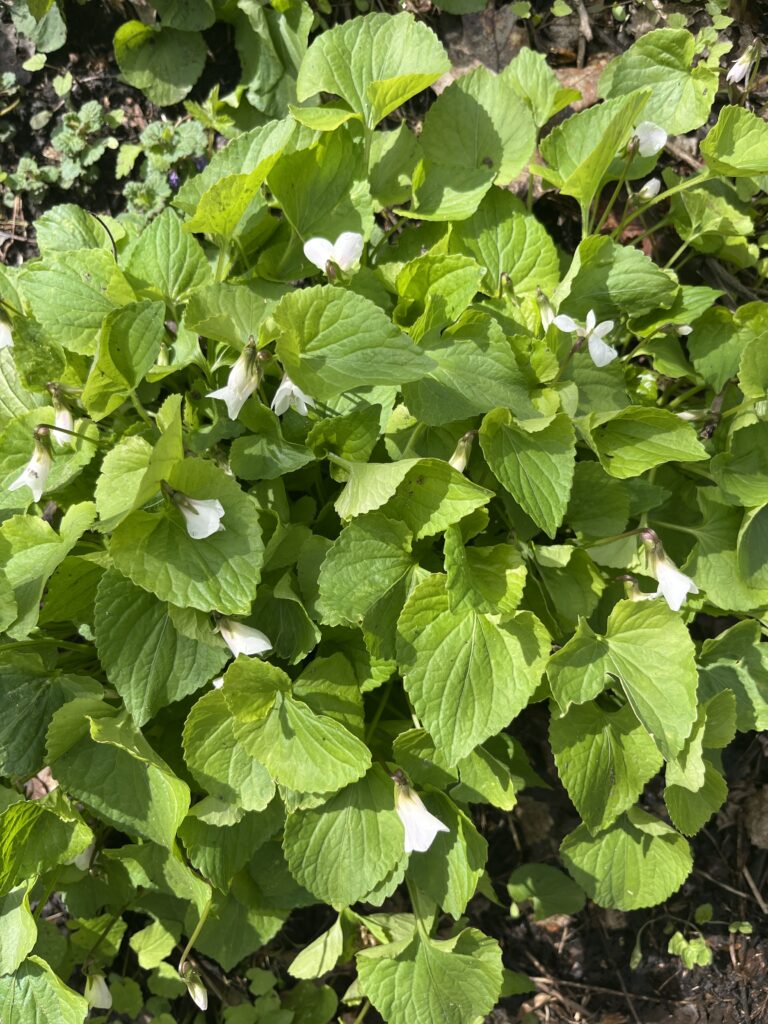
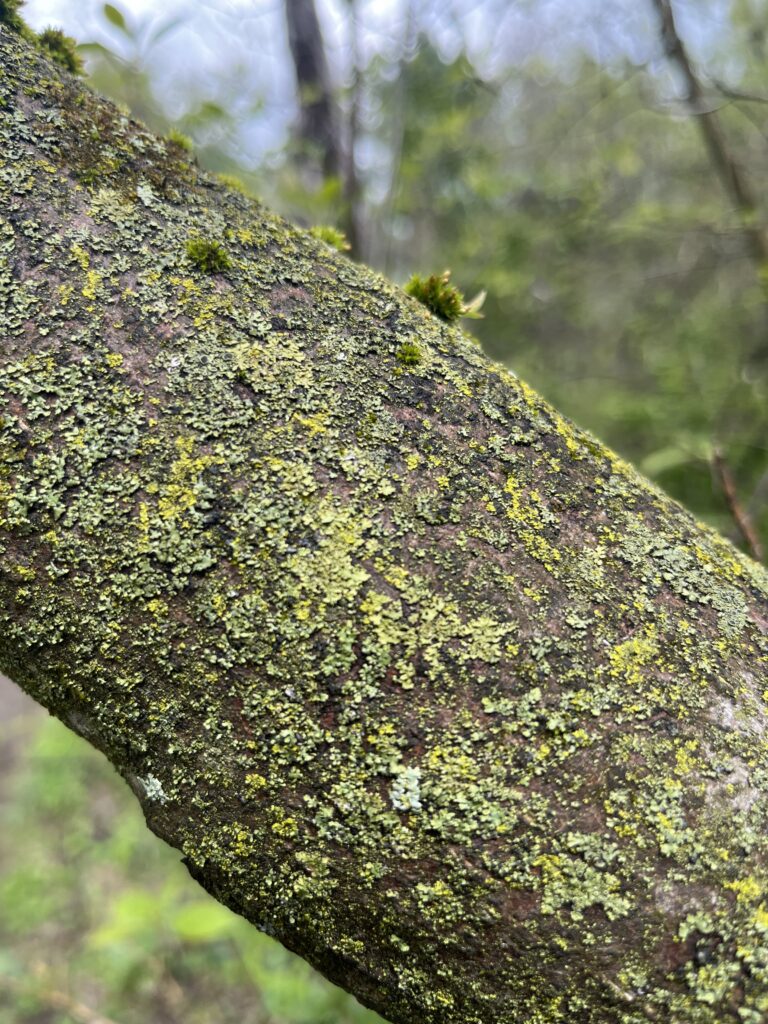


Some of the animals and plants I observed.
April 24th
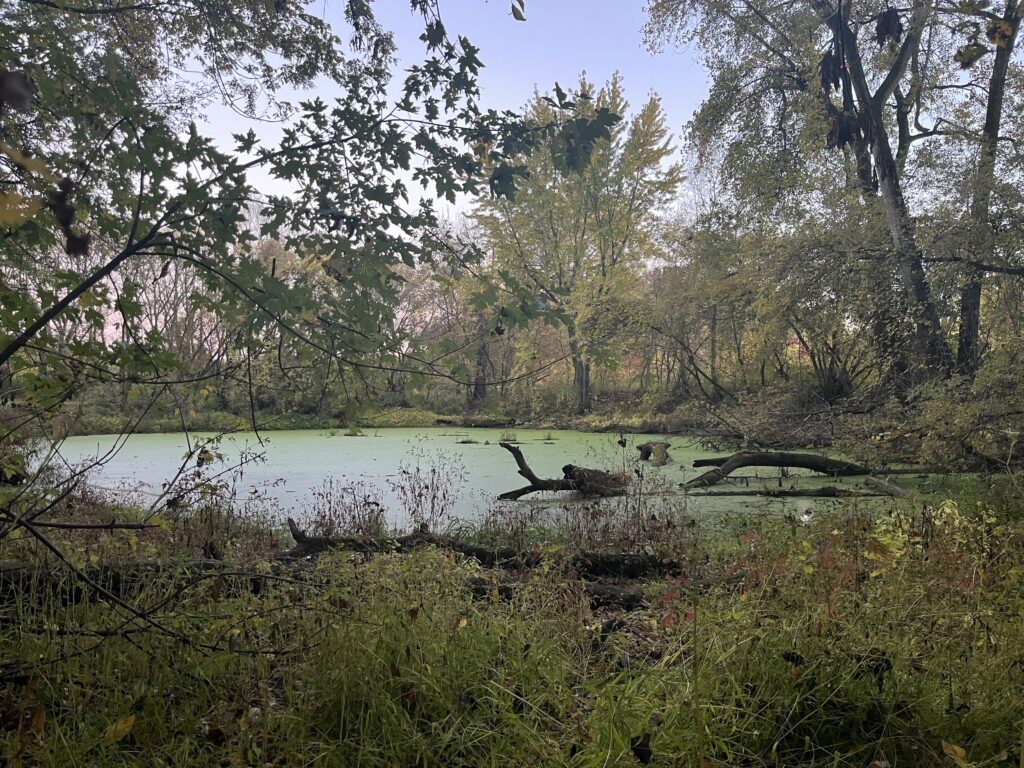
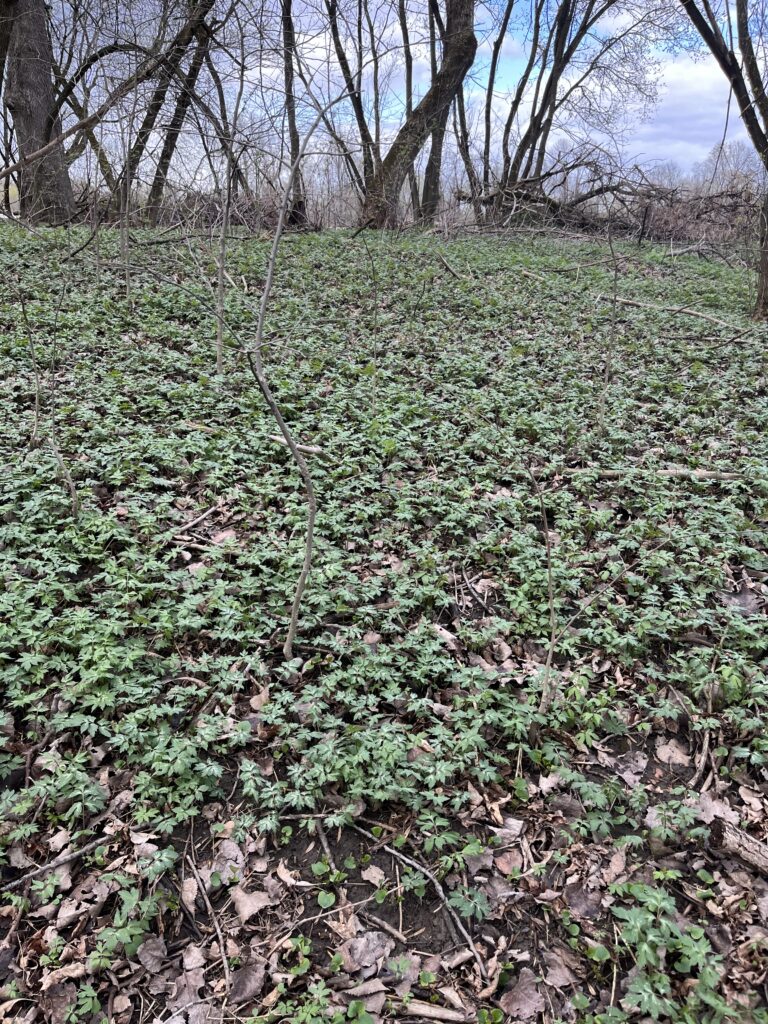
My phenology site has changed dramatically from over the winter. There is now no snow, the duckweed that was on the pond has grown back, turning the surface of the water green, and there are still no leaves on trees, although many buds are starting to open. There is a carpet of small green plants on the forest floor, mainly composed of garlic mustard, an invasive species. There are no new fallen trees and no major human or storm-caused changes. Some of the landmarks I’ve become familiar with are the fallen boxelder tree in front of the pond, the large eastern cottonwood trees still standing tall, and the shape of the pond, which hasn’t grown or shrunk noticeably over the winter.
Nature and culture intertwine in this space in several ways. This land is part of the Intervale, a community farm supported by people. The farm creates a habitat for many bird species, and while I was sitting observing the area, I heard a downy woodpecker, northern cardinal, and many white throated sparrows. The trails on the farm present a space for people to interact and get to know these ecosystems by the Winooski River better. Just visiting my phenology spot over the past year has made me grow attached to it, and want to integrate the natural world into my life more. Finally, this land used to belong to the Abenaki, who made the area their home and intertwined every living thing into their culture and respected the natural world as a whole.
I don’t consider myself a part of my place, however I do think of myself as an observer, someone who watches but doesn’t intervene in the natural processes of this spot. I’m not part of this place because I do not consider it my home, I don’t spend much time there, and I’m not a part of the land like the birds, squirrels, and deer. I do, however, want to keep returning to this spot to watch as it changes back into the way it looked in the fall, and I value my time spent here this year.



April 10th
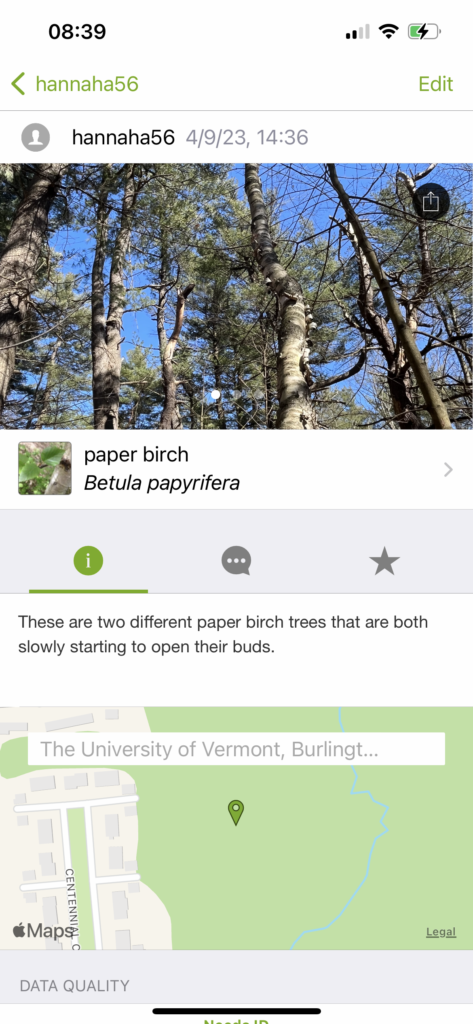
When I went back to my site on April 9th, the weather was noticeably warmer, there was no more snow, and a lot of other species were starting to put out tiny leaves. This paper birch still hadn’t gone through any noticeable changes, but it was difficult to see the buds because they were so high up. I checked a few other nearby paper birch trees to see if they had started to put out leaves, but all of the birches in the area still hadn’t begun to open their buds. Paper birch is one of the later species in our list to flower in the spring, but I expect that the birches in Centennial will begin to change soon. Below are two different birches in Centennial, one is the original that I’ve visited for the past few weeks, and another is a younger tree with buds a little closer to the ground.


March 27th
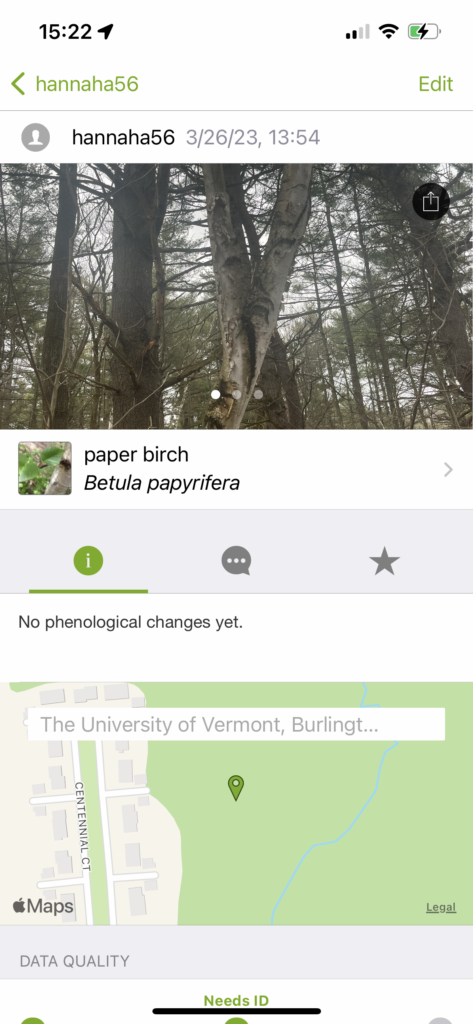
I revisited the paper birch in Centennial, and the tree looks about the same as last time. The buds could have gotten a little bigger since last time, but otherwise no phenological changes have taken place yet. There is still snow present in Centennial Woods, and the weather was cloudy and chilly. In the next few weeks I expect there to be more changes in this tree as it warms up.


March 11th
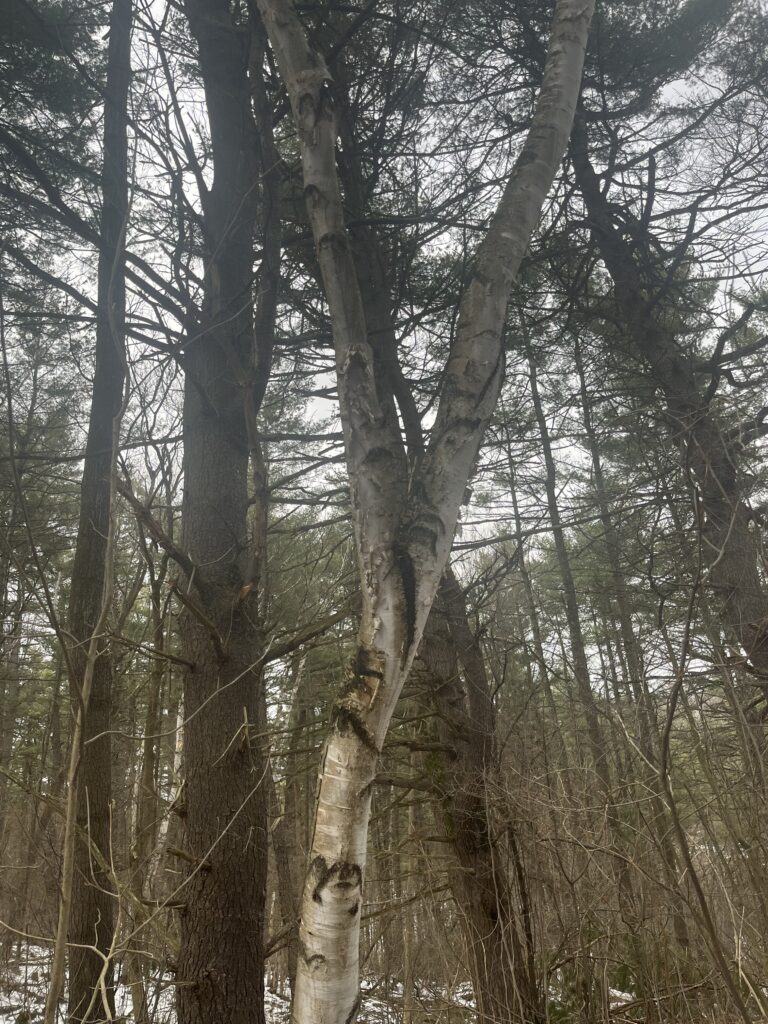
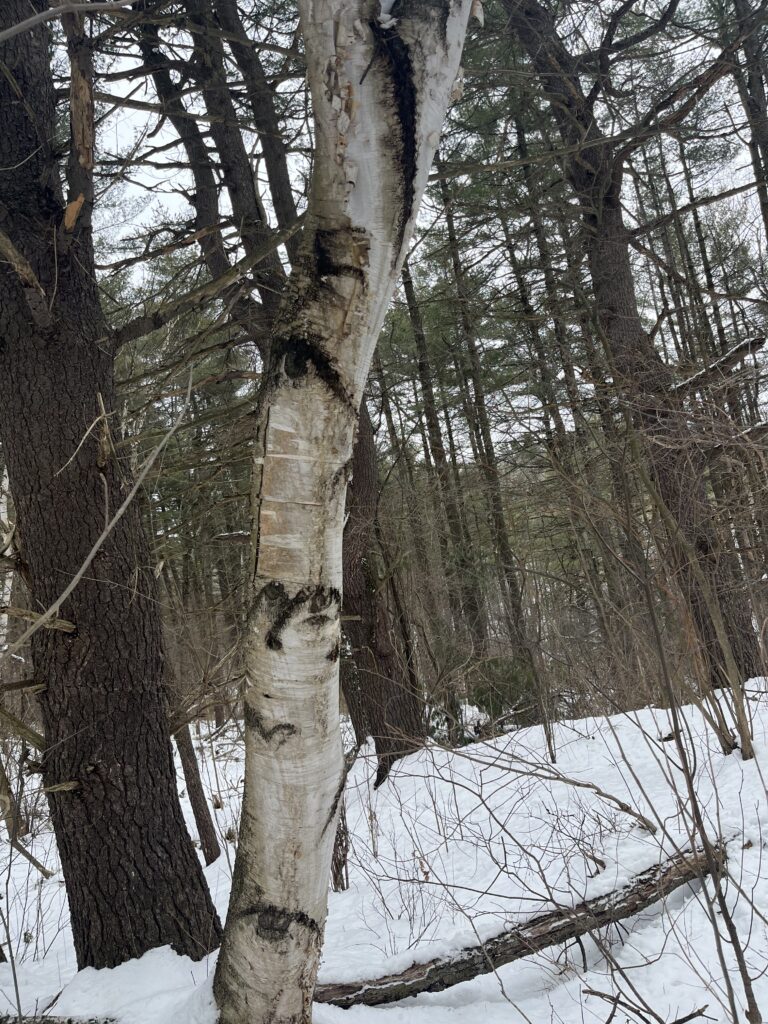
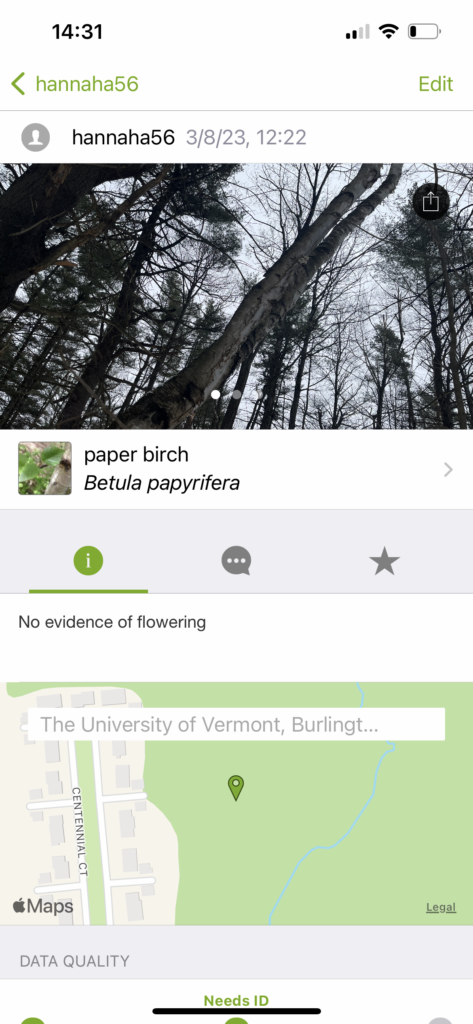
The tree I found was a paper birch towards the entrance to Centennial Woods. I was sure it was paper birch because it’s bark was bright white and peeling in large sheets, unlike yellow birch, which has shiny golden/yellow bark that comes off in tiny strips. This tree was also growing alone, not in a small clump like river birch like to do. Grey birch have much darker bark as they get older, and also don’t peel as much as paper birch, while this tree had many areas where the bark was coming off. This was a large paper birch tree, and although the twigs weren’t accessible, I could see that there was no evidence of flowering yet, because the buds were still extremely small. Paper birch usually start flowing a bit later in the season, in April.

February 12th
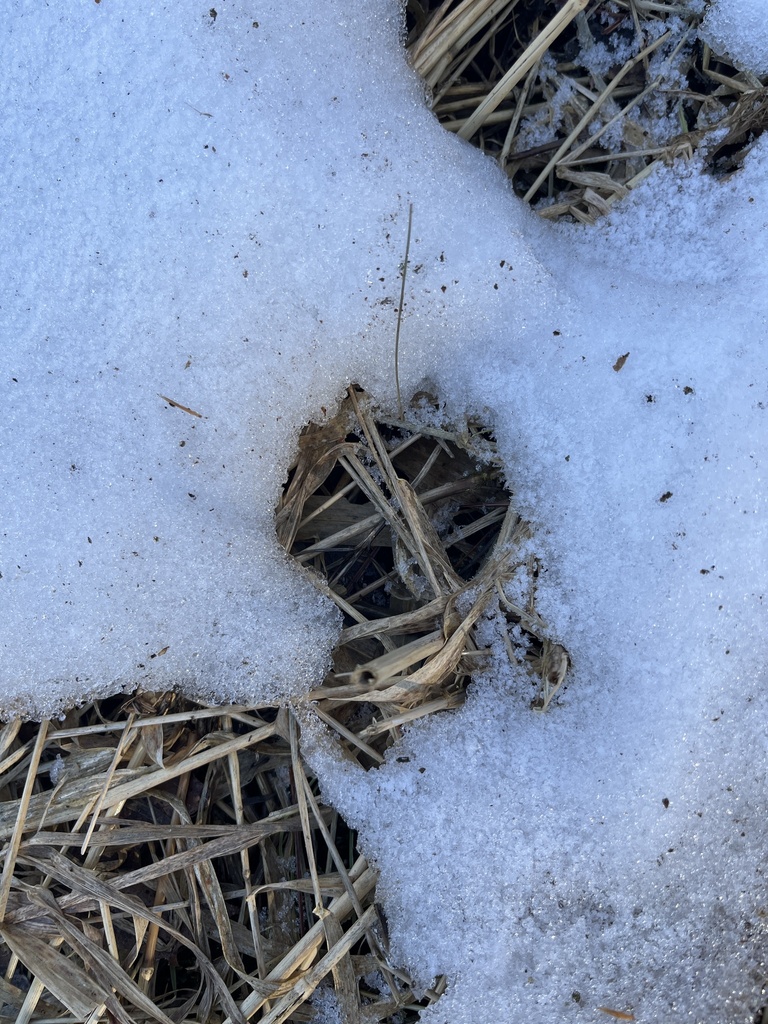
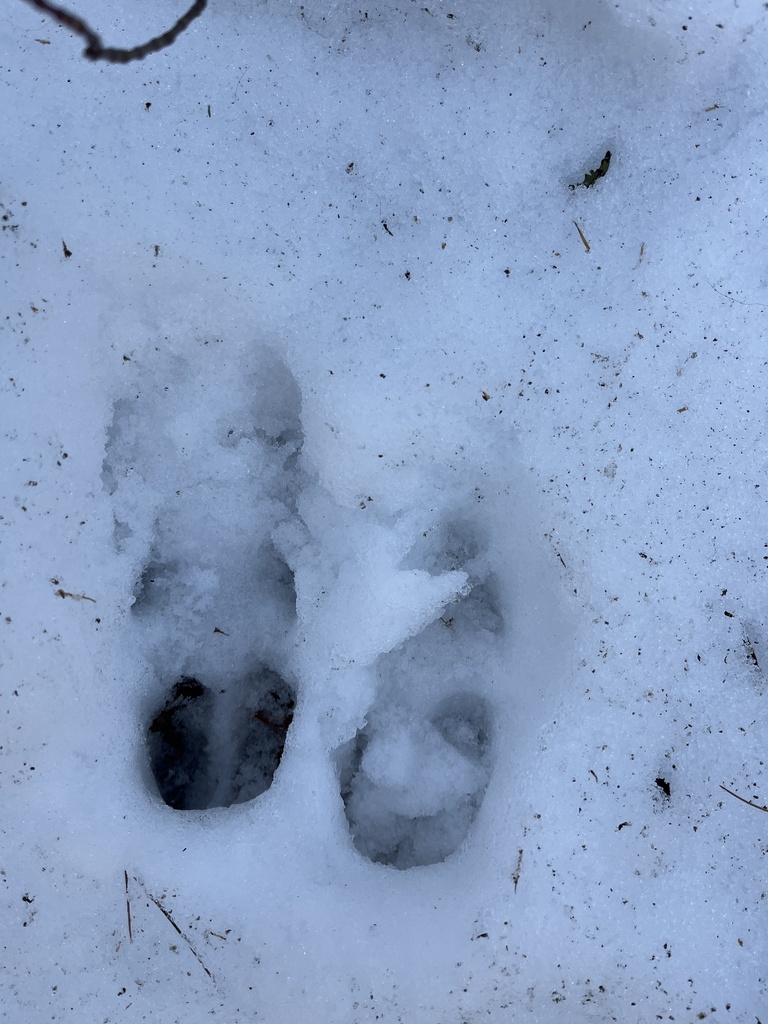
To find animal signs around Burlington, I went to Centennial Woods and walked on the trails towards the beaver pond and back. It was difficult to distinguish the many dog tracks present around the trail, but when I went further off the trail towards the brook, there was evidence of many small rodents under the snow, some deer, and a few sets of unidentifiable tracks that we weren’t sure about. I found that iNaturalist was easy to use, and it was simple to take photos and record my observations. Here are a few of the photos we took:

January 24th
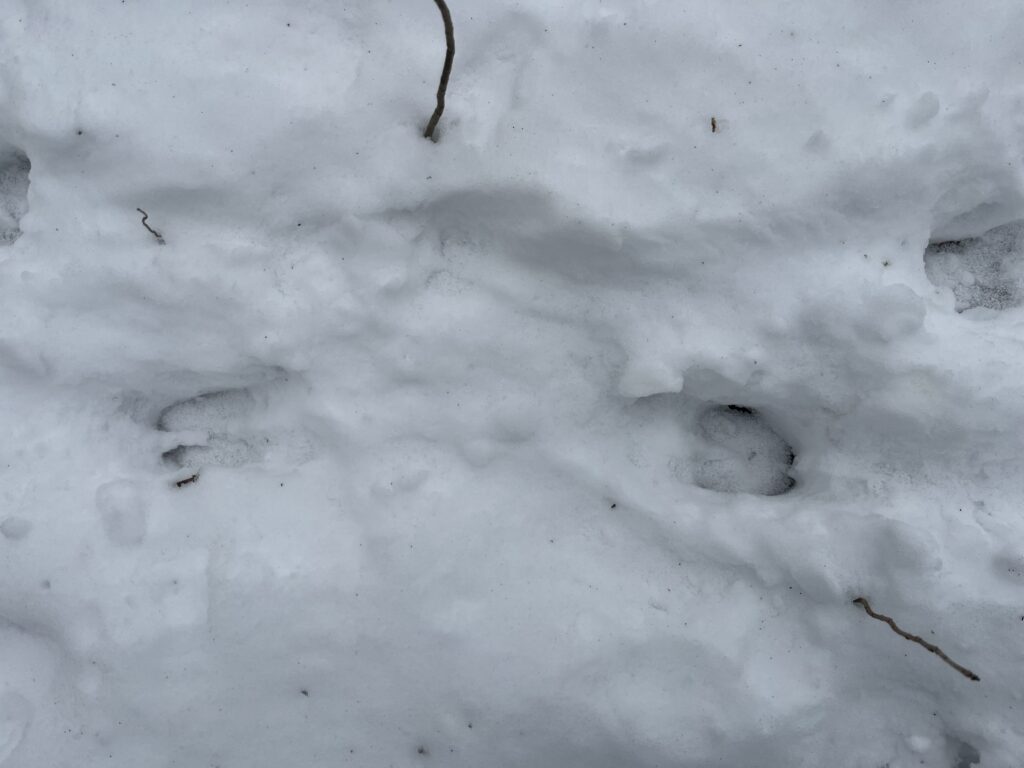
There are many phenological changes that have taken place since I have last returned to my phenology spot. The whole area is covered in about six inches of snow and the pond has completely frozen over. The area was silent except for several cawing crows, marking the absence of normally active songbirds. I watched a grey squirrel climb an eastern cottonwood tree, going back into a hole he had found to stay warm. There were no green plants, and the woody trees and vegetation were completely bare. Although the area was quiet when I visited, there was evidence of many animals passing through, most likely at dawn and dusk. There were many deer tracks, some squirrels, and possibly a raccoon or a mink. There were several twigs on the younger trees that had been bitten off by the deer, who had passed through for food, while the smaller animals were probably searching for seeds and finding a place to hide under the snow. It was cool to clearly see where the animals had gone, and try to think about who they were and why they were there.


December 8th – Final Post in Semester 1
My phenology place has become even more brown as plants and animals get ready for winter. There are several tree species that are still holding on to dead leaves – I noticed that the wild grape plants that had twisted around the eastern cottonwood trees at the edge of the pond still had a few leaves, as well as some boxelders that leaned out over the water. The only green vegetation at my site was some garlic mustard I found growing in the dead leaves at the base of trees, some grasses by the pond, as well as the duckweed floating in the pond. The only fruit that I found at my site was a few dried wild grapes hanging onto branches and on the forest floor. There is definitely evidence of decomposers at work, and there were a few mushrooms and lots of moss in the area. Most of the downed wood is starting to rot, and the nutrients will be recycled for the next growing season in the spring.
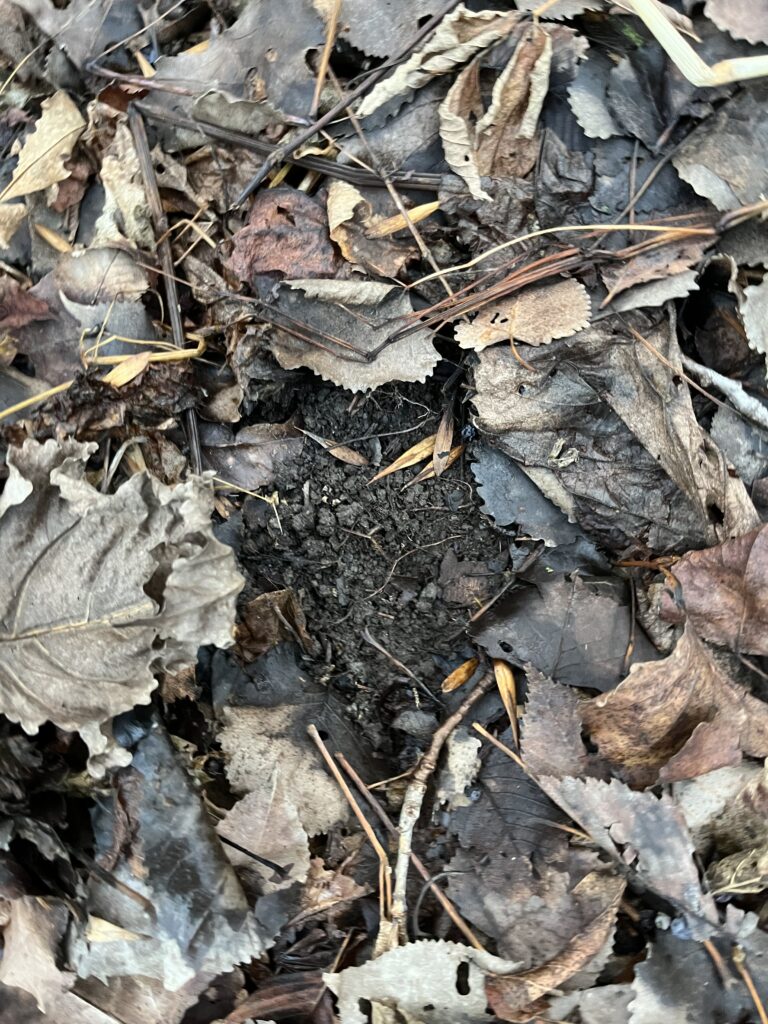
I was able to notice more signs of animals at my site than the previous time. I found an interesting cache of dried wild grapes left in a tree by a creature. There were several other signs of animals including scat left by what I think is a woodchuck, as well as tracks left by either a woodchuck or a raccoon along a log. I also saw some claw marks on a log and some bark scraped off a tree. The only animals I saw or heard at my site were some gray squirrels, some wood ducks on the pond, and some white-throated sparrows. I would say there is less activity from birds or amphibians, who have either migrated by now or are starting to slow down for the winter, but there is still a lot of signs of life from other species, who are finalizing their preparations for winter. Most of the mammals are trying to finish storing food and find a good place to hole up.



There are many aspects of my phenology place that I enjoy. I like how there is something new to discover each time, and the pieces, patterns, and processes that shape the landscape are constantly changing. I like how the more I go to my place, the more details I am able to see, like a new type of plant growing, a new sign left by an animal, or something indicating that humans had been there before me. My phenology place is important for many different types of species, and now is also important to me.
November 28th
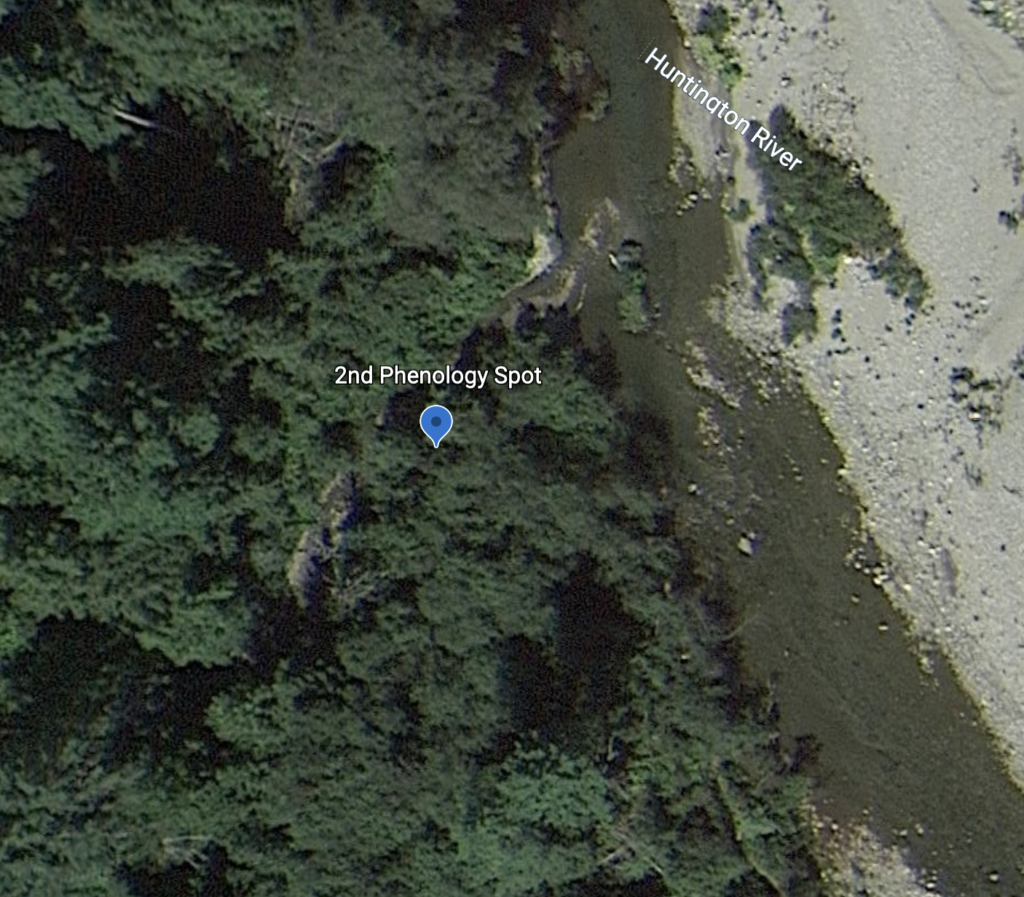
The new phenology place I choose isn’t too far from my other one. Over break, I went to the Audubon Vermont nature center in Huntington to a spot by a brook. I think this is a special place partially because I have many memories coming here during my childhood, either as a summer camper or a camp counselor leading other kids. This place is also important ecologically, as it serves as an important habitat for amphibians and reptiles like red salamanders, wood frogs, and garter snakes. The area is surrounded by mature hardwoods mostly Eastern Hemlock, Yellow Birch, and Red Maple. This time of year, most animals are collecting food and getting ready to hole up for the winter. This place is similar in many ways to my other phenology spot at the Intervale, because they are both at the same latitude. However, in this new site there is running water, which doesn’t freeze over as quickly as still water, which is found at the pond at my other place. There are almost no Easter Hemlocks at my other place, and there are no Eastern Cottonwoods or ash trees at this new place. There is very little understory at this spot at the Audubon, largely because humans walk in this spot frequently. Each place represents a diverse habitat that serves as an important ecosystem for a diverse array of species.

This is a gift that I left at my site, a few hazelnuts for the squirrels and chipmunks!
11/7
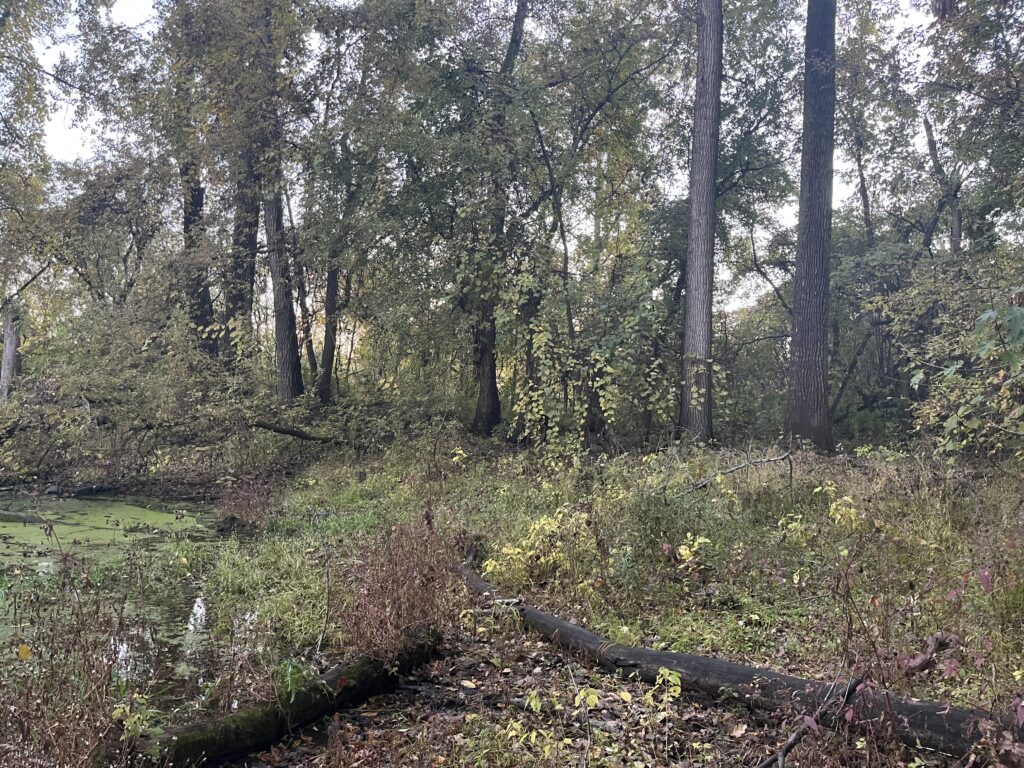
After sitting at my spot for 15 minutes, I noticed many new aspects of the area around me. I had thought the water in the pond at my site was static and unmoving, but I noticed that the surface is constantly in motion. There was evidence of human presence at my site as well. Someone had littered an old couch cushion and a small tire that were sitting in the mud at the edge of my pond. It was nice to take a moment and be silent. There were robins chirping, and I noticed during the 15 minutes that I had become covered with small burrs, from a plant I discovered was called “beggartick”, and was growing everywhere around me. My site had become much less green since I last went, and the vegetation was now made up of woody, dry stems, with only the duckweed covering the pond and a few grasses on the shore being green. It was much easier to spot birds because of the lack of leaves on all the trees. The buckthorn berries growing around me were also much more visible. Overall, my spot looked the way a forest does before it snows-dead leaves everywhere and all the plants and animals getting ready for cold weather.
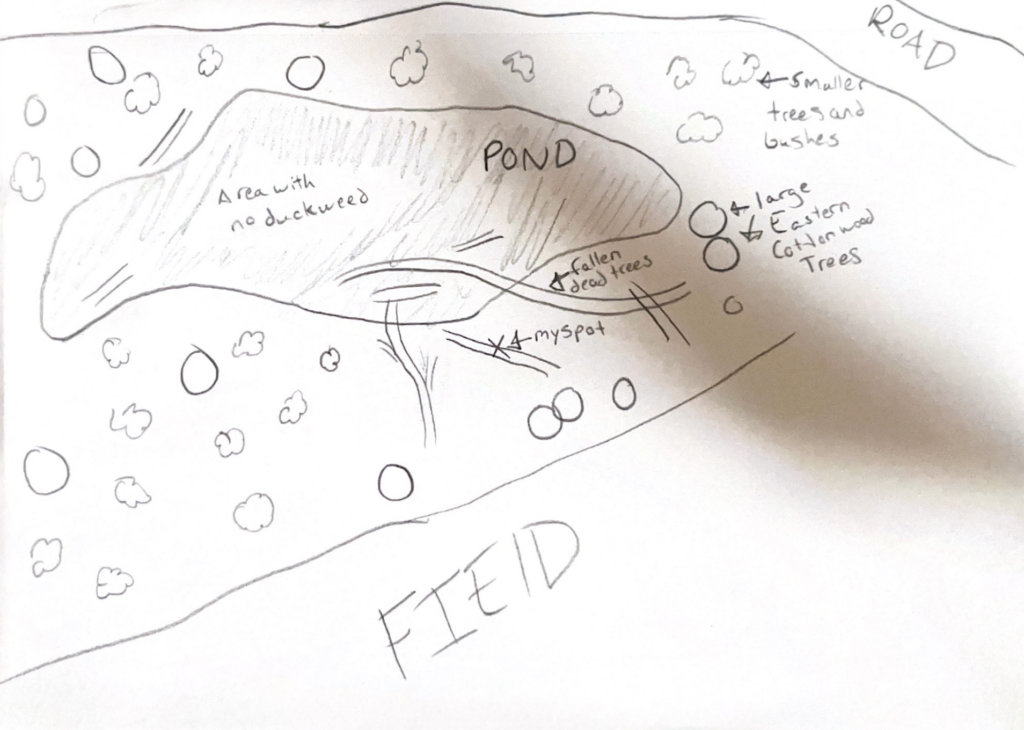
My phenology place: a small pond at the Intervale
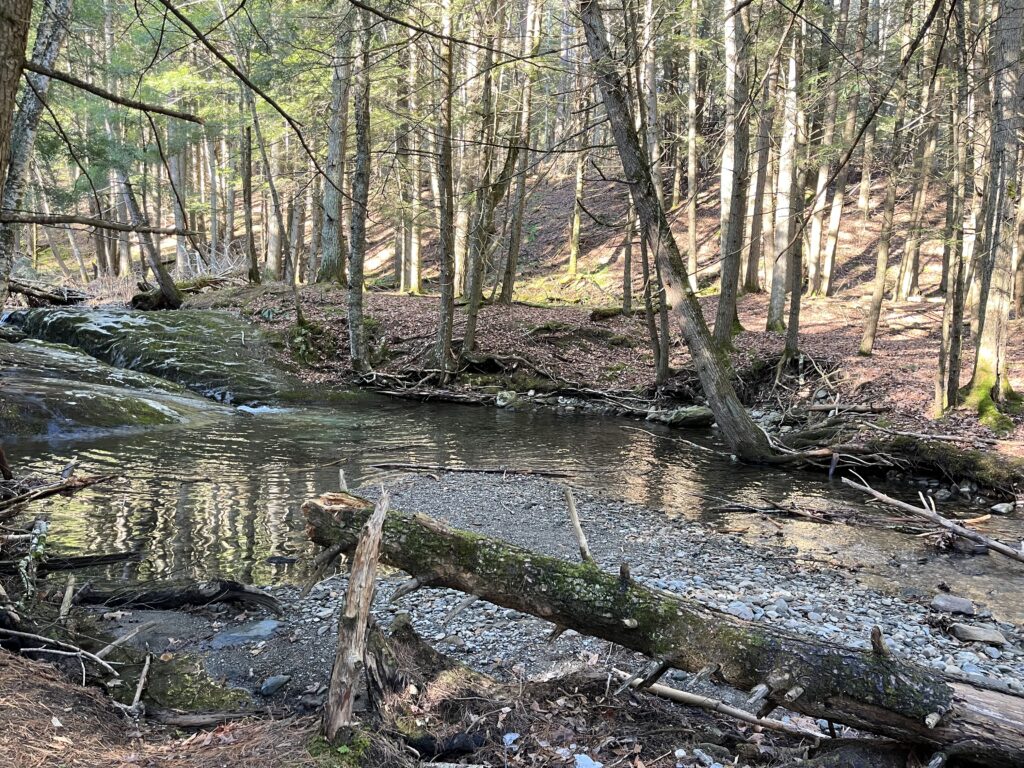
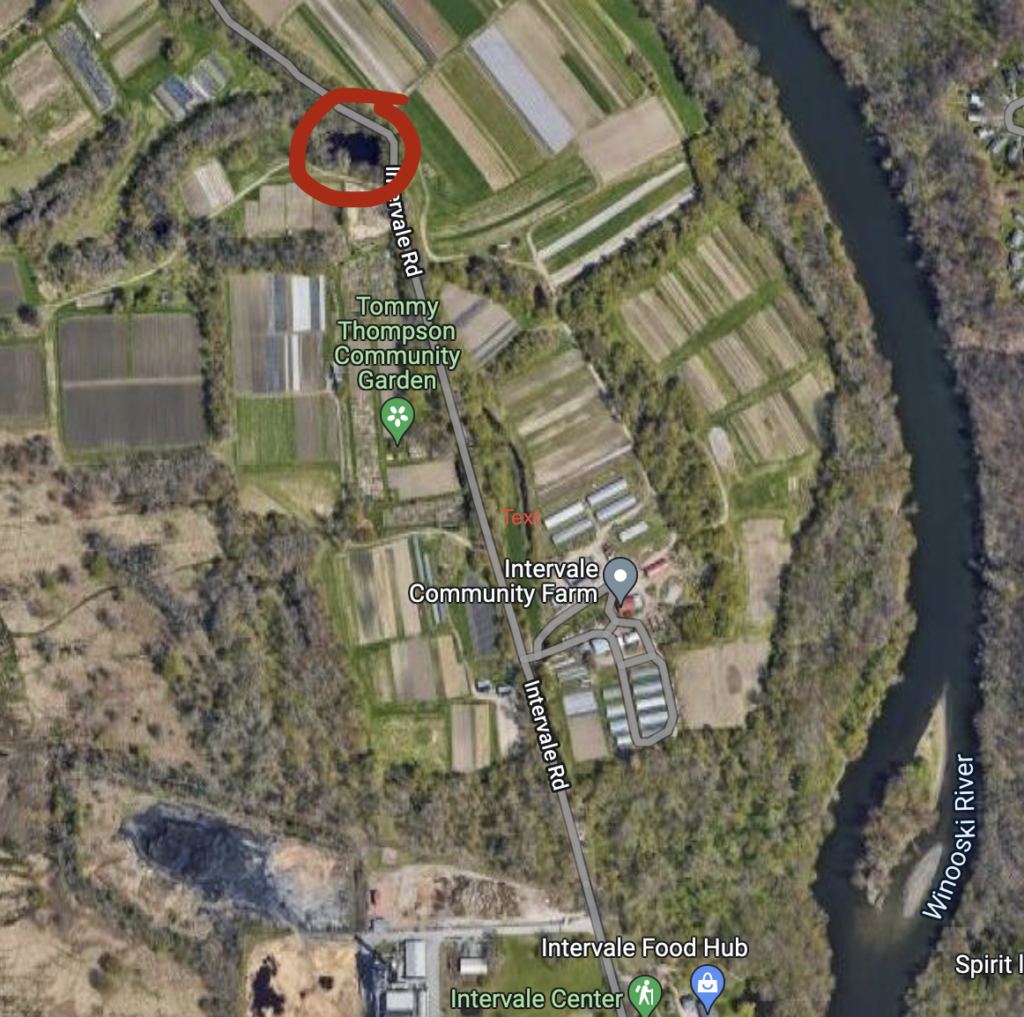
Burlington has many amazing natural areas to explore. I chose the Intervale because it’s not too far from campus and is near several different water features (Lake Champlain, the Winooski River, and numerous small ponds, streams, and wetlands). To get to my place, go down North Prospect street until it joins Intervale Road, then continue along the dirt road until there is a slight bend to the left. On the left side of this section of road there is a small pond covered in Duckweed surrounded by huge Eastern Cottonwood trees. I chose this spot because I think it would be interesting to study the effects of the surrounding farms on this pond, and because it’s a beautiful spot to sit, with numerous birds, squirrels, and other wildlife.
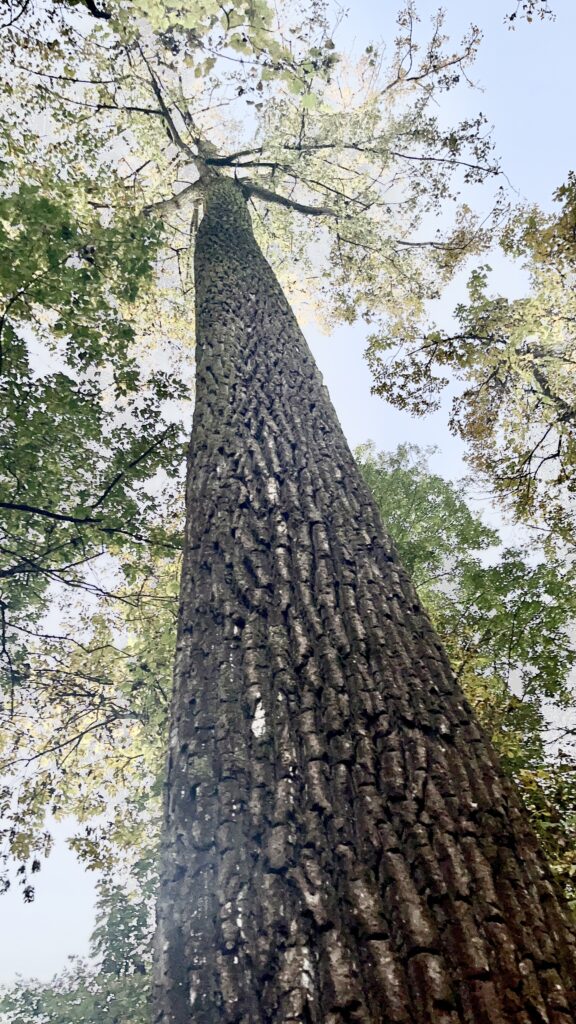
The vegetation in this area is mostly short, herbaceous plants that are starting to turn brown and die from the coming cold. I observed Riverbank Grape wrapped around trees on the edge of the pond, False Nettle, Tall Blue Lettuce, and Wild Raspberry in the surrounding woods and Jewelweed growing right on the banks of the pond. The most common woody plants are enormous, old Eastern Cottonwood trees that create the canopy and tower over everything else. There are also many Green Ash trees and several Boxelders.