April 27, 2024 –
Location: Red Rocks Park
Species Encountered: 11
On Saturday, I explored Red Rocks Park in South Burlington. This is also the site of my phenology project. I’m not sure if it’s because spring is underway or because I haven’t been paying close enough attention before, but it felt like Red Rocks Park had more species of plants, birds, and small mammals than ever.
I encountered and logged the following species on iNaturalist:
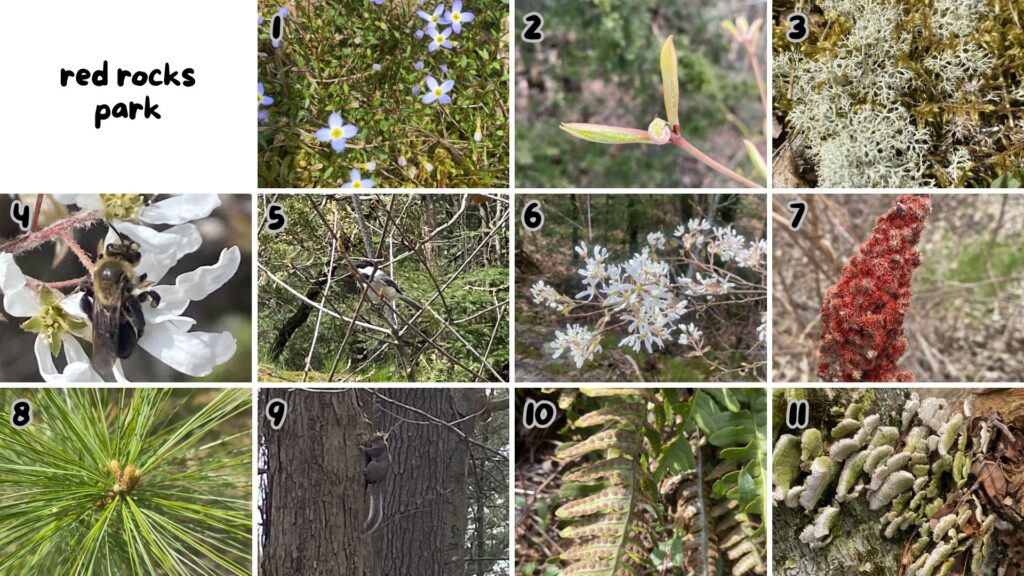
- Either an azure bluet or a thyme-leaved bluet. Unfortunately the way to tell them apart is the leaves and leaf stalks, which I did not get a clear picture of.
- Striped maple.
- Some sort of reindeer lichen. I was not able to identify which.
- Some species of mining bee. I originally thought it was a bumble bee, but then I learned that mining bees are slightly smaller and less hairy.
- Black-capped chickadee.
- Some sort of serviceberry (common serviceberry?)
- Staghorn sumac
- Eastern white pine
- Eastern gray squirrel
- Rock polypody
- Some sort of polypore. I think it’s a mossy maze polypore but I’m not entirely sure.
I also saw a woodpecker, a chipmunk, a sparrow, and a wren but I wasn’t quick enough to get a picture.
I had such a fun time looking for different organisms and logging them on iNaturalist. I think it’s a great platform for the ecology community and for citizen science. I really like that it’s a place to learn, and people from all over will help you identify something if you can’t figure out what it is. I think I will definitely use it in the future.
Taking a look at the Global City Nature Challenge, I found it interesting that some of the cities with the highest rankings of most observations and species found were densely populated urban areas. It just goes to show that biodiversity can be found all around us, and there is nature everywhere if you know where to look for it.