Today I visited my phenology site in Centennial Woods for the final time of the semester!

(the tree canopy above my site taken 4-29-25)
The past few days i've noticed significant budding/sprouting of flowers and plants around the UVM campus. So I was expecting to see lots of changes in my spot compared to my last visit!

Above is a picture of my site from the highest point of the hill near the trail system!
When I first approached my site, I noticed lots of new fallen trees and snags


I also noticed that somebody had de-rooted some invasive honeysuckle by the stream and placed it roots up in a nearby tree

During my first phenology visit in October, I noticed many of the same species of plants that I noticed in my visit today
In October I noticed a sizable population of invasive species, like Barberry, Honeysuckle, and Buckthorn. And during my visit today I noticed these species had already leafed out before the native plants in the area.
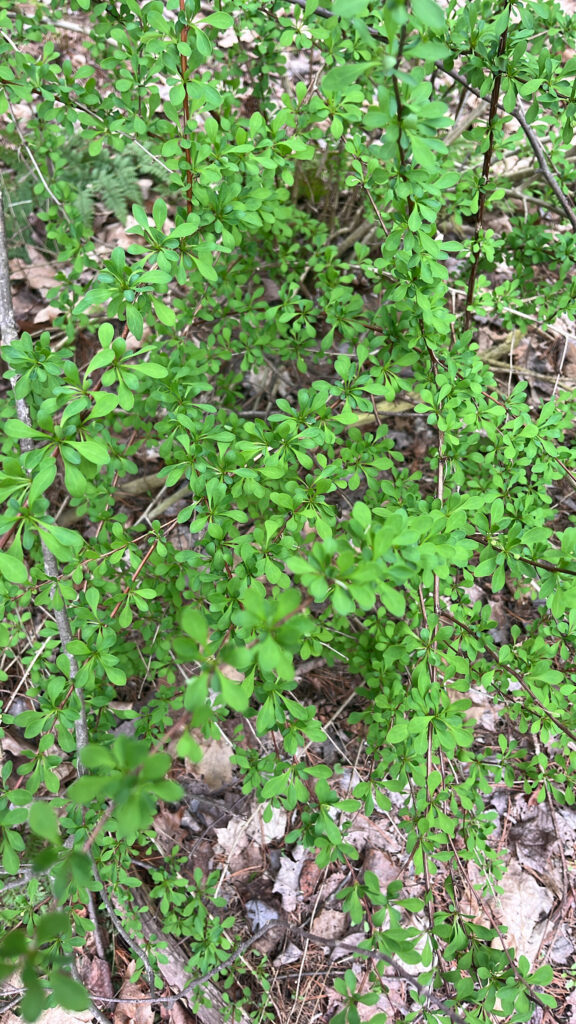
(above is a picture of a large patch of honeysuckle I found)
Lastly, the biggest difference I noticed on this visit compared to my first visit was the birds
Today I heard multiple bird calls/sounds within only around a minute of recording sitting on a log near the stream by my site.
When I first visited my spot in late October, most of the birds had migrated and my spot was silent except for the stream. But now I can hear the birds clearly over the rushing of the stream.
In this recording taken at 5:41 pm today, I noticed four species!
-Great Crested Flycatcher
-Tufted Titmouse
-Black-capped Chickadee
-Winter Wren
What are some landmarks i've come to recognize on my site?
Centennial Woods became a protected natural area in 1997, after being cleared for grazing and farmland in the 1700s. This early deforestation significantly impacted the species richness, and
A major landmark of my spot is the stream that runs through Centennial Woods. In the fall and spring, I can hear the stream from 500+ yards away. And the composition and water levels of the stream doesn't change much through out the seasons.


A minor landmark i've come to recognize are the large Hemlocks surrounding the entrance to my spot

Centennial Woods became a protected natural area in 1997, after a long history of deforestation for mainly agricultural purposes, but also other human uses. Like the short-term ski resort that persisted from 1962-Likely 1967, before being burned down by arsonists. Hemlocks are a Late-Successional Stage species, meaning that they prefer to grow long after disturbances and in mature forests. They grow very slow, and wait for a gap in the tree canopy to appear.
The large presence of Hemlock trees in my spot points towards Centennial beginning to become a mature forest as forests begin to become populated with more late-successional species.
The interaction between nature and culture at my spot
During this visit, I noticed a teepee made out of sticks on a tree directly above my spot.

Seeing this creation in nature inspired me to brainstorm more about how culture plays a role in nature, and how nature also plays a role in culture.
During my time in Vermont, i've found it has a very outdoors based culture. So I imagine a kid building this small structure using what they see around them to create.
By learning that you can create from nature and that you can have lots of fun outside as a kid instills a strong sense of connection to the outdoors. When I was a kid I spent all of my time outside building and playing, and this background helped lead me to the Rubenstein School.
This is just a small example of how nature and culture interact, based on my experiences and observations. But nature and culture impact each other in many different, more impactful ways!
Lastly, I was asked to answer a question for the final assignment: Do you consider yourself a part of your place?
This question stumped me for a bit. I couldn't decide what role I play in nature...
On one hand I consider myself a part of nature because humans are nature and i've spent a lot of time immersed in this place, so I feel connected to it.
But on the other hand, I feel like to be a part of a place you need to live and grow in it, which I haven't done in this place.
After considering, I came to the realization that for humans to feel connected to a place, we need to feel a part of this place. My NR 1020 lectures have emphasized the importance of place-connection to conservation. So since I feel a need/importance to protect this spot in centennial, I must be a part of it and connected to it somehow.
You do not have to be good.
You only have to let the soft animal of your body
love what it loves.”(Mary Oliver, Wild Geese)

