I visited my phenology spot last Saturday, 4/23, around 2pm. The weather was in the mid 60s, humid, and slightly cloudy. It has been really interesting seeing how much a place changes over the course of 8 months. I was able to see the leaves turn bright shades of red, yellow, and orange then fall off the trees. I was able to see the landscape covered in a thick layer of snow and ice, almost unrecognizable from what it looked like a few months before. Now, I am able to see the earth re-emerge from the icy grip of winter and leaves return to the trees. I am also starting to see bird species that I haven’t seen since the fall return to the land. One of these species is the red-winged blackbird.
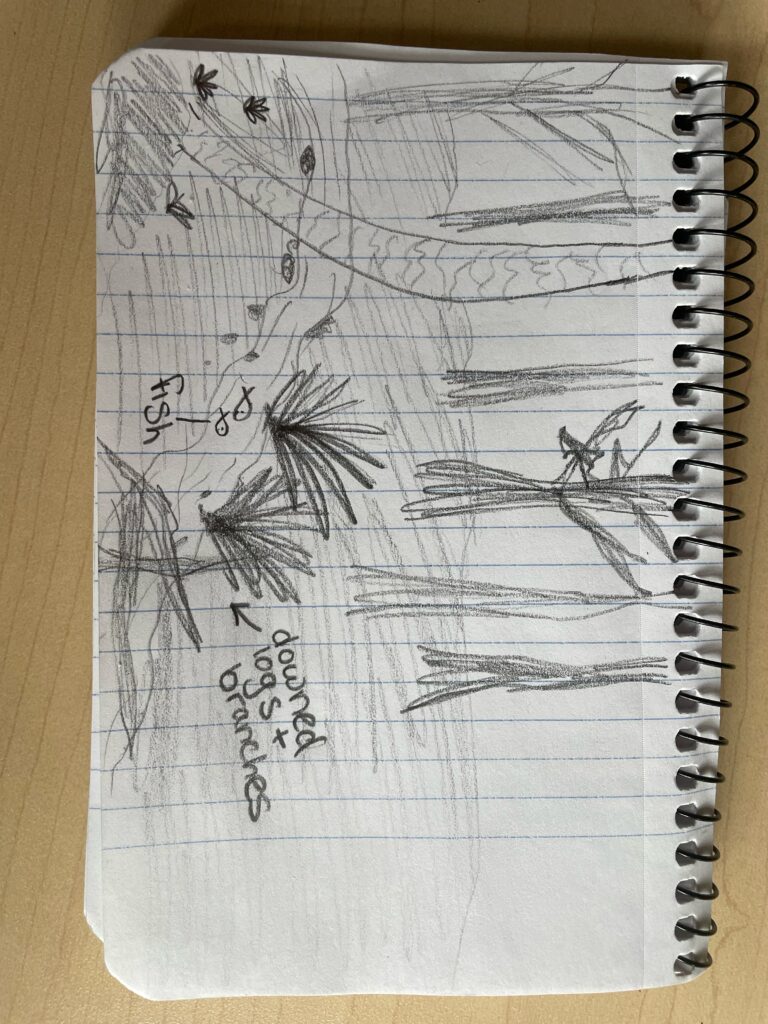
When compared to the photos of my spot from September, I noticed that there is considerably more debris and sticks in the stream. This could be from storms. The curves of the stream seem to have also slightly shifted.
There has been a curved black cherry tree growing toward the left side of my site. Throughout the months it has become a landmark for me and its scaly burnt potato chip-like bark has stayed a constant even when every other aspect of my spot seemed to change so much.
My spot, and centennial woods as a whole, really does show how intertwined nature and culture really are. People have been using this land for centuries, from indegenous land, to farm land, to eventually being owned by UVM and used for research purposes or as hiking trails for the community.
I do think that I consider myself part of this place. This place has been a constant throughout my first year here at UVM. Visiting it has been a relaxing escape from the busy life of college. Because of this, I feel a connection to this land and I even plan on visiting after NR2 is over.
I sat and drew this photo of my spot.