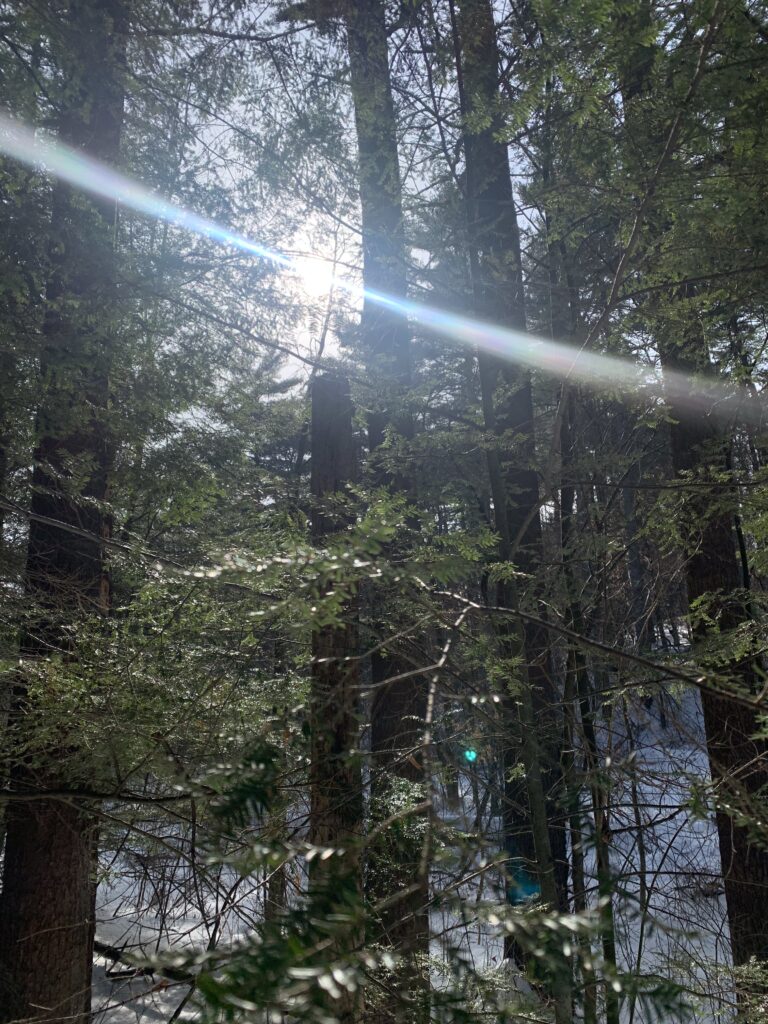
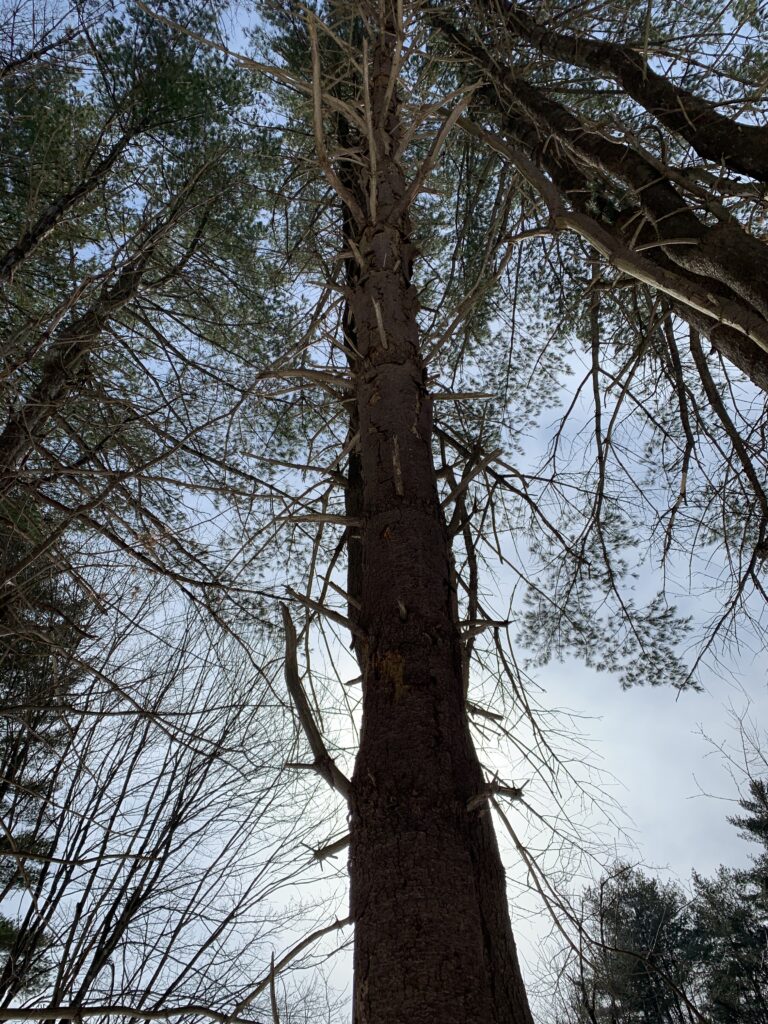
I journeyed into Centennial Woods last weekend on Sunday, February 23rd. This was a very warm day, where the temperature was on the brink of 40 degrees Fahrenheit. Due to this, there were a lot of phenological changes at my site because of the thawing of the area. Because of the melting snow, it was very difficult to find animal tracks, but I did hear a woodpecker in the pine stand in my phenology site.
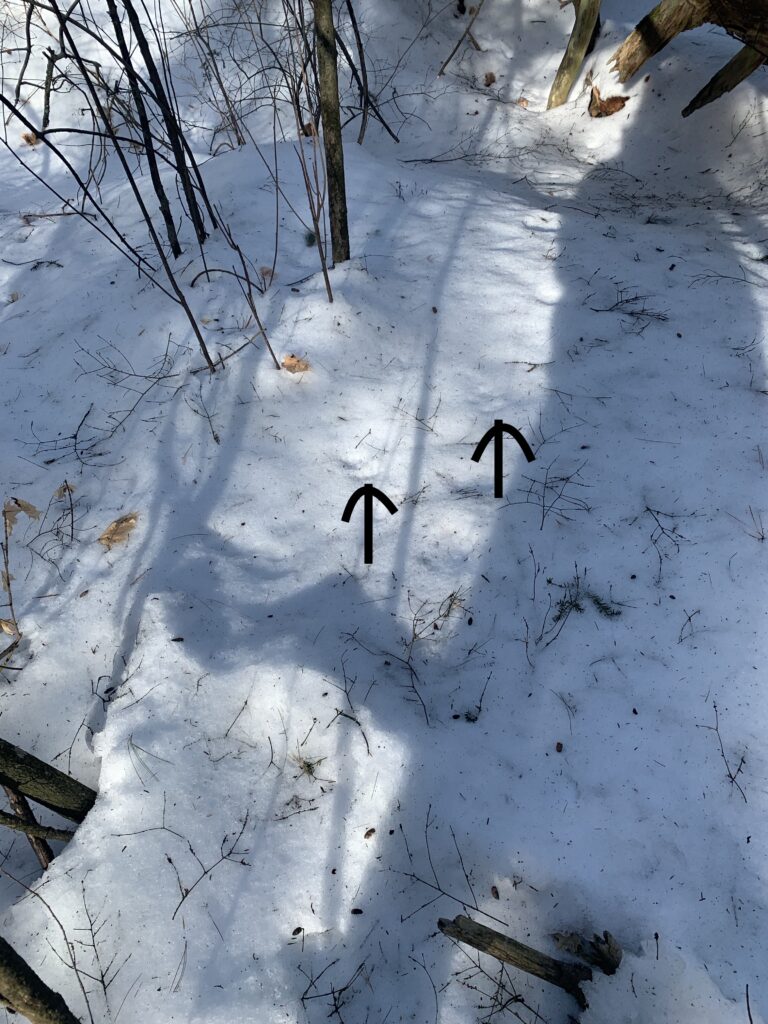
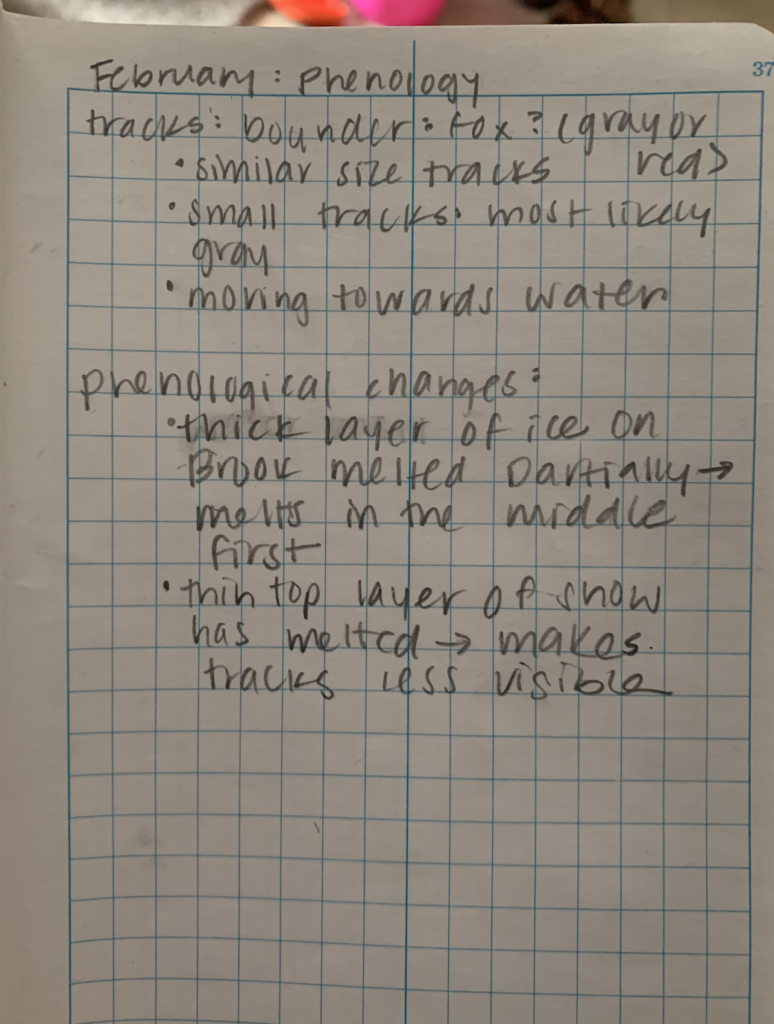
One animal track that I identified was a fox track. I was able to identify it as a fox track because the prints were of similar size, and it was a bounder. The tracks were on the smaller side, making me think that it was most likely a gray fox. The tracks were moving towards the brook, and began disappearing at the edge of the brook. According to Vermont Fish and Wildlife, the gray fox “habitat is commonly located along the banks of streams and rivers. The gray fox requires den sites, which may be a hollow log or tree, rock crevice, piles of wood or a brush pile,” (Vermont Fish and Wildlife). The site explains that gray foxes like hardwood forests, which explains why I saw the tracks in my phenology site, and why they were right near the brook. The gray fox eats rabbits, rodents, birds, crickets, grasshoppers, squirrels, and more (Vermont Fish and Wildlife). The gray fox is “primarily nocturnal, but may forage during the day,” (Wildlife Science Center). It has a few predators, including bobcats, coyotes, and great horned owls (ESF SUNY College of Environmental Science and Forestry).
One species that the gray fox interacts with is rabbits, which they consume. Assuming that this fox had a burrow in the hardwood stand in my site, it could have left its burrow to follow a rabbit at night. This makes sense because rabbits are nocturnal too. Another piece of evidence that would support this is that there were many other tracks present where the fox tracks were found. They were not very visible to me though because of the melting snow.
Another species that the gray fox interacts with is the coyote. It is quite possible that the coyote encountered the fox’s burrow, and the fox fleed in order to escape the coyote and jumped across the brook.
Due to the warm weather, a phonological change that happened at my site this month was that the thick layer of ice on the brook at my site has melted. It began melting in the middle of the body of water first, and still was present on the edges of the water. Also, a thin top layer of snow has melted at the site which made it difficult to look for tracks in the area. The melting of snow has made the understory more visible.
Citations:
Gray Fox. (n.d.). Retrieved from Vermont Fish & Wildlife Department website: https://vtfishandwildlife.com/learn-more/vermont-critters/mammals/gray-fox
Maier, B. (Ed.). (n.d.). Gray Fox. Retrieved from Wildlife Science Center website: http://www.wildlifesciencecenter.org/gray-fox
Saunders, D. A. (n.d.). Gray Fox. Retrieved from ESF SUNY College of Environmental Science and Forestry website: https://www.esf.edu/aec/adks/mammals/gray_fox.htm