
November 3rd, 2024
Hi!
15 minutes of Silence in my Phenology Site Sit Spot Reflection
This Phenology site observation began with fifteen minutes of quiet sitting in the center of my site. I used my senses to engage with my place and make deeper observations. I was able to breathe more deeply this time and noticed the smells of wet leaves, pine needles, and decaying plant matter. I also noticed the lack of scents that are present in everyday urban life, such as cigarette smoke and engine exhaust. There was a presence of the sound of birds, and I could even hear running water from the small brook near my phenology site if I listened closely enough. The amount of noise pollution was significantly less than in an urban environment like downtown Burlington. However, if I focused enough in my sit spot, I was still able to pick out the man-made noises that existed, such as airplanes and cars off of the nearby road. Overall, the environment of my phenology spot had a much more tranquil atmosphere than the urban development landscape in which I typically spend the majority of my time. During these fifteen minutes, I found that I was much more capable of breathing deeply and was more in tune with myself.
Birds-eye Map
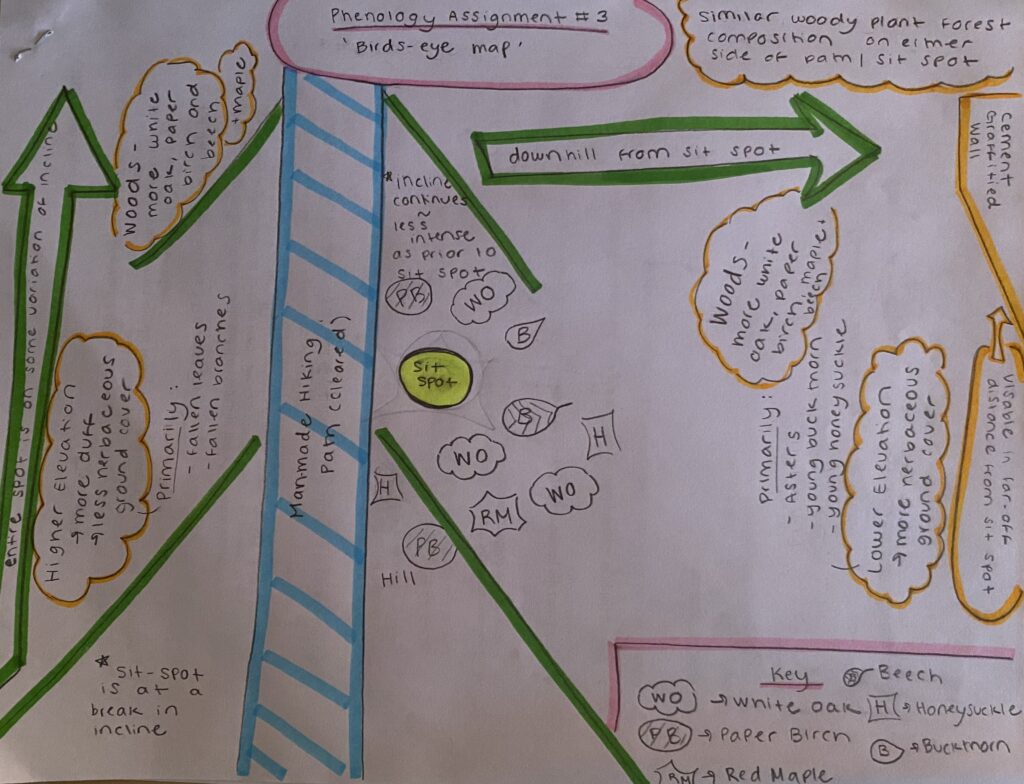
Changes in Vegetation Appearance
As for changes in vegetation since my prior visit to my phenology spot, I noticed that many trees, aside from evergreens, had lost a majority of their leaves. Although some leaves had remained intact on the branches of trees like Maples, Beeches, White Oak, and others, the vibrancy of their leaf colors had gone down drastically. Instead of being vibrant hues of yellow, orange, and red. I observed the forest color makeup to consist of dark green from the evergreens and a variation of brownish-yellow, orange, and red. Additionally, I was able to observe that the trees that had shed their leaves had led to a significant increase in the amount of duff littering the forest floor. This duff consisted of undecayed organic matter such as leaves and branches and it covered much of the herbaceous ground cover that I observed on my last visit to my phenology site.