
Part 1:
Saturday, July 2nd, 3 pm. Today the temperature outside is around 4 at the time of observation, it is humid with partly cloudy skies and no wind.
Part 2:
Today when I arrived at my site, I decided I wanted to play a little game with myself. My goal was to see how many different tree species I could identify by their characteristics such as bark, leaves, and anything else that could help me. As a forestry major, who has yet to take dendrology my tree identification skills are still pretty limited. With that being said, in about 10 minutes I was able to confidently identify quite a few trees in the area. The first tree identified was a Sugar Maple. The sugar maple is an iconic tree of the Northeast. I was able to confidently identify this tree by the five-lobed leaves and by the fact that it has five veins. The next tree I identified in the area was a Balsam Fir tree, which is also a very iconic Northeast tree. Balsam Fir trees are easily identified by their bark which is often smooth and grayish in color with blisters that seep sap. Then I identified an Eastern Hemlock and this one was a little bit tricky because it looks fairly similar to a Balsam Fir tree, but they have softer needles that are not as “sharp”. The last tree I was able to identify was the American beech tree. I find this tree very easy to identify because they have this smooth grayish silver bark. In the short amount of time, I was out in the field, I felt that I was able to accurately identify a lot of trees. This is something that made me extremely excited, and I’m hoping that every time I go I can learn more about the species in the area.
Part 3:
When I was trying to identify as many tree species as I could in my area I came across one which I was unfamiliar with. At first, I thought it was a Sugar Maple as the leaves looked very similar but instead of five lobes, this species only had three. I took a leaf home and did a little bit of research and found out that the tree that I had stumbled upon was a Black Maple (Acer Nigrum). I was able to figure out what species I had here with a quick Google search. I typed in “what species looks like a sugar maple but only has three lobes” with that Google search I found an image that looked identical to the leaf that I brought back home and concluded that the tree is a Black Maple. One thing I learned about the sugar maple is that historically it had always been considered its separate species, but it is now considered a subspecies of the Sugar Maple. A fun fact is that Black Maples are highly prized in the timber industry and are used to make furniture, musical instruments, paper, and baseball bats.
Part 5:
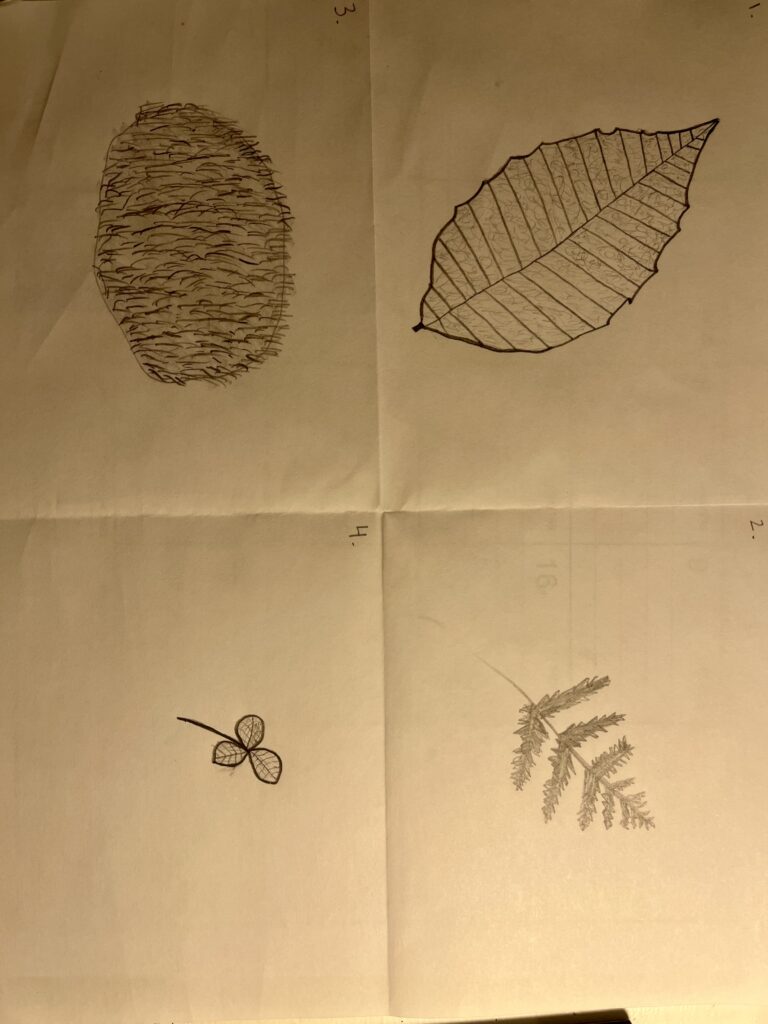
1. My first sketch was of a Beech tree leaf. I gathered it when I was trying to identify as many tree species as I could. One thing that I tried to focus on in this sketch was the veins in the leaf. I sketched the back side where they were more prominent and easier to identify.
2. My second sketch was of a fern. I chose to sketch a fern because they’re very abundant in this area of the trail that I’ve been looking at. The fern was definitely by far the hardest to sketch because there are so many little details.
3. Next I found a little chunk of moss on the ground. The moss was shaped in a perfect little circular blob and it looked almost as if a rock had grown hair. For this sketch, I tried to make sure that I was getting all of those little hair-like moss pieces.
4. For my final sketch, I drew a clover, and although a clover is extremely simplistic looking when I did my sketch I tried to get all the details I could and focus on coloration and the veins.
Conclusion:
The process of sketching was challenging for me. I have never been super artistic, but of course, I wanted to make my sketches look as best as I possibly could. By doing this, I felt like that took away from my overall experience. I love being out in nature and the Joppa Hill loop trail is one of my favorite spots in my hometown, but I’ve never been out there and also had to deal with the frustration of doing something that challenges me.
This week I noticed myself focusing on a lot of bigger elements of this area, such as the tree species that populate it. Next time I go to my site, I’m going to try to zoom in and take in more of the small details that make my site what it is.