
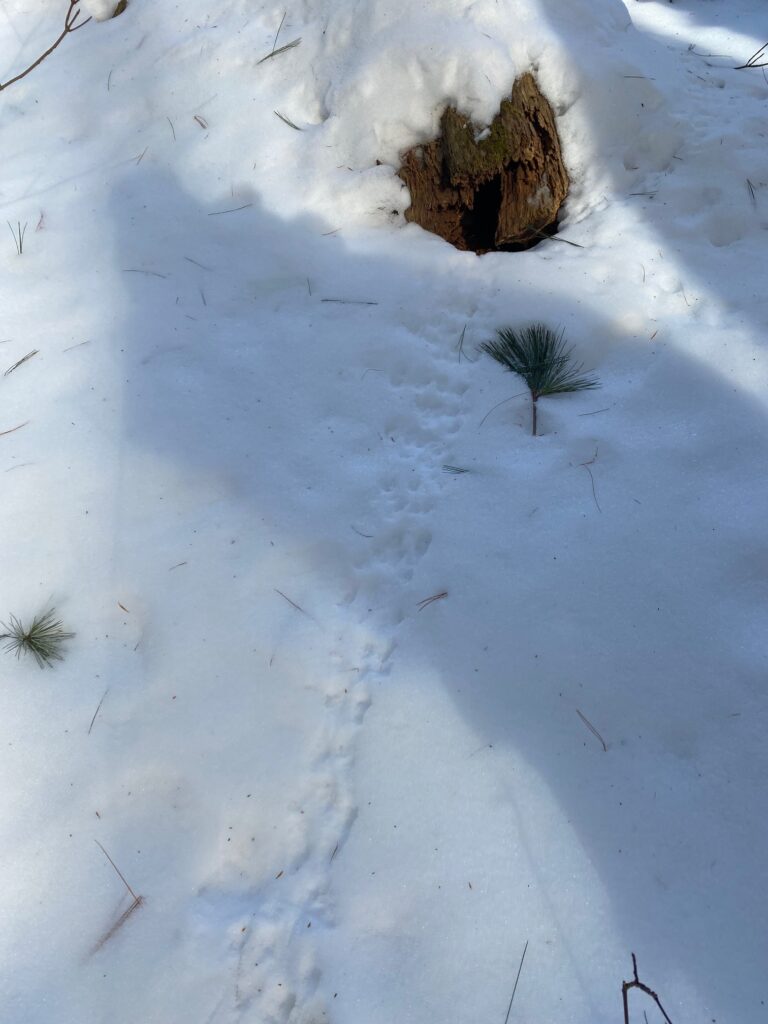
I was curious about tracking in the greater Burlington area and decided to take a morning stroll through the nature reservation next to Saint Michael’s College just on the other side of the Winooski River. The snow was thick, and it was clear to me that I wasn’t the only one who had decided to come through the same way. I started by seeing what appear to be mouse prints that lead into a log that a couple or more mice seem to have resided in for a period of time. Mice don’t hibernate in the winter, so they are essentially in a constant search for food. The entire season is made up of finding and taking shelter near food sources, generally seeds, nuts, and grains, and it’s important for them to be in very close proximity to a good amount of food available. The White Pine needles next to the burrow tell me that the mice may be eating the scales from pinecones, as well as acorns and beech nuts from the other species I observed nearby.
The next set of tracks that I saw confused me for a while and I’m still not 100% positive because it was very hard to make out the individual foot prints because there appeared to be a tail dragging behind the animal, dragging snow over the tracks of the feet.
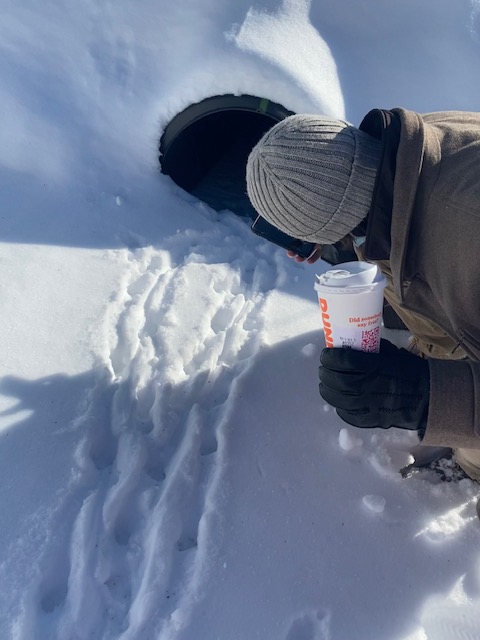
I referred to iNaturalist to help me out with identifying these tracks. One angle that I photographed (not-pictured) was suggested to be in the Phasianidae family, some kind of a pheasant, grouse, or partridge. However, from this angle, foot marks are easier to make out and iNaturalist says that it believes the owner of these tracks is a marten or fisher, which I think makes more sense. The alternating walk and tail print occurs twice in this region of snow, but I think that the creature entered the pipe and then walked out the same way they came because of the just distinguishable enough opposite directions the prints are facing. The supposed fisher may have been entering the pipe for one of two reasons: food or shelter, or both. Fishers often search for small animals to prey on in nooks and crannies, and could have been scouring out the scene for the hopes of squirrel or mouse dinner. I’m still new to tracking so it is also possible that this animal is something else such as a skunk. iNaturalist was helpful to use in this instance because it got me thinking about the different options of the source of the tracks, but it wasn’t too exact which is the same experience I feel as though I encountered first semester identifying tree species etc. I don’t expect any app such as this one to be perfect but it would have been nice for there to be more explanation and walk through when identifying the species.
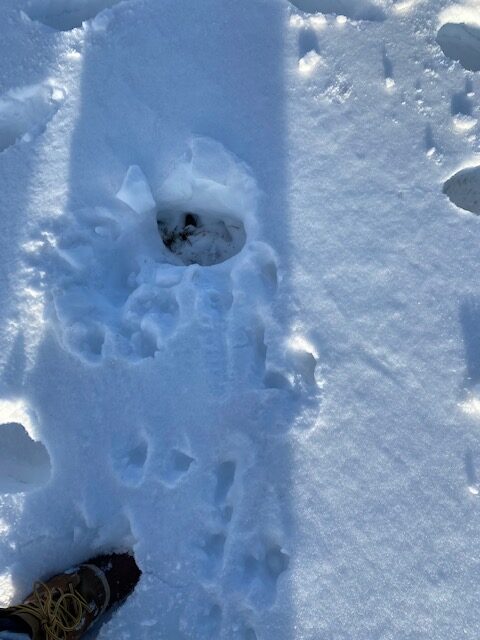
We also came upon white-tailed deer scat and tracks, which I am realizing I’ve come to see very often this semester since being back up in Vermont in the winter.

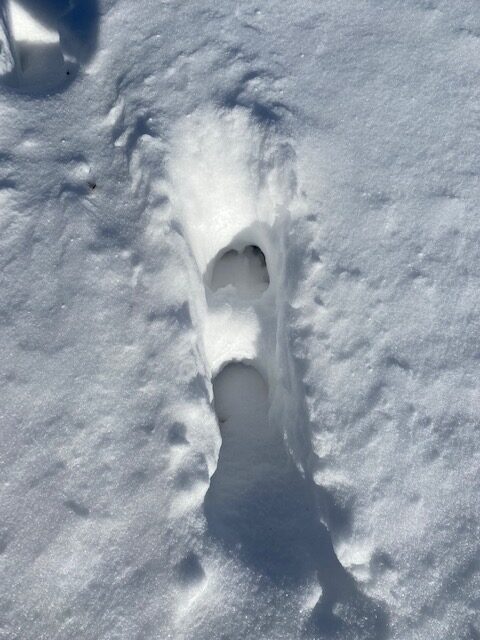
I took the bus back from Colchester and was walking back to my dorm from the medical center bus stop and came upon just a few more bunny and mouse tracks and a mouse hole with the tracks leading up to it. The common Cottontail Rabbit is most likely the suspect of the tracks on the left, with the two smaller front leg tracks almost completely run over by the larger back legs that spring forwards with every hop. The mouse hole on the left doesn’t clearly show the mouse tracks leading up to it, honestly due to the fact that I kind of stepped too close to them and then didn’t get a great picture of the footprints, but there was a trail of mouse tracks, very similar to those shown in the previous mouse tracks in the first picture I included.
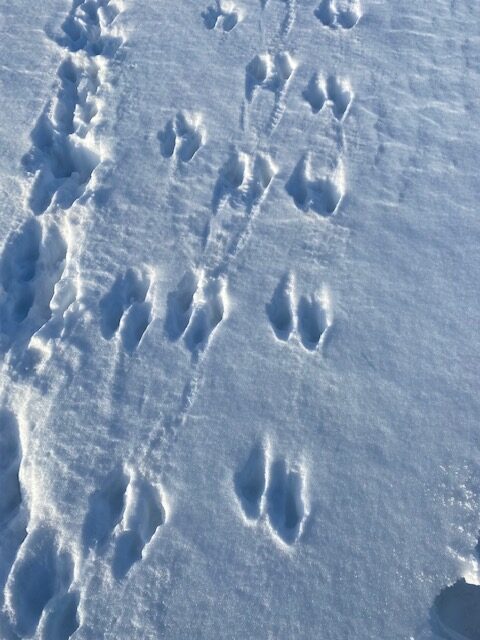
Right: Mouse den (most likely House Mouse or Deer Mouse)
The greater Burlington area did not disappoint me on my outdoor tracking adventures this week! It was a beautiful, sunny day to share with the mammals and birds who reside in Burlington and I loved getting out and about to explore new natural places that I have not yet adventured through.
-Dani