Today, I went out on my phenology walk. All five trees had no breaking buds, no leaves or flowers, and no signs of new spring growth. To be honest, this isn’t very surprising, as it’s still pretty early in the season. I wouldn’t expect buds to start breaking until later this month or potentially early May. Today certainly didn’t feel like spring, as it was a crisp 38°F at the time of walk.
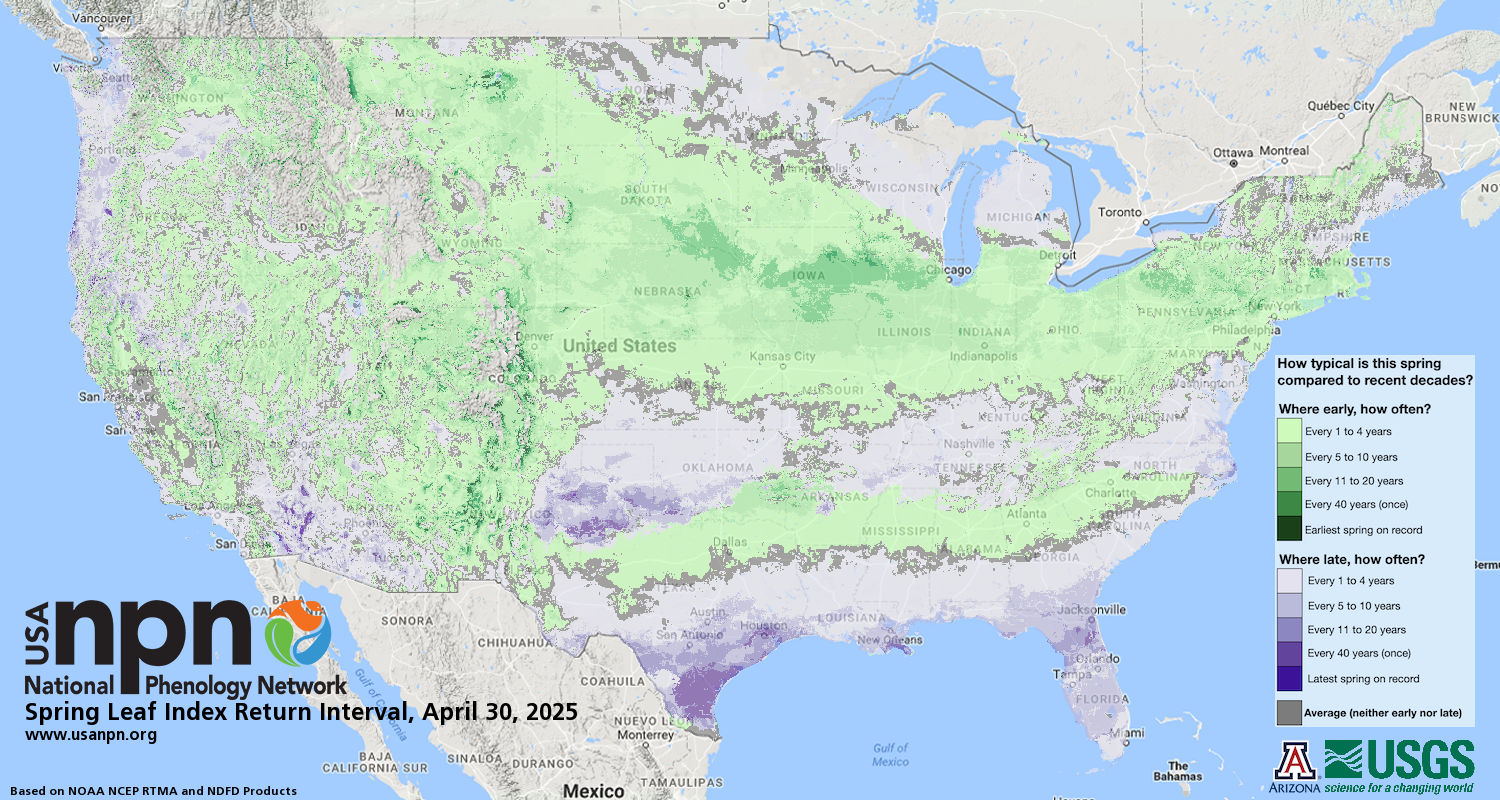
Taking a look at the National Phenology Network website, I found an interesting map displaying the Spring First Leaf Return Interval (or how typical this year’s phenological changes are compared to past years). For some reason, I can’t add the image of the map here, so I will link the website below. As of today, April 2nd, the map shows earlier than typical leaf return in states such as Nebraska, Iowa, Missouri, Indiana, Ohio, southern Pennsylvania, New Jersey, Connecticut, northern Mississippi, northern Georgia, northern Alabama, South Carolina, Utah, Arizona, New Mexico and northeastern Texas. These early leaf returns aren’t incredibly atypical, occurring around every 1-4 years. Conversely, states such as Florida, southern Texas, Louisiana, southern Alabama, southern Mississippi, southern Georgia, Tennessee, and Kentucky are seeing later than usual leaf returns (by around 1-4 years). This spring seems to be split between being early and late, depending on location. No data has been listed yet for Vermont, as spring has not yet started here. According to the Vermont Forest Health Insect and Disease Observation (linked below) from May 2022, “Sugar maple trees at our longterm phenology monitoring site in Underhill, VT broke bud on May 5, 2022. This was very close to the long-term average for budbreak at the site (May 3).” From this information, it seems that early May is the typical bud-break time, at least for Sugar maples. It will be interesting to see how our data compares to this timeline as my peers collect data into the end of the month.
https://www.usanpn.org/files/npn/maps/six-leaf-return-interval-2025.png
https://fpr.vermont.gov/sites/fpr/files/doc_library/2022%20Forest%20Health%20May%20Observations.pdf