 <\/figure>\n\n\n\n
VT NRCS summary of changes as shared by Sandra Primard, State Agronomist:<\/p>\n\n\n\n
Recently the VT Nutrient Management Standard 590, UVM \u2018Nutrient Recommendations for Field Crops in Vermont\u2019 and the Vermont Phosphorus Index have undergone updates.<\/p>\n\n\n\n
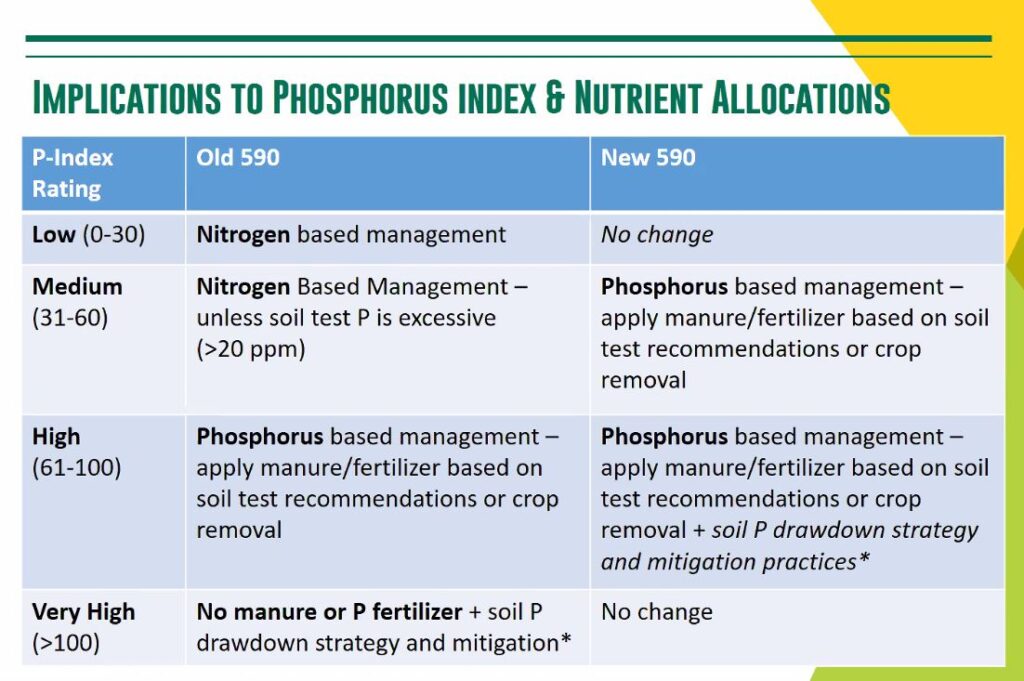
The UVM \u2018Nutrient Recommendations for Field Crops in Vermont\u2019 corrected some typos, made a few minor edits for clarity and updated sample soil and manure submission forms.\u00a0The recommendations have NOT changed.\u00a0The new version is BR.1390.3 and can be found at https:\/\/www.uvm.edu\/extension\/agriculture\/vermont-phosphorous-index<\/a><\/p>\n\n\n\n The Vermont Phosphorous Index updated the nutrient management interpretations of the Vermont PI scores to fit the new VT 590 standard.\u00a0The new version is Version 6.2.\u00a0No changes to the structure or calculations in the P-Index were made, just the resulting nutrient management interpretations which are given at end of this email. Scores produced using Version 6.2 should be identical to those produced using Version 6.1, given the same inputs.\u00a0The Vermont Phosphorous Index can be found at\u00a0 https:\/\/www.uvm.edu\/extension\/agriculture\/vermont-phosphorous-index<\/a><\/p>\n\n\n\n The updated VT Nutrient Management Standard 590 occurred because every five years the NRCS National Headquarters updates the National Standards.\u00a0 Then each state shapes the National Standard to fit their state.\u00a0Each state can make the National Standard stricter but not less strict.\u00a0Vermont worked with its many partners to update the standard so that it fits with the State laws of the Required Agricultural Practices (RAPs) and the State Water Quality Regulations.\u00a0 In the past, the Vermont added language in the standard was in blue font.\u00a0 Now it is in bold italics.\u00a0The VT 590 can be viewed here: <\/p>\n\n\n\n Summary of 2020 VT Nutrient Management 590 Standard Changes<\/strong><\/p>\n\n\n\n Aligns with the State water quality regulations and requirements including the Required Agricultural Practices (RAPs).<\/p>\n\n\n\n Soil tests must be no older than 2 years when developing new nutrient management plans.<\/p>\n\n\n\n Additional clarification on annual sampling of manure tests.<\/p>\n\n\n\n Additional clarification on realistic yield goals.<\/p>\n\n\n\n Additional clarification on applying nutrients on frozen, snow covered and saturated soil conditions.<\/p>\n\n\n\n The Plans and Specification section has been developed more fully.<\/p>\n\n\n\n The Operations and Maintenance section has been developed more fully.<\/p>\n\n\n\n Vermont Phosphorus Index<\/p>\n\n\n\n The medium rating of the VT PI requires P application not to exceed crop P removal rate or soil test P recommended rate.<\/p>\n\n\n\n The high rating of VT PI also requires P application not to exceed crop P removal rate or soil test P recommended rate. In addition, a soil P drawdown strategy is needed along with implementation of mitigation practices.<\/p>\n\n\n\n The very high rating of VT PI requires no manure or P fertilizer applications. In addition, a soil P drawdown strategy is needed along with implementation of mitigation practices.<\/p>\n\n\n\n <\/p>\n","protected":false},"excerpt":{"rendered":" VT NRCS has made some changes to the 590 standard, which is the standard that applies to Nutrient Management Planning. The most important change is what is allowable under a medium and high P-Index score. Here is a summary of some changes: VT NRCS summary of changes as shared by Sandra Primard, State Agronomist: Recently … Continue reading “Clarification for Changes to 590 NMP Standard”<\/span><\/a><\/p>\n","protected":false},"author":2702,"featured_media":0,"comment_status":"closed","ping_status":"open","sticky":false,"template":"","format":"standard","meta":{"_monsterinsights_skip_tracking":false,"_jetpack_newsletter_access":"","_jetpack_dont_email_post_to_subs":false,"_jetpack_newsletter_tier_id":0,"_jetpack_memberships_contains_paywalled_content":false,"_jetpack_memberships_contains_paid_content":false,"footnotes":""},"categories":[301554],"tags":[],"class_list":["post-2683","post","type-post","status-publish","format-standard","hentry","category-nutrient-management"],"jetpack_sharing_enabled":true,"jetpack_featured_media_url":"","_links":{"self":[{"href":"https:\/\/blog.uvm.edu\/cvcrops\/wp-json\/wp\/v2\/posts\/2683","targetHints":{"allow":["GET"]}}],"collection":[{"href":"https:\/\/blog.uvm.edu\/cvcrops\/wp-json\/wp\/v2\/posts"}],"about":[{"href":"https:\/\/blog.uvm.edu\/cvcrops\/wp-json\/wp\/v2\/types\/post"}],"author":[{"embeddable":true,"href":"https:\/\/blog.uvm.edu\/cvcrops\/wp-json\/wp\/v2\/users\/2702"}],"replies":[{"embeddable":true,"href":"https:\/\/blog.uvm.edu\/cvcrops\/wp-json\/wp\/v2\/comments?post=2683"}],"version-history":[{"count":3,"href":"https:\/\/blog.uvm.edu\/cvcrops\/wp-json\/wp\/v2\/posts\/2683\/revisions"}],"predecessor-version":[{"id":2688,"href":"https:\/\/blog.uvm.edu\/cvcrops\/wp-json\/wp\/v2\/posts\/2683\/revisions\/2688"}],"wp:attachment":[{"href":"https:\/\/blog.uvm.edu\/cvcrops\/wp-json\/wp\/v2\/media?parent=2683"}],"wp:term":[{"taxonomy":"category","embeddable":true,"href":"https:\/\/blog.uvm.edu\/cvcrops\/wp-json\/wp\/v2\/categories?post=2683"},{"taxonomy":"post_tag","embeddable":true,"href":"https:\/\/blog.uvm.edu\/cvcrops\/wp-json\/wp\/v2\/tags?post=2683"}],"curies":[{"name":"wp","href":"https:\/\/api.w.org\/{rel}","templated":true}]}}