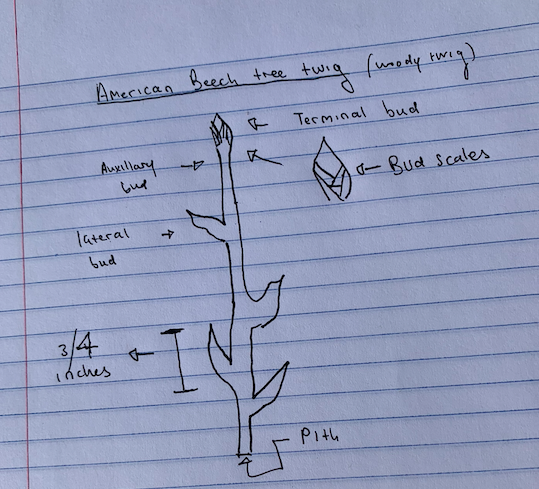
Back in Centennial Woods at my phenology site, I have witnessed several changes. As the snow slowly disappeared, the flowers started to bloom. I witnessed the beginnings of budding twigs for an American beech tree (as pictured below). I also witnessed a tulip in the initial stages of blooming. To represent this I sketched a diagram of a tulip and the parts that are pertinent to it’s growth.

In addition to changes in twigs and herbaceous species like the tulip, there have also been changes in the wildlife and I saw several species I had never seen at my spot before. These included lower food chain species like fungi in the soil that had been frozen over with snow all winter, worms coming to the surface and carpenter ants. It was nice to see these smaller critters.
Other interesting animal sitings have been a salamander, pileated woodpecker and a barred owl. To be fair I’m not actually the one who saw the barred owl and I’m not 100% confident that the bird I saw was a pileated woodpecker but from data collected by others on INaturalist, it seems like a reasonable assumption. I saw the salamander a short ways away from my phenology spot when I was actually on an unrelated adventure- a trail run.
To connect all these species, we can look at something known as a Species Interaction Diagram which documents the different ways species act as competitors and resources for one another. I placed these species in a diagram seen below and highlighted how each benefits and takes from the other. 4 of the 6 species are actually on the same trophic level. This means they prey on similar lower-level species in the food web, however it doesn’t always mean they are in direct competition at the same time. The dashed lines show species that prey on the same lower food web species but don’t directly eat one another, as is the case with worms and carpenter ants feeding on soil fungi and salamanders and pileated woodpeckers eating worms.
Although the salamander and woodpecker compete for the same resource, they wouldn’t eat one another. Additionally, although they are depleting the same resource, they may do so at different times.

Overall, this was a great time to be out and about enjoying the phenology of Centennial Woods. I’m looking forward to more animal sightings- especially birds- as the weather warms.