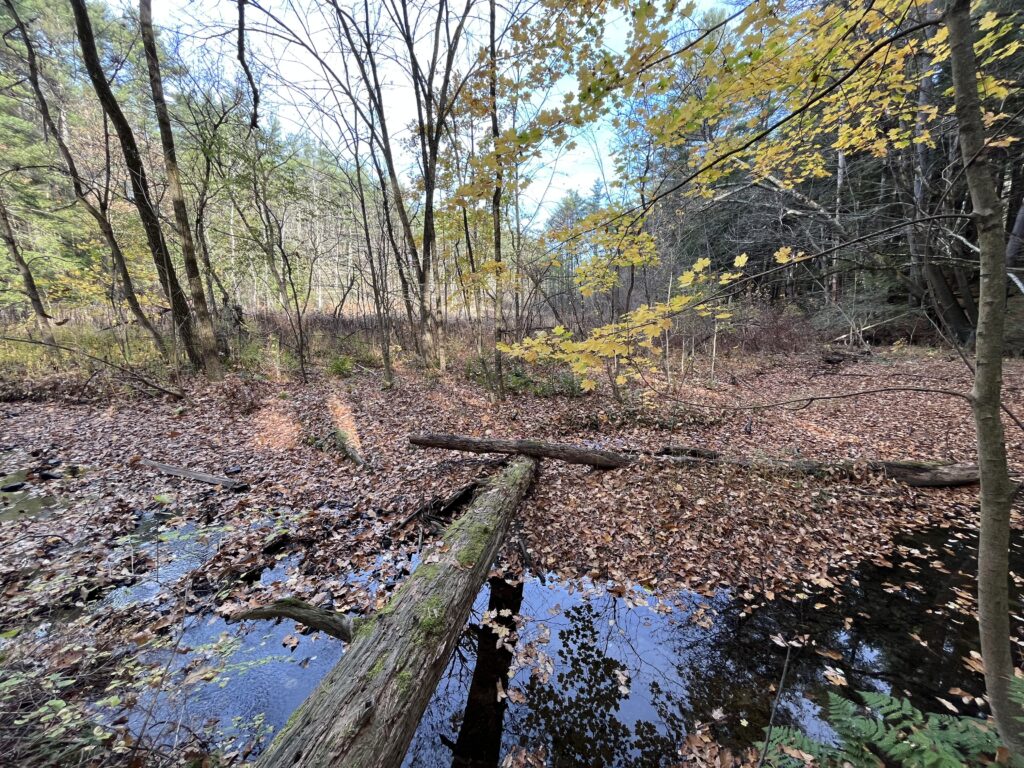
Feeds:
Posts
Comments

4/30/2023

For this year’s BioBlitz, myself and my friends decided to walk around campus and walk towards Centennial Woods. We thought that the walk over to Centennial Woods will have other species to observe and record, and when we arrive at Centennial, there will be even more.
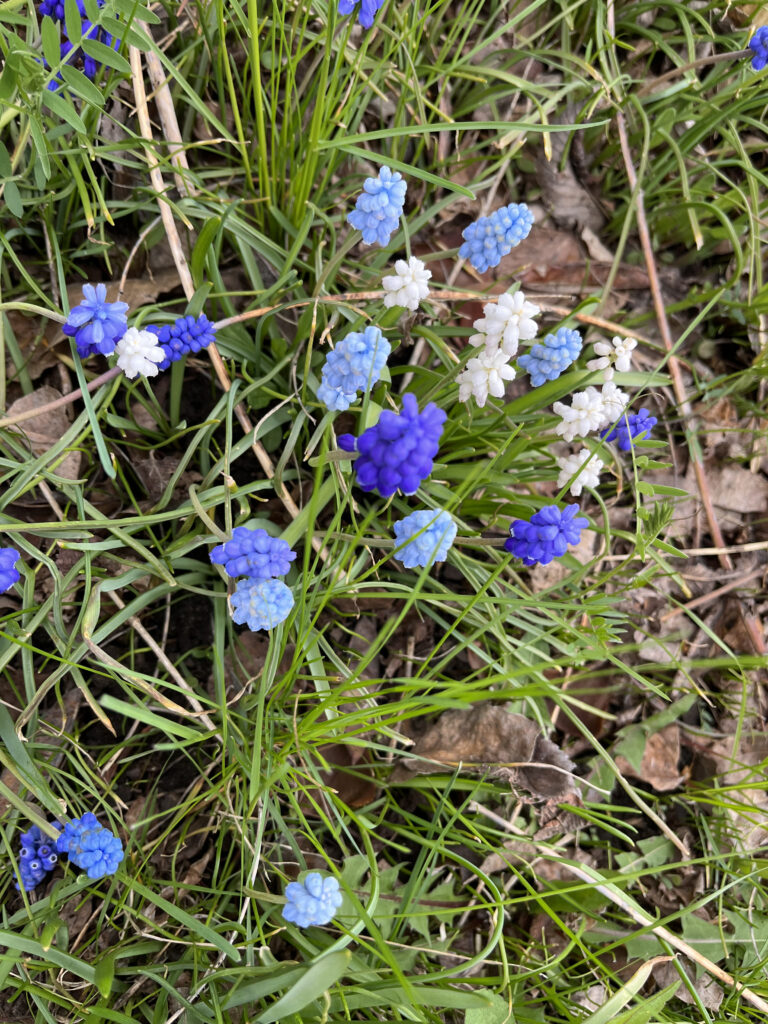
Grape Hyacinths found outside of Jeffords

I have used iNaturalist before for other blog posts and lab assignments, so I was fairly familiar with the application on my phone. When I checked the leaderboard for NR 2, my lab section was third in place. Although third isn’t bad, I knew that my friends and I could rally together some observations.
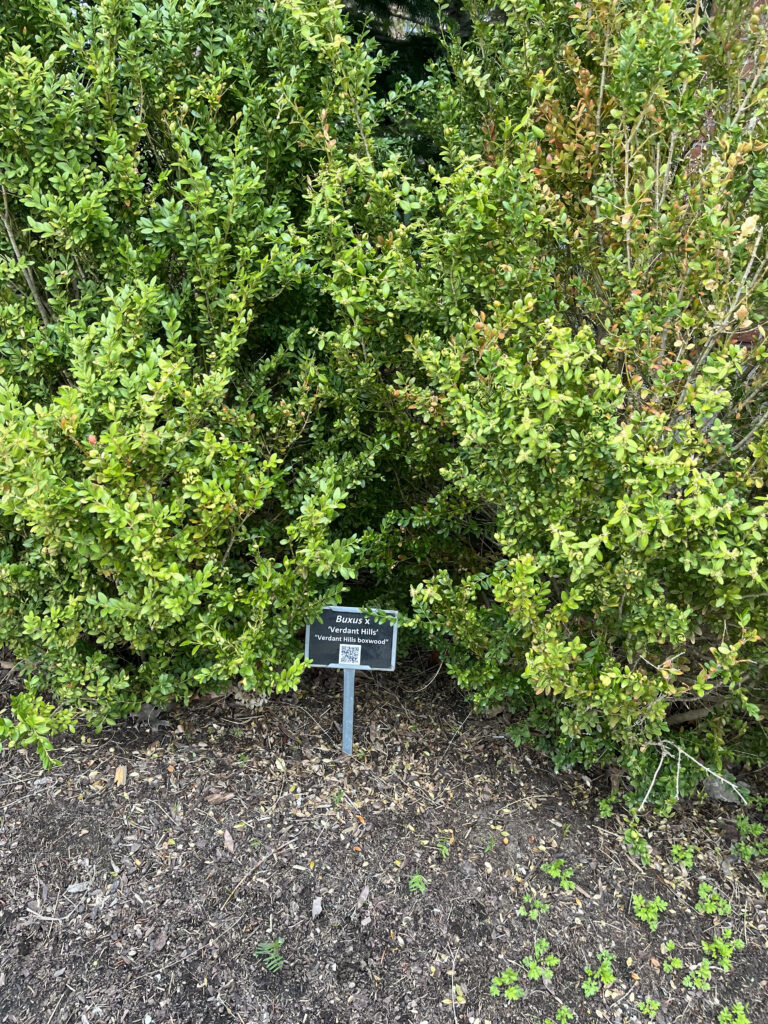
Verdant Hills outside of Jeffords

I was able to encounter about twenty species, maybe more. My friends and I did not want to overlap our observations so we found plants that others had not photographed yet. I encounter a lot of mosses, ferns, trees, and even some birds. It had rained the night before we went to Centennial, but the trail was dry so there was not a lot of prints in the ground.

When I looked at the City Nature Challenge globally, a lot of American cities were in the higher ranks, but were overshadowed by Cape Town and La Paz. I think that the city from Bolivia, South America is in first place because they are closer to the equator, where more biodiversity is found than other places. There is also lesser areas of metropolises and cities, and larger spaces between populated areas. The third place city is the city of Cape Town, which is found in South Africa. Their observations consisted of a lot of tropical flowers and birds.
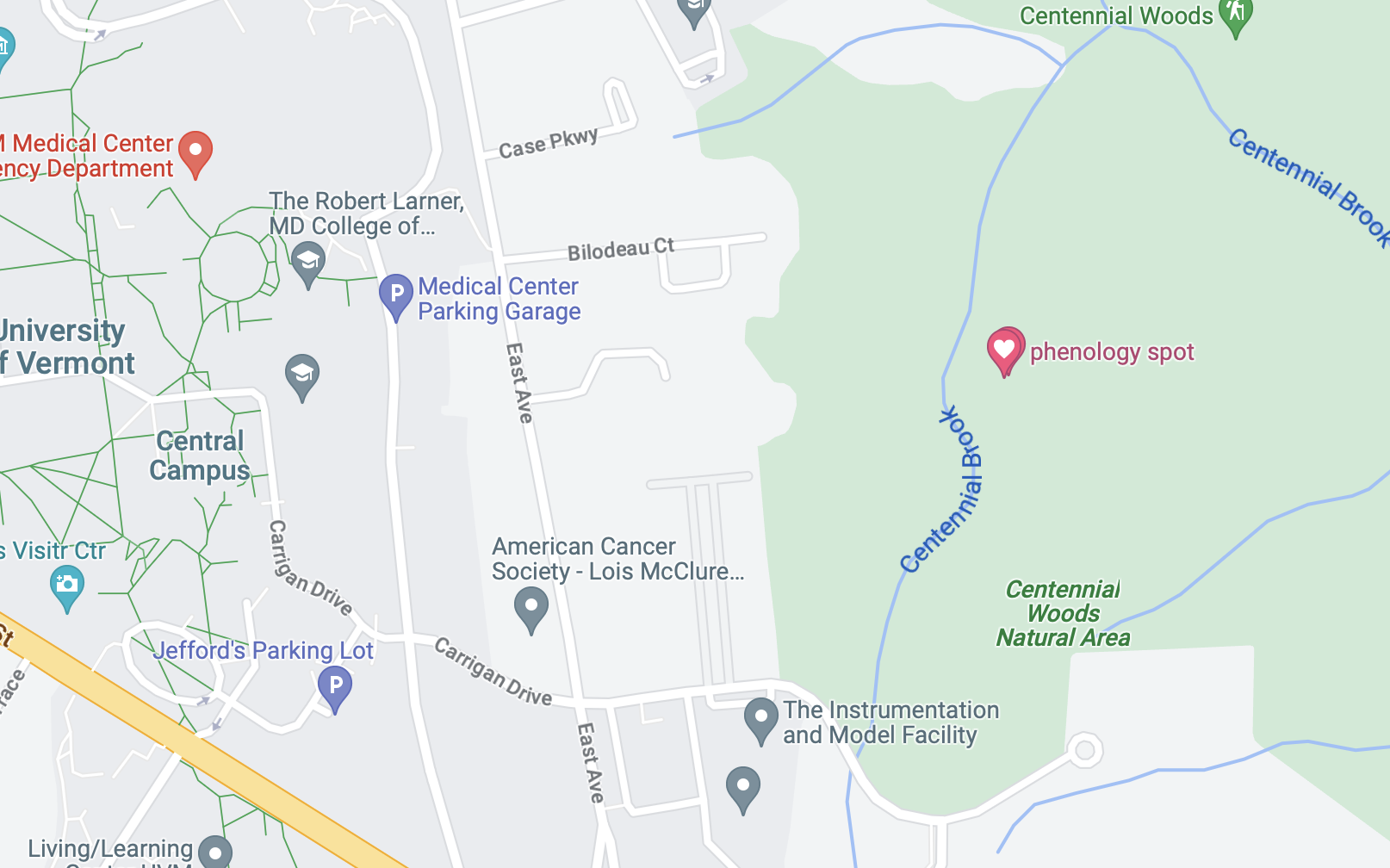
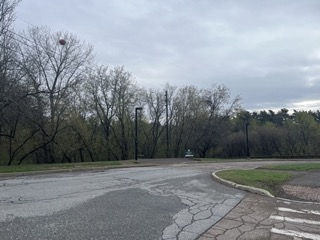
Map of where I went for the BioBlitz.

4/24/2023

I have not seen green on the trees in Centennial Woods since I first visited my site one semester ago. It made me so happy to finally see those green buds emerging from the tree branches, almost welcoming me back to my phenology spot. Over time, I have observed and noted the phenological changes at Centennial Woods. From the leaves changing color, to falling off and becoming apart of the forest ground, to now leaves coming back in time for spring and summer. I have also noticed new growth in the woods. For example, it has been raining the past few days along with warmer weather, which has brought new moss on trees and small flowers poking through the leaves. This new growth was not here a month ago.

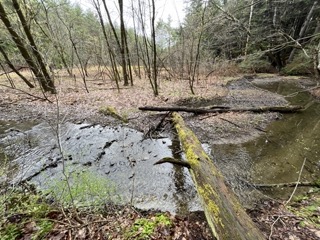
Centennial Woods 4/24
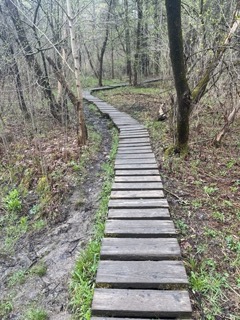
Wooden Walkways

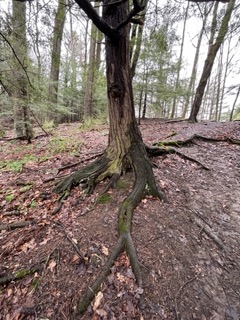
Over time, I have familiarized myself with Centennial Woods, and I can easily get there with little difficulty. Some landmarks that are important to my walk there are the wooden pathways. There are about four sections throughout the trail that I have walk on to get to my phenology site, and they aid in helping people avoid walking in a ditch where flooding occurs often. Another landmark that I associate with my site is this semi uprooted coniferous tree that looks over my spot. Its long roots covered in moss are hard to miss when walking to Centennial Brook.

Some minor landmarks include the small hills and turns that I have to walk up and down, and I feel comfortable walking over them because I know I am going the correct way.

Large Coniferous tree near Centennial Brook

Centennial Woods is a small getaway from UVM’s college campus and the busy shopping center of Burlington. Here, students and locals can explore Centennial Woods and gain a deeper understanding of what it provides to our community. I think that Centennial Woods intertwines cultural and nature because in some ways, it is a meeting ground for people to enjoy nature and immerse themselves in the outdoors. Students learn about the ecosystem process and services that Centennial Woods provide, and in turn, we want to preserve them. Centennial Woods also provides a sense of place to the citizens of Burlington, and pulls people in because of its nature and beauty.

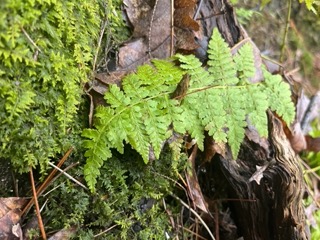
A fern found near Centennial Brook

I do consider myself a part of my place because I have spent so much time observing and coming back my spot that I feel connected to it and a part of it. I feel like since I have learned so much about the environment, and what phenology means, I am able to connect myself further with my spot and understand the living organisms that live in Centennial Woods.

Centennial Brook, Carmela’s Phenology Spot, April 24, 2023!

4/8/2023

Today’s walk to the phenology site was much more pleasant than the walk last time. There was no snow on the ground, and the sky was blue and bright! I decided to make a video vlog about my walk and findings at my phenology spot. The video is posted below.

To summarize the visit, the northern red oak I have been observing has not yet budded, as for other hardwoods surrounding the tree in Centennial Woods. However, I did hear a lot of cheerful birds as I entered the forest, and saw some green spots of grass and other flowers poking through the forest floor. I am hopeful that the next time I visit more action will be occurring!

Below is a link to my iNaturalist observation!

https://www.inaturalist.org/observations/153971628

3/26/2023

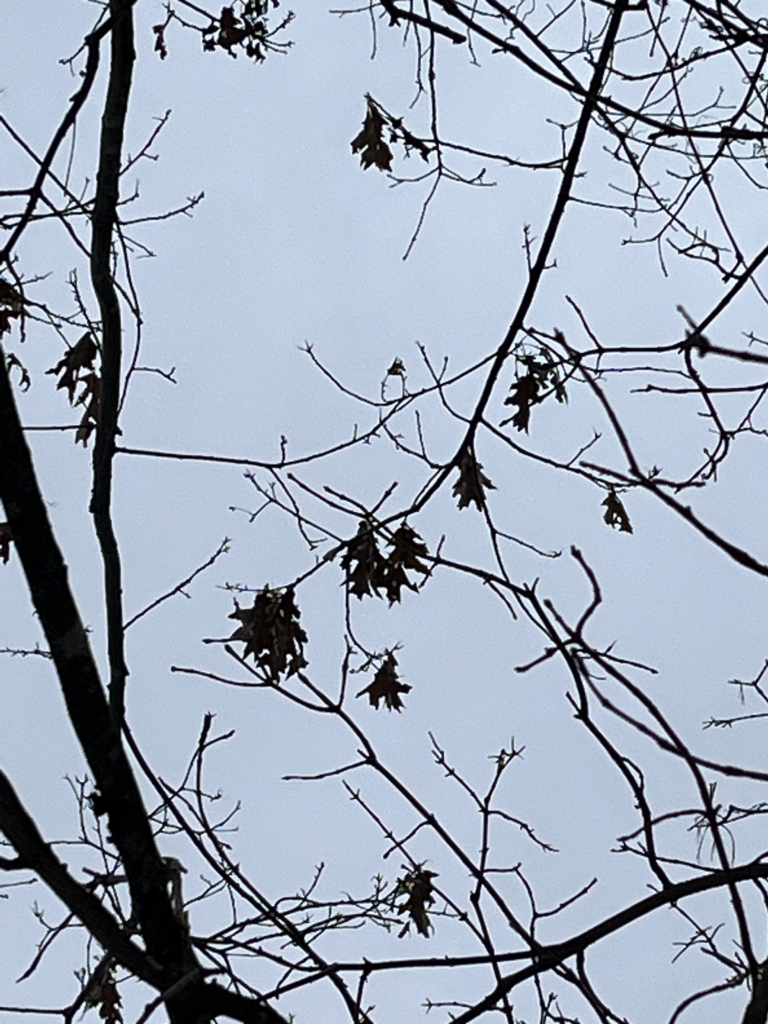
The tree had little change on its branches.

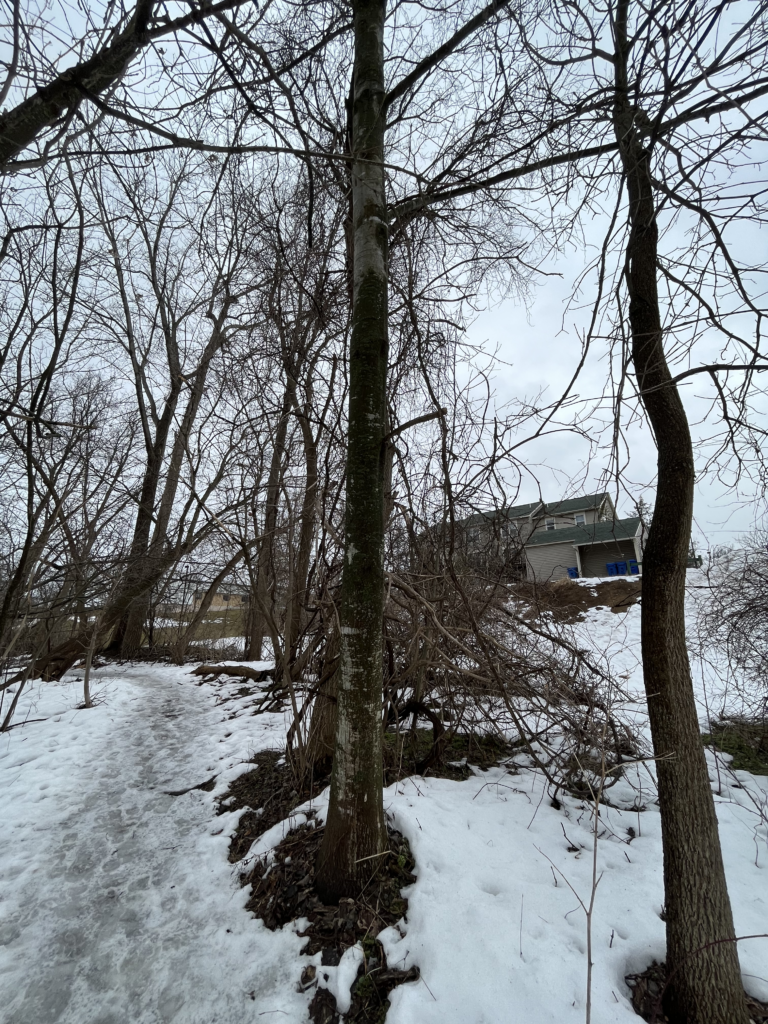
The weather in the Burlington area has been off and on, with a few warm days and clear skies, and cold days with dark grey skies. The day before I visited my tree, it had flurried, but no serious snow had fallen. When I walked to Centennial Woods this morning, the array of trees still looked very bare, and it made me miss when all of the trees were decorated with leaves. Upon entering Centennial Woods, I was hopeful that maybe the northern red oak I had been observing had some bud breaks, but from my observations, they hadn’t yet.

As I approached the tree, I observed that there was snow visible around the trunk of the tree, but nothing stuck to the branches above me. Since this oak tree is somewhat tall, it is harder to observe and see the buds on the branches However, I can conclude from photos and my own eyesight that the oak had not had any blooms yet, and was still holding on to last year’s leaves.

Centennial Woods with the recent snow fall.

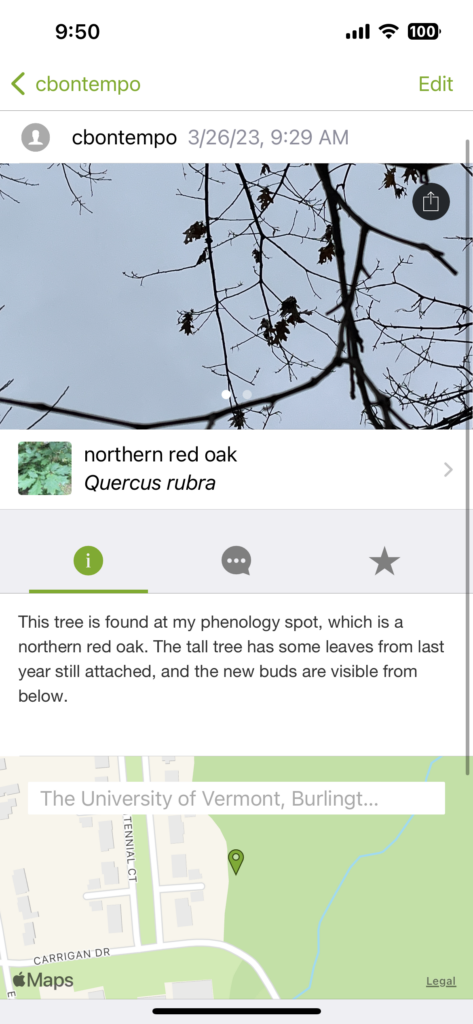
I am hoping that next time I visit the oak tree that there is more action happening with its buds. Below is my iNaturalist post that I made observing the northern red oak tree.

iNaturalist Post

3/7/2023

Northern Red Oak

In the early days of March in Vermont, the majority of trees look almost the same. The muted brown and leafless twigs make it difficult to identify what tree is which. At Centennial Woods, I originally had tried to identify a beech tree because the smooth bark was easy to identify among others, and I thought that it would stand out. As I walked through Centennial Woods, I thought that I had right away spotted an American Beech!

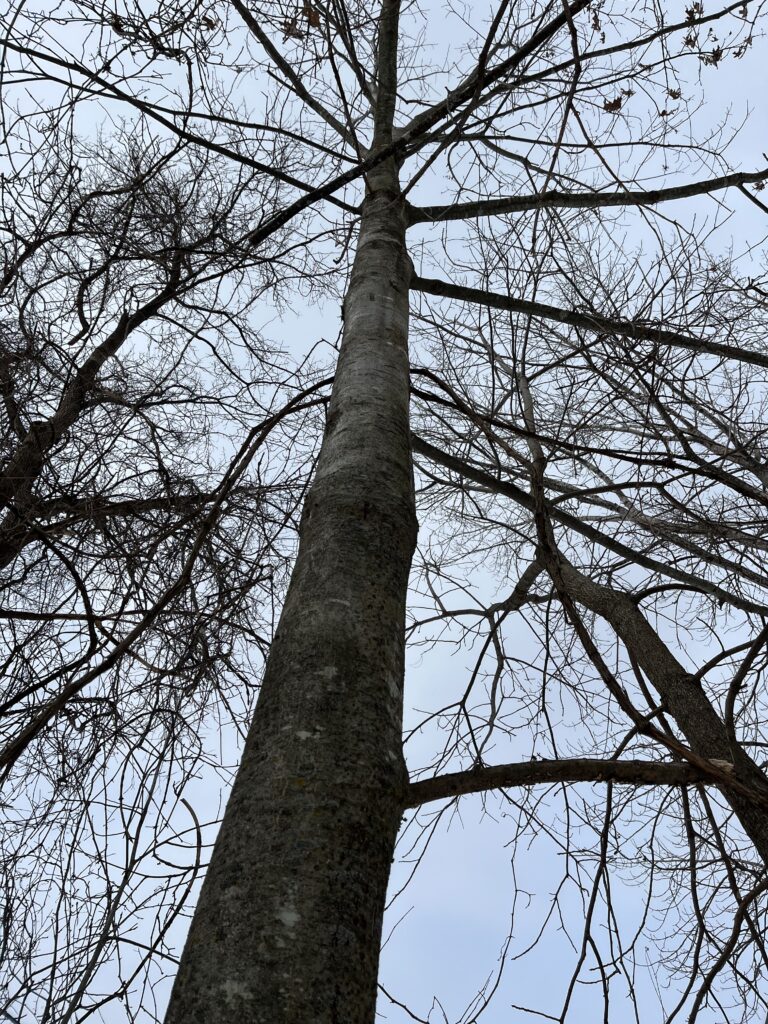
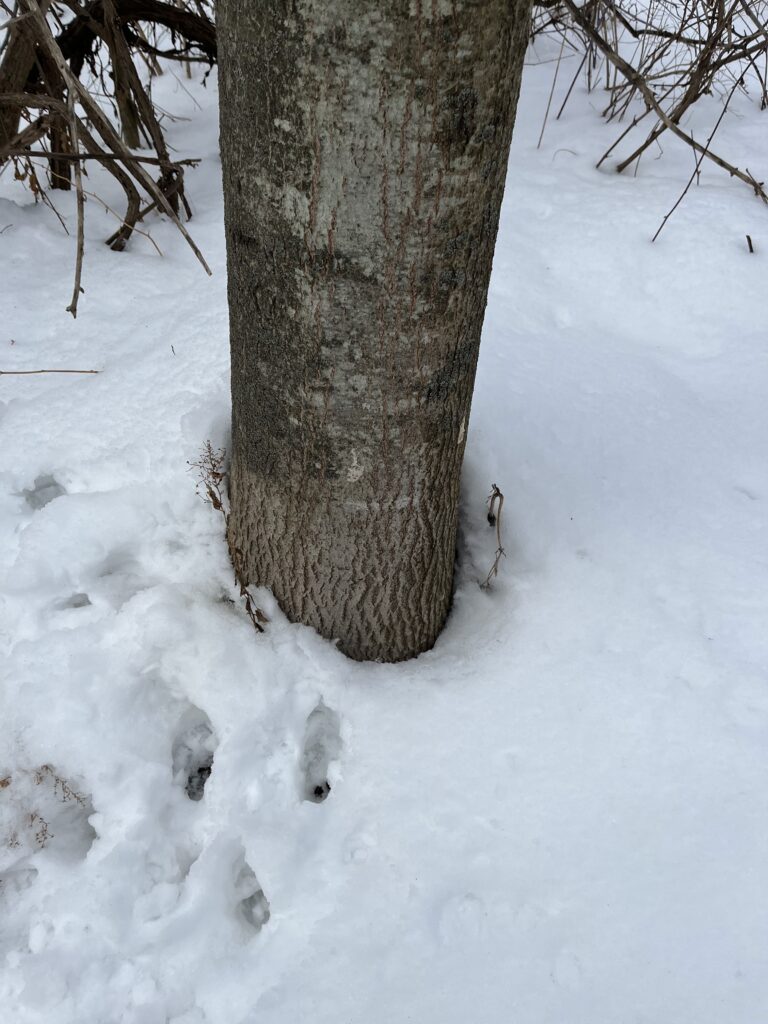
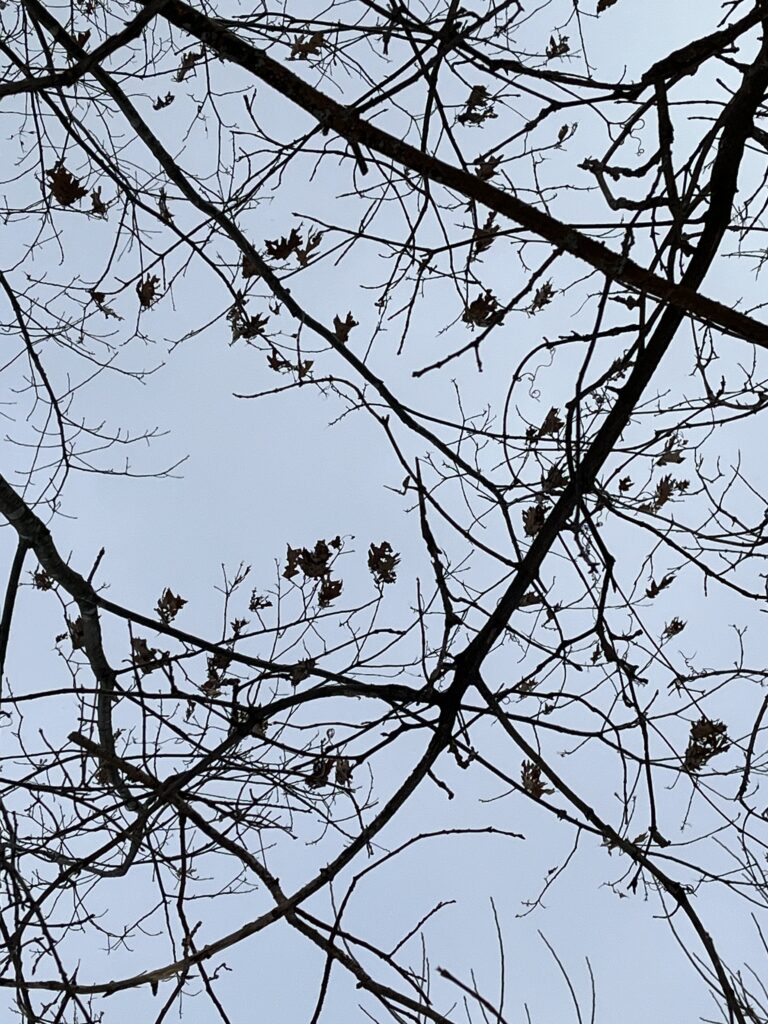
After looking for some twigs and other characteristics, I had to rethink what tree it was. At the bottom of the trunk, it was smooth bark and instead had engravings in it, similar to that of a northern red oak. As I looked up and scaled the tree, there were a few leaves hanging on at the top of its canopy. Through further inspection, I had come to the conclusion that this tree was a northern red oak.

Mostly smooth bark with engravings at the bottom
Northern red oak leaves, no evidence of flowering or fruiting.

I knew that I could decipher it from cotton woods because I had the evidence of red oak leaves at the top branches of the tree. There was no evidence of flowering on the buds of the trees

2/16/2023

The past few days have been unusually warm in Vermont, with temperatures almost hitting the low fifties. With these warm temperatures, a lot of the snow in Burlington has almost melted away, leaving animal tracks hard to come by. One must look in the mud and by water to see if they can find signs of life.

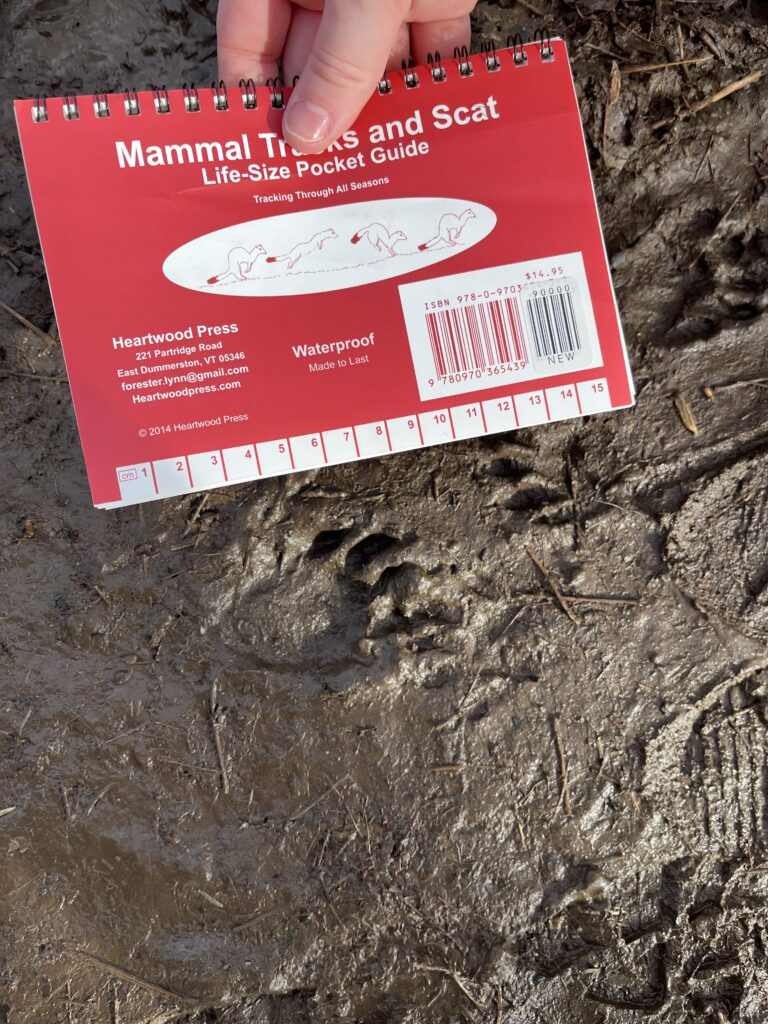
I went to Centennial Woods with a few of my friends to try to find animal tracks in the Burlington area. Immediately, we found smaller paws off the side of the trail right in the beginning. Using a handout sheet and our guide books, we were able to identify the tracks to be a raccoon’s tracks. From looking at the claw imprint, number of toes, and overall size of the print, it became easy to narrow it down to raccoon.

It was an enjoyable experience tracking animals because it made me become more aware and observant of my surroundings when I was in Centennial Woods. I uploaded the photo above to iNaturalist, and through the website, other people can comment and confirm if it is a raccoon or not. I think that it is a helpful and educational tool in identifying tracks and other living organisms.

1/30/2023

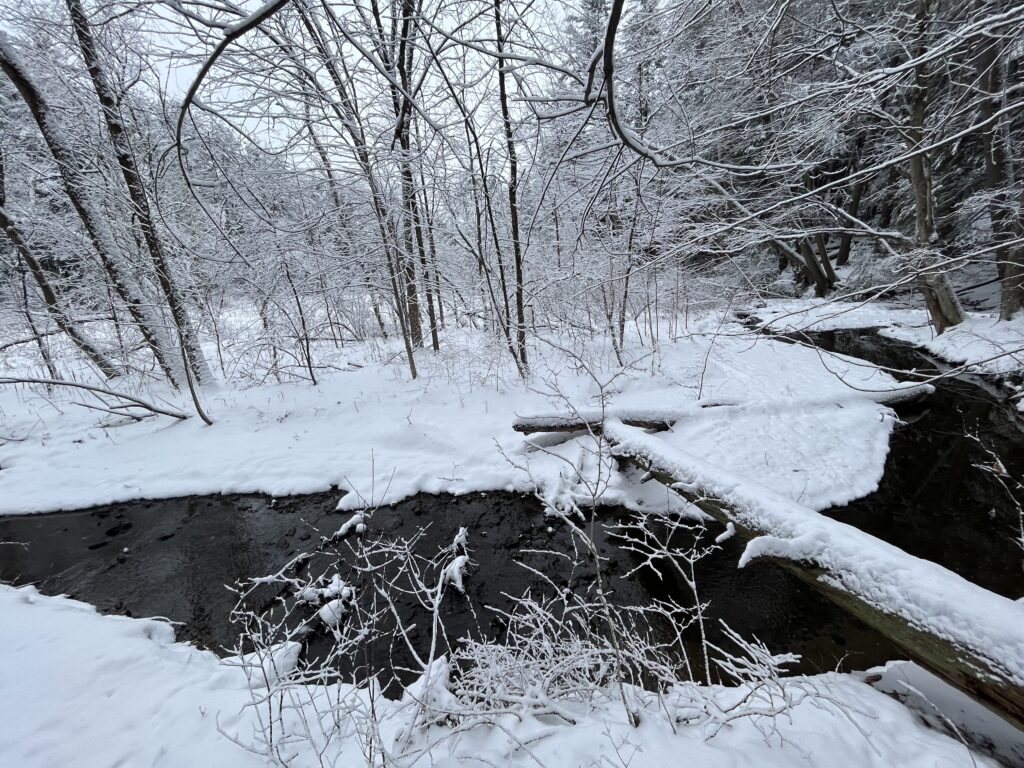
A wide view of what my spot in Centennial Woods looks like now after a snowy night.

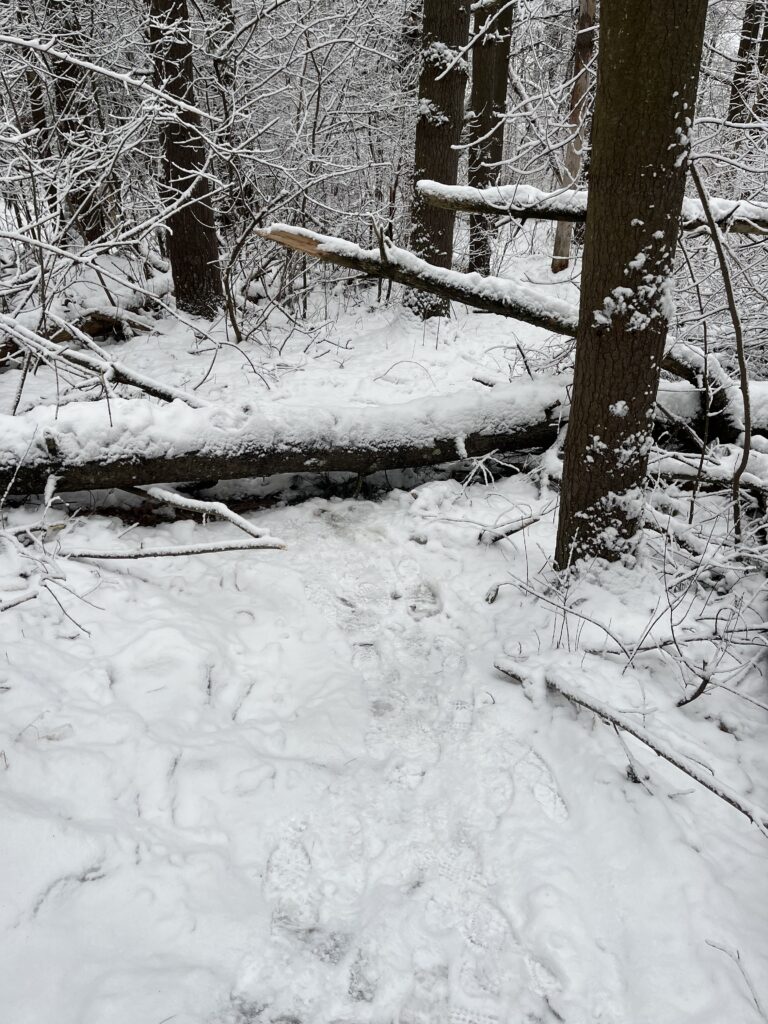
As winter break closes, and the start of the spring semester begins, snow welcomes everyone back. The walk to Centennial Woods was very quiet, with snow still falling all around me. I looked everywhere throughout the woods for animal tracks left behind, but the only prominent one were human foot prints. I was very surprised to see shoe imprints in the snow so early in the morning. I was also surprised to see a couple of fallen trees. There were multiple new trees that had moved while I was gone, and it was much more difficult to get to my spot now with the snowy obstacles in my way. Eventually, I made my way to my spot alongside Centennial Brook. Before I had left for winter break, some of the remaining oak trees still had their leaves hanging on by a thread. However, this time, there were no leaves left on any oak trees, and only the pine needles on coniferous trees were left.

A new fallen log in the middle of the trail, and the tracks of humans surrounding it.

The most prominent sense of change in Centennial Woods was the arrival of snow. It looks like a whole different forest now that it has snowed. Millions of tiny snowflakes are stuck to tree branches, and fallen off twigs. It is extremely quiet as well in the woods, and when you are by the brook, the quiet sound of running water is the only thing you can hear. There is no sound of leaves falling, or leaves rustling in the wind, or squirrels jumping around. It is a different type of serine now that the seasons have changed over.

Another note of change is the brook. Most parts of the brook from my view were frozen over, but by the massive fallen log, part of running water peaked out. If I had one, I would like to set up a camera to see what animals come to the brook at night to drink from it.

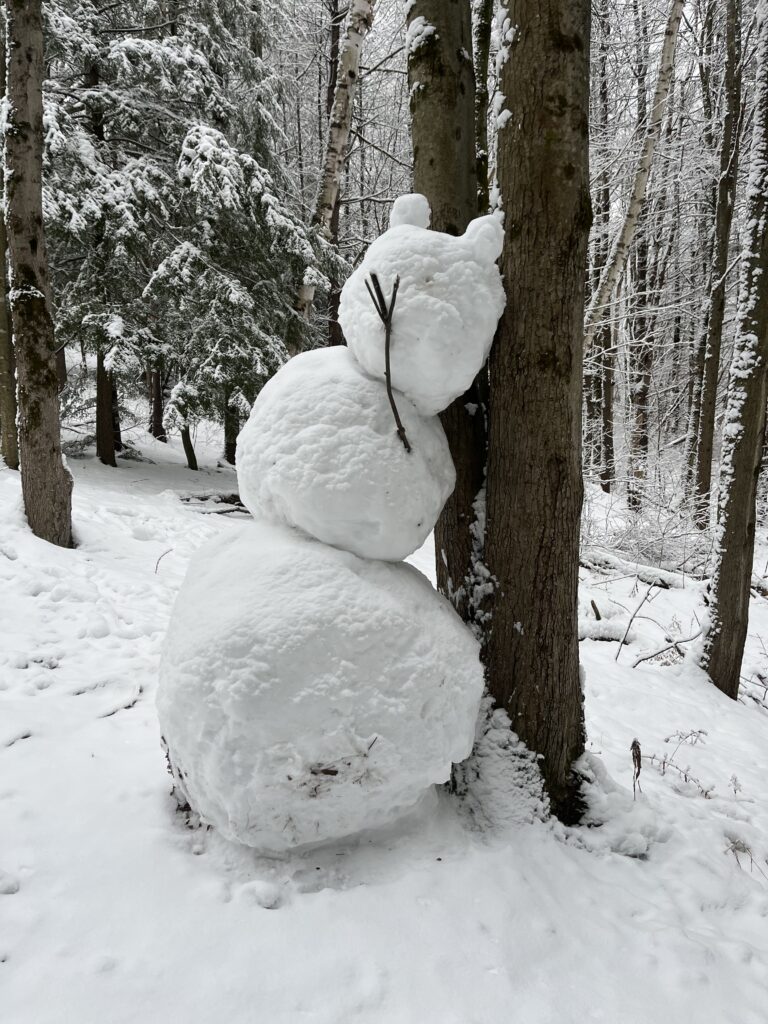
A warm welcome.

12/10/22

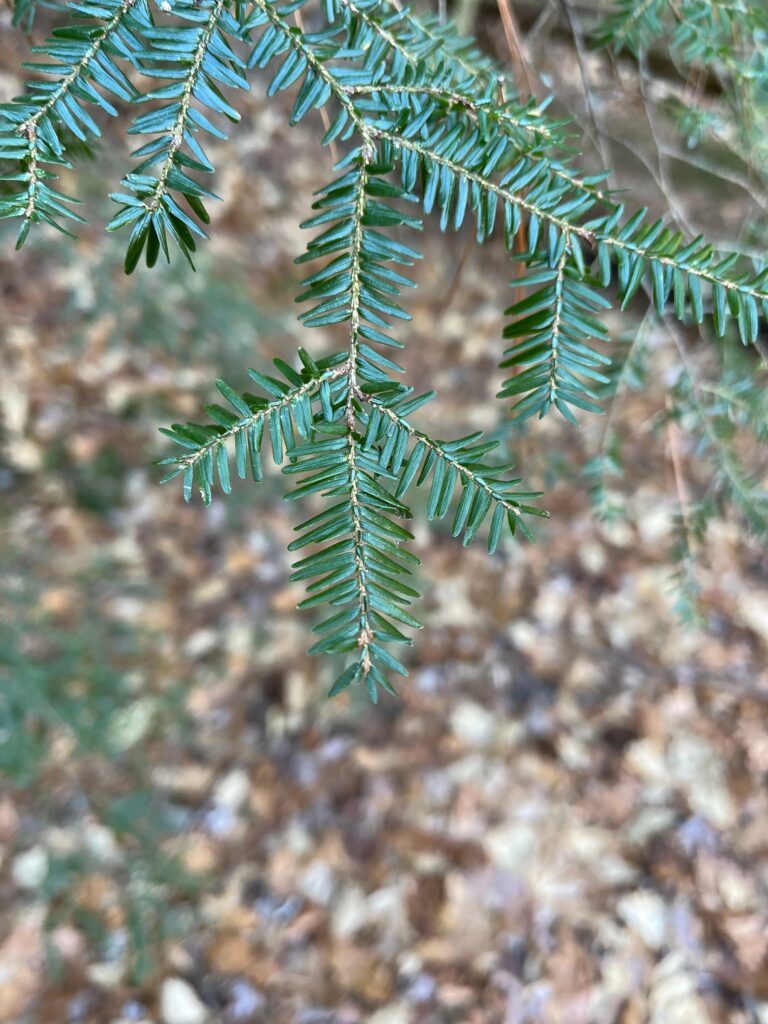
Near the creek are a line of Eastern Hemlocks. The top part of the needle is a dark green color, while the underside of the needle is white.

Saturday, December 10, was fourteen degrees outside. The cold, sharp air and bits of frost on the grass made it feel like it was really winter. Although Centennial Woods did not look as alive as it once did in September and October, it was alive in other ways. One of the more noticeable changes to the forest was the decreasing amount of leaf litter on the ground. There was none running through the stream and some were scattered around the sides. When you looked up, only coniferous trees had there foliage intact, while the other hardwood trees were bare.

Throughout my time that I have come to observe Centennial Woods, I have been unsuccessful in seeing any signs of animal tracks. I do see birds every now and then, and there was even a woodpecker to great me this morning at the entrance.

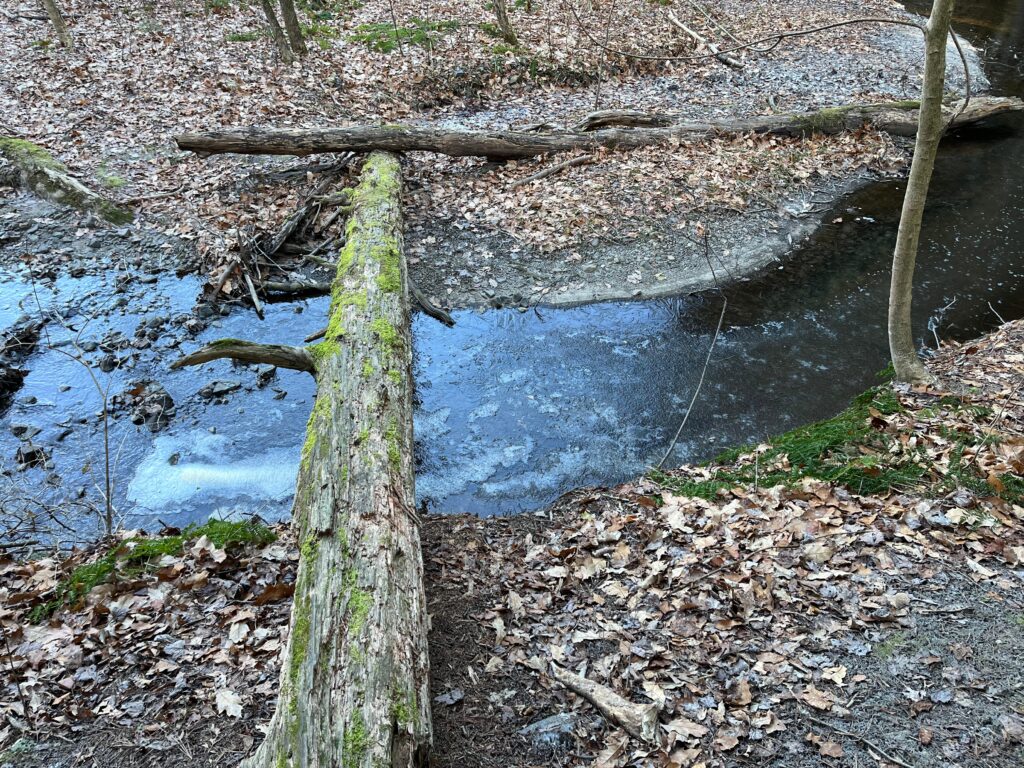
This cold morning brought a lot of change to the forest, especially the brook. The running water trailed down the forest, but a large portion of the creek was frozen at the top. It was not completely froze, one could see the latter part of the creek at the end running. It was interesting to see how much the creek and changed since I had been at the spot in a month. The creek’s speed did not decrease at all, and seemed to be faster if anything.

Above is an image of the frozen creek.

I choose Centennial Woods because of its close proximity to my dorm, but as I travel more often to the woods, I have increasingly enjoyed my experiences at the sanctuary within an urbanized city. Centennial Woods reminds me of the woods in my town, a natural area surrounded by roads and pavement. I think my favorite part of Centennial Woods is the fact that once you enter, it feels like there is no highway or town nearby. The natural community within the woods have adapted and thrived under the conditions that the forest is surrounded by, and continue to be lively. Besides the casual plane flying overhead, Centennial Woods feels like its own special far away place, and i thoroughly like how it makes me feel.

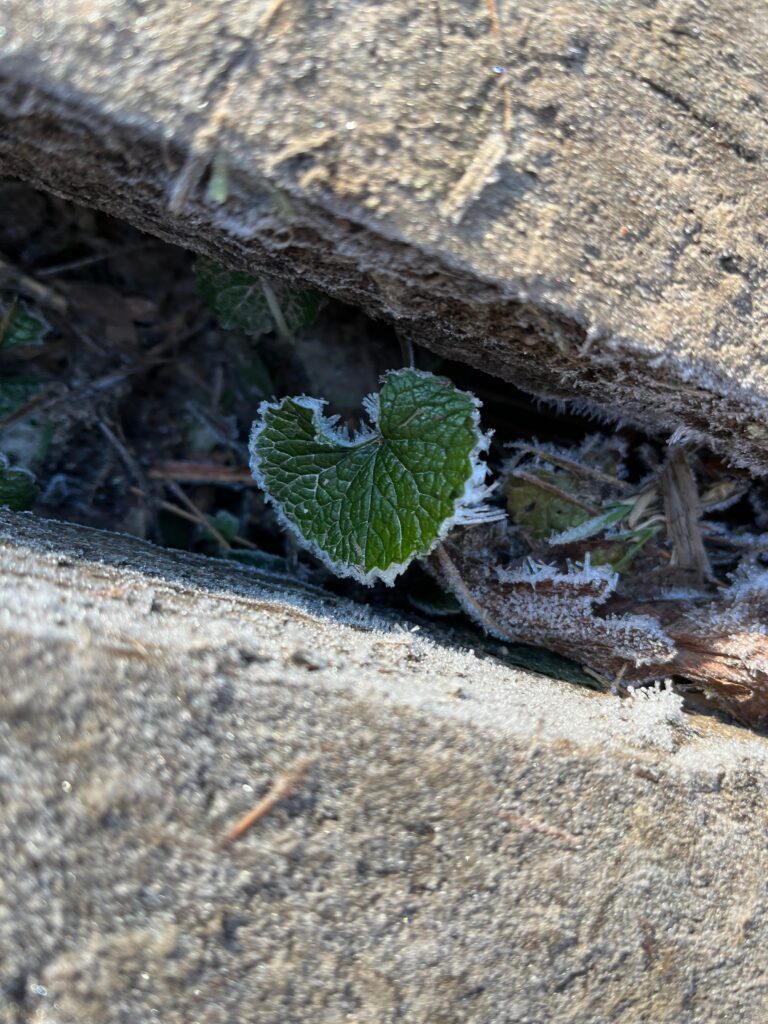
A small frosty plant sprouting between the walkway.

11/23/22

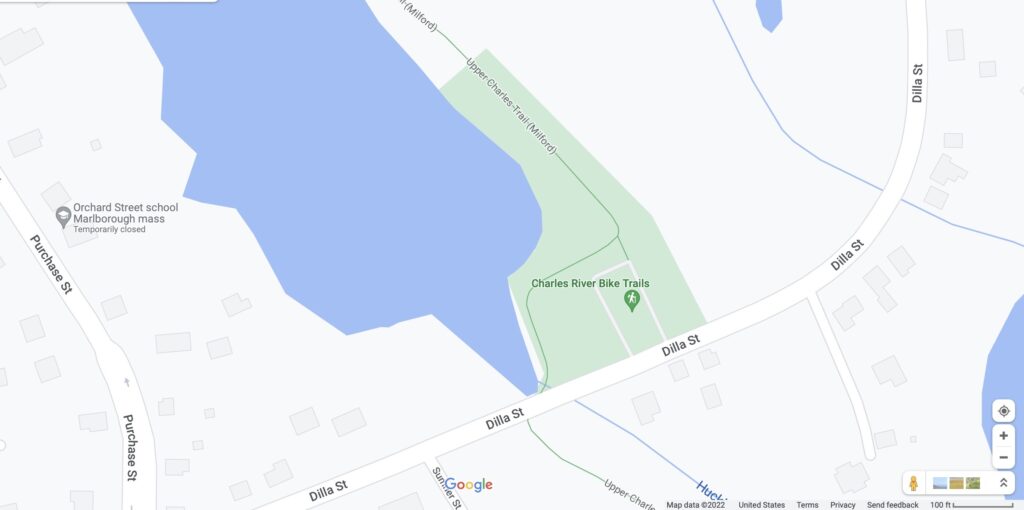
The Milford Bike Trail

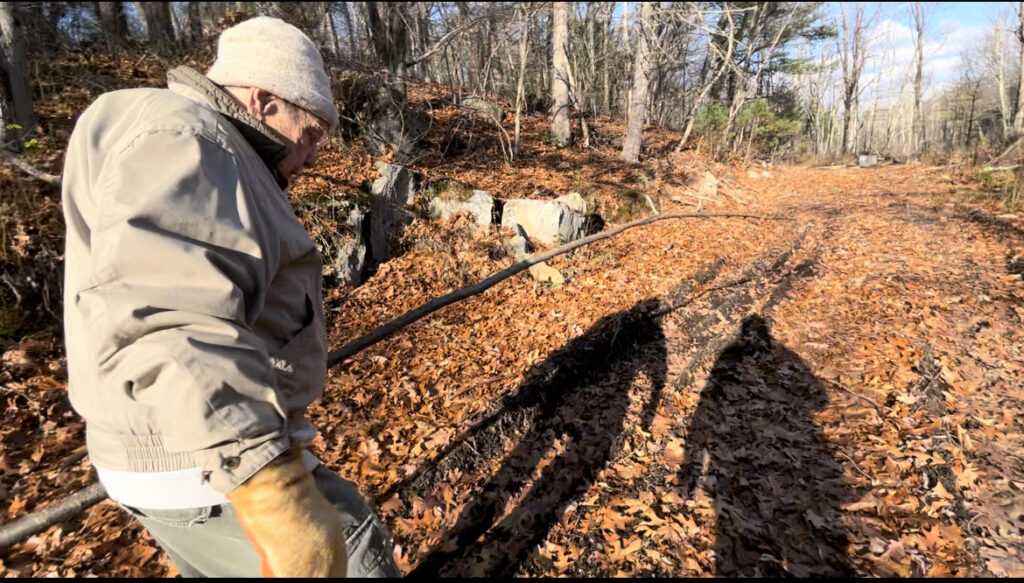
The Milford Bike Trail is a paved walk way through forested ecosystems in the town of Milford in Massachusetts. Next to the trail is Lousia Lake, which connects to the Charles River. Surrounding the trail is a busy road and multiple neighborhoods. Similar to Centennial Woods, they are located within urbanized areas. Both forested areas have similar tree species, including paper birch and white pine. This also alludes to the fact that Centennial Woods and the Milford Bike trail were previously disturbed areas, and these trees are successional trees. My grandfather, who is 80 years old, walked me through both the trail and the history of the Milford Bike Trail. The forest around the trail was used as a dumping place by a construction company, and was also mined for pink granite.

Both Centennial Woods and the Milford Bike trail provide educational and recreational value to the communities that are surrounded by. They have important natural systems and give animals and plant life a habitat to grow in, as well as give the humans around it a space to learn and develop a better understanding of what lives near them. Both forested areas also give people the chance to run, hike, canoe, and do other sports within their spaces.

My grandfather, Noel Bon Tempo, holding a walking stick he found. The wood was previously a small beech tree.
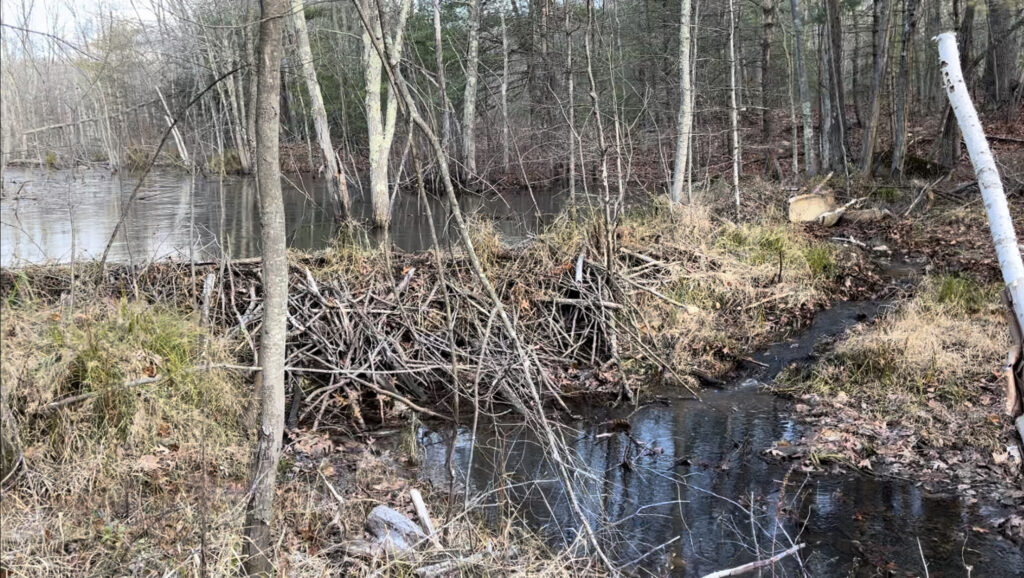
Like Centennial Woods, beavers in habitat the forest around the Milford Bike trail. The picture above shows a dam built by the local beavers.

11/05/22

This Saturday morning was surprisingly warm, and the walk down to Centennial Woods was very pleasant. It has been a couple of weeks since my last visit, which meant that many things have changed! When I first arrive to my spot, the most obvious change was the lack of leaves on the trees. The hemlock trees that overlook the stream had a nice green color, and a couple of sugar maples still had some foliage, but the ground was covered in white oak leaves. The stream seemed to filled with leaves instead of water, and the current seemed to slow down, as if the weather changing has made it tired.

I typically like to listen to music when I hike, but for my time at my spot, I decided to take off my headphones and enjoy the natural sounds around me. I heard the small trickle of the stream water moving around the leaves, and the soft sound of leaves landing on the ground. I have recently watched a couple of horror movies, so I was slightly paranoid something was making crunching noises, but it was birds jumping from branch to branch.

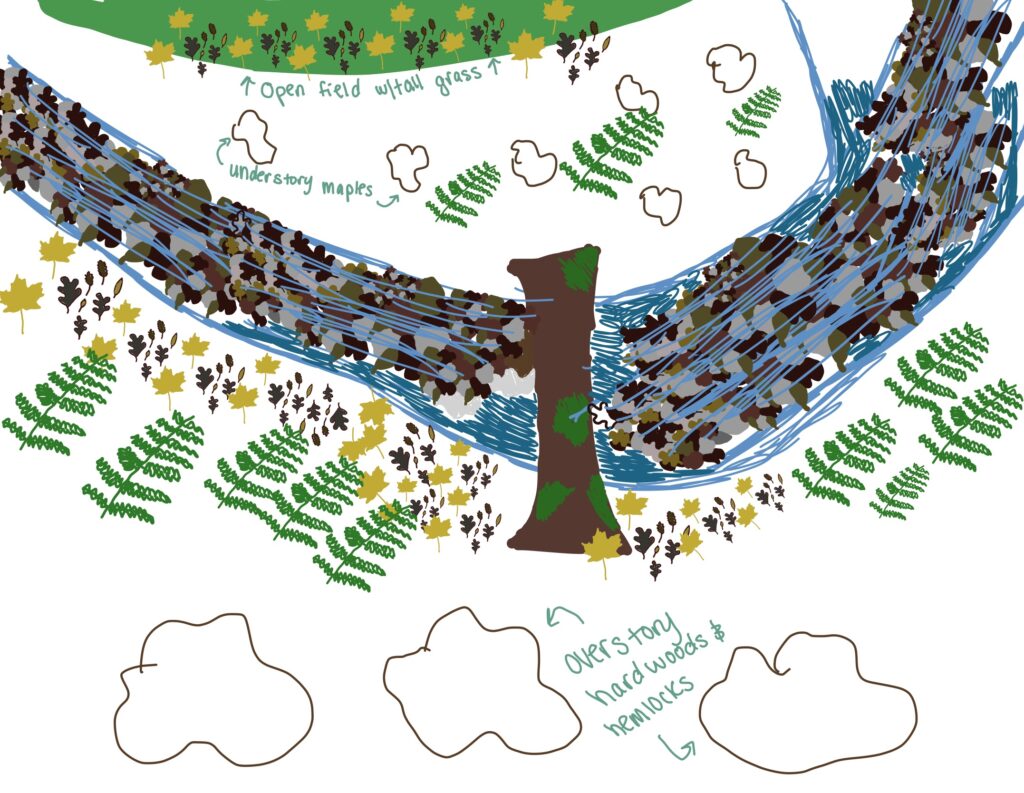
On the right is a hand drawn map of my phenology spot (I apologize for the lack of artistic ability). The main part of the map is the bend of the stream, with its bottom composed of dead leaves and small smooth rooks. Surrounding the stream are ferns and a couple of understory trees. Outside of those trees are bigger hard woods and coniferous trees. Across from the fallen log is an open field of tall grass where the streams goes curves into.

Older Posts »

Skip to toolbar