
2 July 2024
2 – 3pm
Clear Skies, 79F, 35% humidity
I deviated from the rubric for this entry slightly. It asked me to spend at least 15 minutes exploring my site, then find something to ask an in-depth question on, and then find 5 things to take high quality photographs of. Instead, I decided to roll all three parts into one and just spend an hour looking around for interesting things, photograph those I find, and consider each interesting thing in an attempt to come up with a good question. Because of this approach, it makes more sense to attach a few sentences or a paragraph to each photograph rather than a few paragraphs followed by the photographs separately.
I would also like to address my takeaways from this photography exercise now so I can end on a more poetic note. I obviously took away the knowledge of the species that I found from going out today, but that is not explicitly linked to the photography – I would have found them from exploring anyway. Honestly though, there is not much more I think I took away from this exercise; I noticed far more specific details from sketching, as it forced me to look for them in an effort to recreate them. With these photographs, despite making an effort to find interesting and effective lighting, angles, and distances, I don’t feel that those helped me attain a deeper understanding of anything I photographed. The one exception to this may have come from crouching in a swamp for 10 minutes waiting for what I think was a frog – you’ll see later. This time waiting and watching helped me notice that the swamp water is actually rather clear. I assume this is a function of it being still and allowing the sediment to settle, but we always think of swamp water as muddy and dark; this water just looked muddy and dark because the sediment under it was dark mud, the water itself was clear. Despite feeling that I did not learn much from these photographs as opposed to sketching, I still enjoy the end product much more; I think some of these images are very pretty.
Now, without further ado, I present my findings:
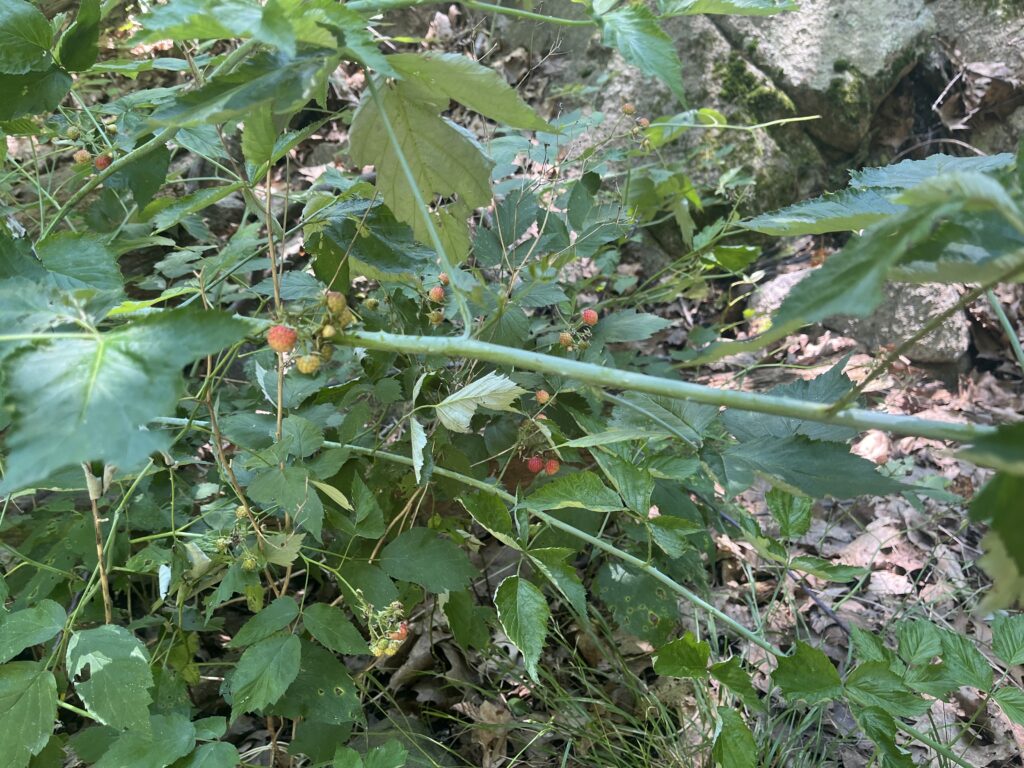
This is a wild Red Raspberry – Rubus idaeus – that I found on the slope above the swamp. While there are some berries, there are very few. Maybe it’s still too early in the season, maybe the site quality is poor for raspberries. Regardless, I chose to take a photo of this plant for two reasons: first, I had not observed a raspberry plant in this park; second, they can be an important food source for many animals, so I wonder how much of a food source they are in this park. As I have only identified the one bush, I find it unlikely that they are a major source of food in the area, but I am not sure if there are more in areas I have not explored.

This is just a large Red Oak – Quercus rubra – I found. It is about 2 feet in diameter at breast height. While I have seen much larger trees, even just a few miles away in the Blue Hills, this is the largest tree I have found in this area. I really appreciate the mottled lighting in the leaves.
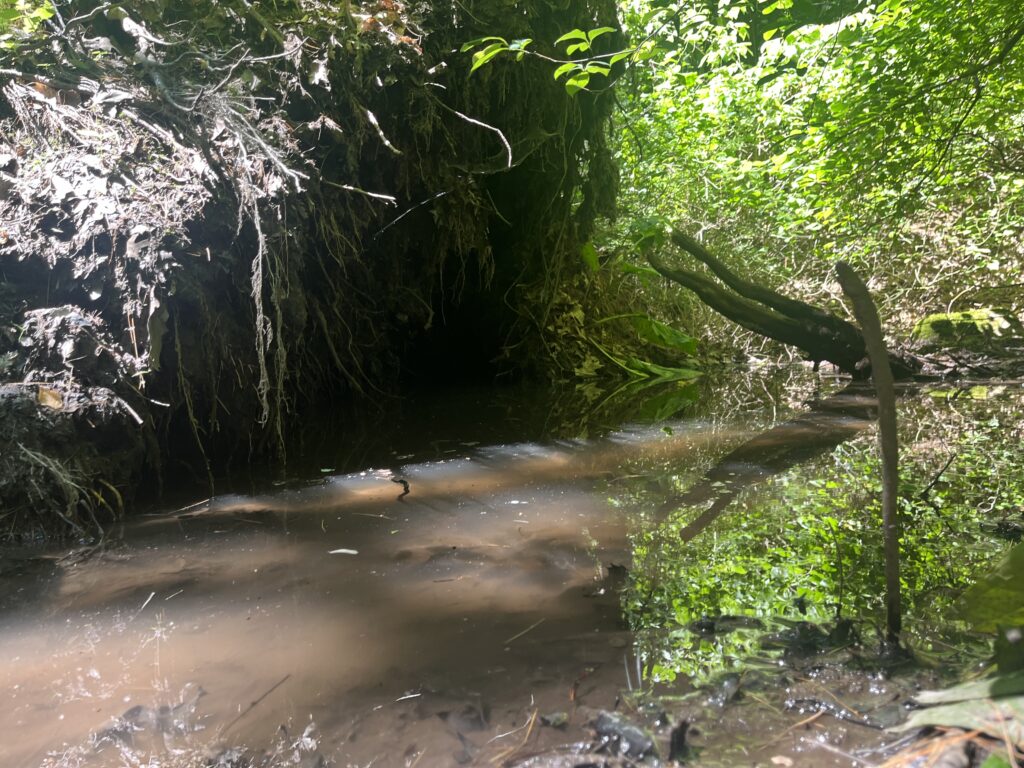
This is a pool in the swamp, formed by the tip-up mound of a tree – one I just realized I didn’t identify. I had noticed movement and a few splashes in this pool, so I decided to investigate. Unfortunately, even after waiting about 10 minutes crouching in the mud, I did not notice any more movement. My best guess is that it was a frog or turtle that proceeded to hide in the shadow of the tip-up mound. I say this as I say no movement fleeing the area so I do not think it was a bird or small mammal, leaving a frog or turtle as the most likely options. Despite not finding what I was looking for, I think the photograph came out beautifully.
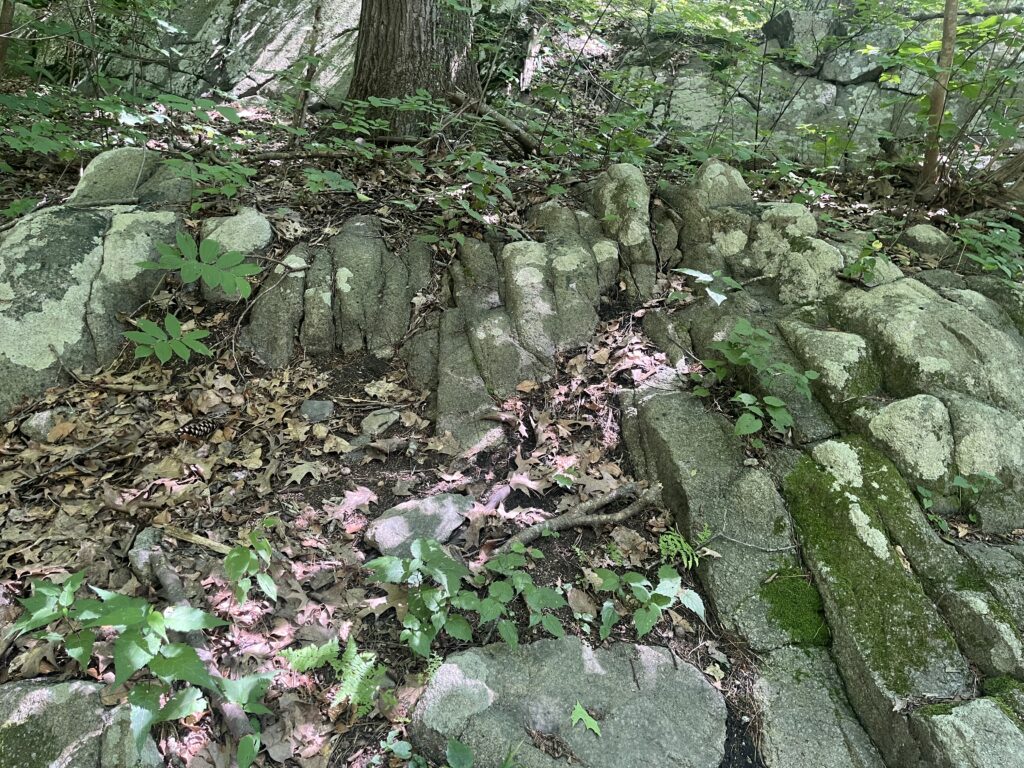
Stepping away from ecology for just a moment, I noticed the layered pattern to this rock. I assume this is glacial till deposited at the end of the last Ice Age – which would explain how layered rock this large could find itself on its side. What I find curious though, is that this does not appear to be sedimentary rock – it appears to be granite. Why would granite be layered like this? Also of note is that the layers are not parallel. Could they be gouges left by the glacier? If so, why are they so sheer in places? Could the rock have been fractured while being carried by the glacier? If so, why didn’t it break apart under the glacier or fall apart during deposition? After doing a little research, they could be gouges left by the glacier, but they do not look like the examples I have seen.

Finally, this is the most exciting find to me: a young American Chestnut! Castanea dentata is a threatened species throughout the United States that used to be an ecologically very important species. Nearly all mature trees were killed in the early 20th century by a disease known as Chestnut Blight. While this individual will most likely not reach reproductive age, I am glad to have found it, and I am curious how it got here. The nearest chestnut I have seen is several miles away and I have never seen a reproductively mature individual. Surprisingly, given the attention the American Chestnut has seen over the last several decades in an attempt to restore it, finding information on the reproduction of the species was quite difficult. According to the Chesapeake Bay Program, the American Chestnut rarely self-pollinates, so there would have to be at least 2 mature trees relatively close (I could not find anything on pollination range) if this were to be the result of a new seed. As I have not seen a single mature tree anywhere nearby, I find this an unlikely scenario. The only other article I could find that gave specifics on regeneration was a series of scientific abstracts that would not let me access the whole articles. This is the latest in the series. Fortunately, it states in the abstract that the furthest seedling they identified from the parent trees was 370 meters. Thus, if this this came from a chestnut seed, I would expect to find a mature tree within a quarter mile. I obviously did not search an entire quarter mile radius, but I have been through much of this area on many occasions and not noticed a mature chestnut.
That left me in a bit of a stump – which, given what comes next, is not a bad pun: I called the American Chestnut Foundation. I know they have planted chestnuts before and I know they keep track of large individuals, so I asked them if they had any insight into how this tree may have gotten here. They explained that they have not done any plantings there in recent years and that seeds almost always sprout the year after the fall. That ruled out intention planting (by them anyway), as well as it being a very old seed that happened to sprout. They also did not have record of any mature individuals near my site. This does not mean there aren’t any, it just means it is very unlikely. They also explained that a seed would be very unlikely to survive ingestion, so dispersal from far away was ruled out. Not to worry however; they explained that many naturally regenerating American Chestnuts are stump sprouts, even if the stump is so old it is unrecognizable or buried. This seems the most likely option to me – sometime between 80 – 120 years ago (probably closer to 120 given that the blight was introduced in New York) a large chestnut was killed, almost certainly by the blight. About a century later it is still trying to sprout. If that is not a story about the struggle to survive, I don’t know what is.
May you be as persistent as this chestnut,
Ben Malisheski