
21 June 2024
4:15pm
Entry #1
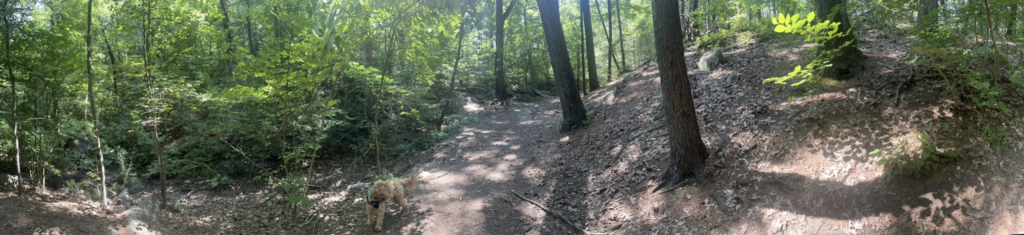
This is the most diverse section of the trail network of Cunningham park, so I figured it would be the best place to analyze. This image is a 270 degree panorama. I would have preferred a full 360 but I was limited by my technology. You can see in the image my research assistant (service dog) Frodo, who will be joining me on my deeper exploration of this place I have walked though so many hundreds of times. To begin a brief description, this is a network of trails that pass by a small swamp, a small ridge, a larger slope, and several flatter but dry forest sections. It smells of your typical northeastern forest, but the illusion of nature is broken by the noise. There are commercial flights that pass directly over the area every few minutes that drown out the sounds of nature. That said, as you get used to them, you can learn to listen during the time between planes. It was a lovely day to be out too: 74 degrees Fahrenheit, sunny, and 85% humidity, though about 3-5 before we are expecting a storm.
In terms of the species around here, we are sadly far more limited than I would like to see. For mammals we have little more than rodent species: certainly plenty of squirrels and mice but little else. Even other small mammals like skunks, rabbits, groundhogs, or raccoons are fairly rare in this park, and I would attribute that to the abundance of dogs. In the hour I was out there today I saw at least a dozen dogs walk past. Deer are also fairly rare in this area – potentially due to the dogs but I am less convinced and I imagine there are other significant factors. In terms of birds, there is a good diversity but I am not well educated on birds. I do know a pair of great horned owls nest in the park, I have seen a peregrine falcon perched just at the edge on a few occasions, and I saw a red-tailed hawk on the edge once, but I encountered none of those today. There are plenty of songbirds out there but I am not able to identify them. For reptiles, the only one I have ever seen is a garter snake. I have never seen an amphibian in this park – though I imagine there could well be some in the wetter parts. That leaves – for reasonably observable creatures anyway, invertebrates, fungi, and plants. I have seen quite a few invertebrate species over the years here, but I would not be able to identify most of them. That said, I have seen several beetles, bee species, spiders, ants, flies, and of course mosquitos. I have not examined aquatic invertebrates. I am also not an expert on fungi but I saw at least two species of mushrooms growing out of standing trees today. Finally, we have plants. I am studying Forestry and Environmental Science, so I have more of a background identifying plants. There are numerous understory species though I find these less interesting, so I will not list them. For tree species, I have seen Red Pine, Eastern White Pine, Eastern Hemlock, White Oak, Black Oak, Northern Red Oak, American Beech, a cherry species that I am forgetting, Pignut Hickory, Red Maple, Sugar Maple, and Paper Birch.
The assignment this week was to come up with a “Question Marathon”. I have chosen to classify my questions into 3 basic groups, though there is some overlap: Geology, Ecology, and Culture.
Geology
1. The parent material of the soil is likely glacial till, but I am not sure, so what is it?
2. What is the general mineral composition of the parent material and soil?
3. Where did the parent material come from?
4. If the parent material is not glacial till, why so many exposed boulders?
5. What is the bedrock?
6. Does the bedrock have any impact on the parent material here?
7. If the parent material is glacial till, how deep is that layer?
8. How deep is the entire soil layer?
9. How deep is each soil horizon? Is this typical of what we would expect given site conditions?
10. What effect has the history of clear cutting and agriculture had on the soil here?
11. What effect does the significant human & canine foot traffic have on the soil here?
12. How does the soil differ in the various natural communities throughout the park?
13. How do the soil characteristics impact species richness, diversity, and health in each of the natural communities?
Culture
14. Does/did this land have significance to indigenous people?
15. Are there remaining descendants of that indigenous population?
16. If there are, what are their feelings on this land being privately owned but open to the public from dawn to dusk?
Ecology
17. What is the species richness, diversity & evenness throughout the park for each kingdom of life?
18. Within the kingdom Animalia, how do those factors breakdown for each of the 6 major groups (Mammals, Reptiles, Amphibians, Fish, Birds & Invertebrates)?
19. How do questions 17&18 change when you look at smaller communities?
20. How many natural communities have been identified in the park? What are they? Are there any rare ones?
21. Have any rare species been identified in the park?
22. Are there any active conservation efforts in the park?
23. Does the park have a conservation easement?
24. How long has it been since the last full-stand-replacement disturbance?
25. Was that a clear cut like I assume?
26. If it was a clear cut, was it for agriculture like I assume?
27. What succession stage is the forest currently in?
28. What is the description of the stand age?
29. Are there any plans for future active Forest Management?
30. Specifically: any plans to deal with pathogens, invasive species & climate change?
31. What is the overall site index for each tree species?
32. How does that change by species and natural community?
33. I often hear about deer browse being a major issue in this area, but regeneration looks fine at a glance; is it an issue right here?
34. Are we regenerating the species we want?
35. Is there sufficient disturbance to maintain structural diversity?
36. Is the human & dog activity enough to significantly impact animal species?
37. There is a popular spot for high school students to party in the middle of the park – and they litter quite a lot; how does this impact the species in the park? How does this impact the soil right there?
38. What is the current stocking level of the trees?
39. How significant of an impact does domestic cats have on wildlife here?
40. How would beavers change everything if allowed to flourish here?
41. Does the noise pollution of near constant planes affect wildlife? How? What about the air pollution of them?
42. Has pollution had a significant impact on species in the park?
43. How have earthworms impacted soil ecology here?
I cannot answer all of these questions, but one that sticks out as possibly reasonable to answer while getting some of the most important information would be the question pertaining to Earthworms. UMass Amherst put out an article on the history, benefits, and concerns about Earthworms in Massachusetts, and it would be reasonable to assume most of this information would apply to this park. The main takeaways are that they increase the decomposition rate of organic material, but increase soil erosion and make it easier for invasive plant species to flourish.
Finally, something that caught my eye today was that this was the first time I noticed a hickory species in this park, so I would like to see if I could find even more tree species that I have not yet seen in the park.
Thank you for reading,
Ben Malisheski