Posts

Wonder Blog: Field Guide for Woody Plants at Cunningham Park, Milton, MA

For the last entry in this blog, I have created a field guide to Woody Plants – both overstory and understory – at my site. Unfortunately, doing this in July means the buds are not well developed, so I was unable to get good pictures of them. As such, I will not be discussing buds, despite them being a good way to identify plants. In the making of this, I discovered several tree species I had not yet identified at this site, and truth be told, did not know how to identify. For most of the species in this guide, I was able to identify them just based on my own background knowledge, but for those that I could not, I used Seek by iNaturalist followed by quick google searches to confirm ID. Sites used to ID a plant will be mentioned in the entry for that plant, and all references can be found at the end of this blog entry. The plants are organized first by whether they are native or non-native, and then alphabetically by genus and species.

Native Species

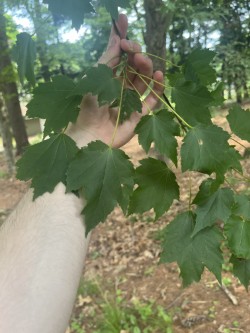
Acer rubrum
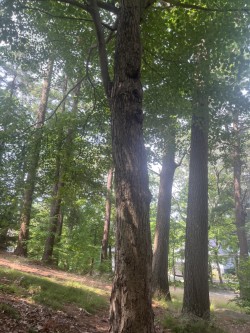
Red maple is a deciduous overstory tree with opposite branching. Its leaves are smaller than most other maples, have 3 lobes, v-shaped sinuses, and serration on their edges. Red maple bark often has “target cankers” – areas of bark where it has grown in a circular pattern. It is usually a light grey.

Betula lenta
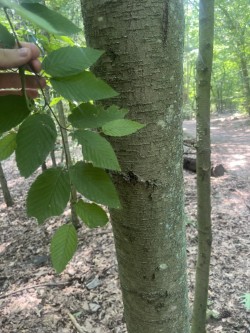
Sweet birch, or black birch, is a deciduous overstory tree with alternate branching. It has soft, serrated leaves. Sweet birch bark is grey and often not as peeled or broken as other birch species.

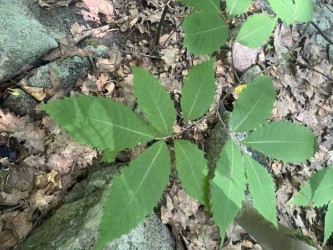
Carya glabra
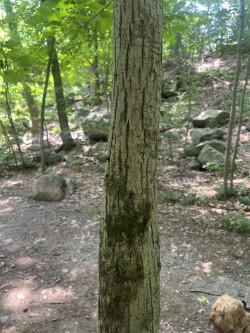
Pignut hickory is a deciduous overstory tree with alternate branching. It has pinnately compound leaves with 5 leaflets (rarely 7) in an opposite pattern. It has grey bark that breaks into a lattice. It is easily confused with mockernut hickory – Carya tomentosa – but that tree has 7-9 leaflets per leaf.

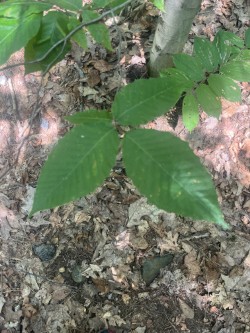
Castanea dentata
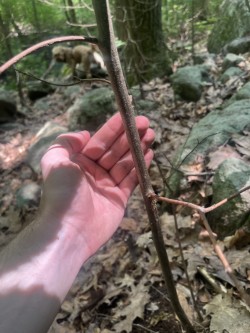
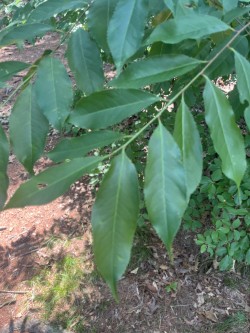
American chestnut was once a widespread deciduous overstory tree, though individuals rarely reach that height anymore due to chestnut blight. This is the largest individual I have ever seen, at about 4 and half feet tall. It has alternate branching. When mature, the bark has deep furrows, though the stem of this chestnut would not be very helpful for ID. American chestnut leaves are fairly long – the largest here is about 7 inches – and obviously serrated.

Fagus grandifolia
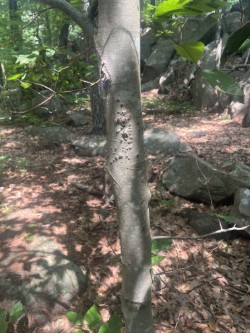
American beech is a deciduous overstory tree with alternate branching. It can be identified by its naturally smooth, light grey bark. Its leaves have very slight serration. Beech trees are threatened by beech bark disease, which causes dark boils on the bark, an unfortunately common way to ID the tree.

Frangula alnus
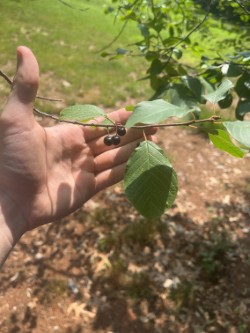
Alder or glossy buckthorn is a deciduous understory shrub with oily looking leaves and round, dark berries. It is often confused with common buckthorn, but that plant does not have the characteristic glossy leaves. I don’t have any other ID tips, I just rely on the leaves and berries.

Gleditsia triacanthos
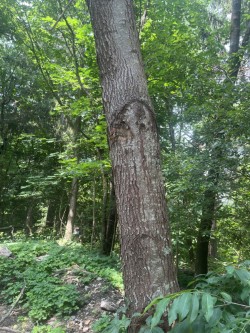
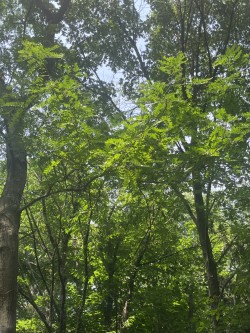
Honey locust is a deciduous overstory tree with alternate branching. It has pinnately compound leaves with many very small leaflets in an alternating pattern. Unfortunately, the lowest branches I could find were still too high up to get a good picture. Anecdotally, honey locust trees often have wild branching, though I have not found any literature to back this up.

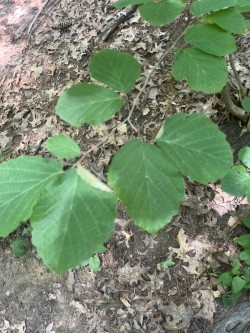
Hamamelis virginiana
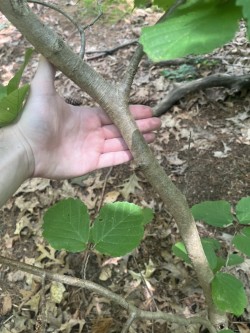
American witch hazel is a deciduous understory shrub identified by its wide, rough leaves. Notably, they are asymmetric where the leaf begins. The bark is smooth and grey.

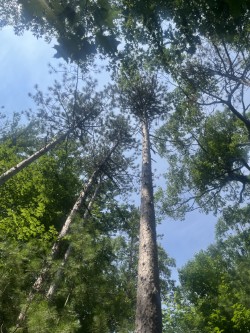
Pinus resinosa
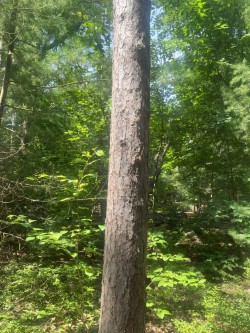
Red pine is an evergreen coniferous overstory tree with symmetrical branching. It has long needles in clusters of 2. It is most easily identified by its red, scaly bark – one of my favorite tree barks. Unfortunately, red pines are dying mysteriously in recent years. There are already a number of dead mature trees in this park, and I have not seen any regeneration, hence why I could not get a good picture of the needles.

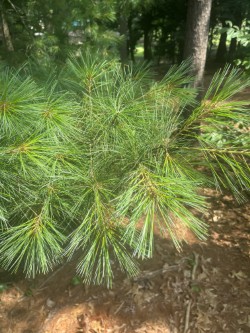
Pinus strobus
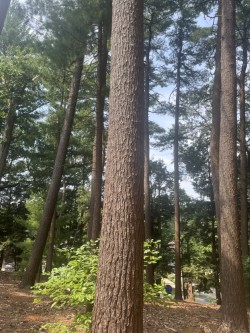
Eastern white pine is an evergreen coniferous overstory tree with symmetric branching. It has smaller needles than the red pine and they grow in bundles of 5 – though finding bundles with fewer is not uncommon as some fall out. Its bark is a deep brown with obvious furrows. The brown can vary from a reddish hue to a dark hue.

Prunus pensilvanica
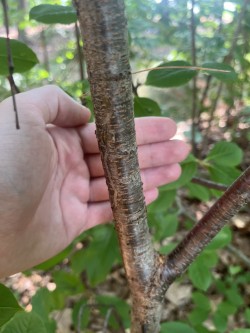
Fire or pin cherry is a deciduous overstory tree with alternate branching, though, according to the US Forest Service, it rarely lives more than 35 years and often will not be competitive in established forests. It can be identified by bright orange lenticels on the bark and long, glossy leaves with fine serration. It is easily confused with black cherry when young, but it has brighter lenticels and longer leaves. Fire cherry fruits are bright red and delicious.

Prunus serotina
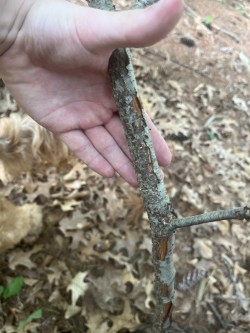
Black cherry is a deciduous overstory tree with alternate branching. Like the fire cherry, it has long, glossy leaves. When mature, black cherry bark is a dark grey – nearly black – and very flaky. It is often called “burnt potato chip bark”. Its fruit is a dark purple when ripe, and also delicious.

Prunus virginiana
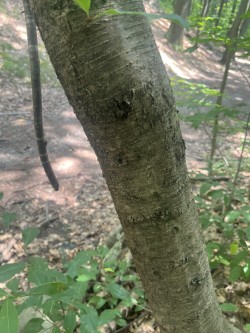
Choke cherry is a deciduous understory shrub with alternate branching. It has shorter, wider leaves than black and fire cherry. It also has lighter bark with less prominent lenticels. Its fruit is also a dark purple when ripe, but is bitter.

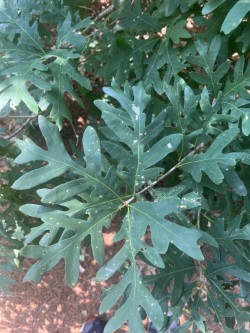
Quercus alba
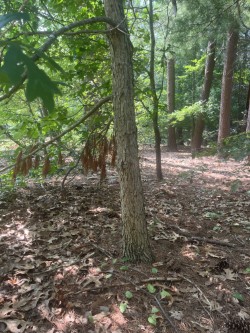
White Oak is a deciduous overstory tree with alternate branching. Its leaves have the traditional oak shape with rounded lobes. They can have deep sinuses like these ones or very shallow sinuses, like those in the red oak below. It has very light bark with thin, deep furrows. When mature, its bark can take on a “cheese grated” appearance – especially at the base.

Quercus rubra
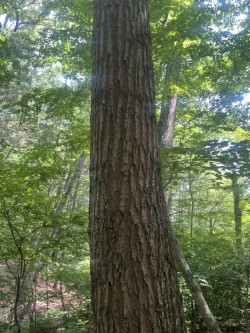
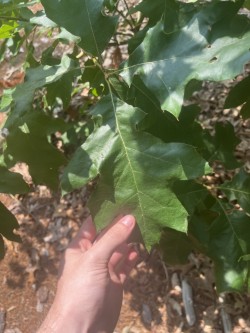
Northern red oak is a deciduous overstory tree with alternate branching. It has the traditional oak leaf shape with pointed lobes. The sinuses can be shallow like these ones, or deep like those of the white oak above. Its bark tends to have wide furrows with a red hue inside them, though this red hue is not always present.

Sassafras albidum
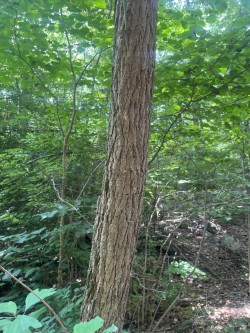
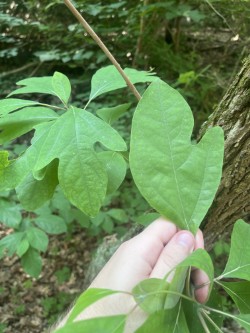
Sassafras is a deciduous plant that usually grows as an understory shrub, but can reach the overstory. It has alternate branching. Its leaves are distinguished by the “glove” shape. Leaves can have a single sinus or two, as shown in the image, but not all leaves will have a sinus. The bark has deep furrows that form a lattice work.

Tsuga canadensis
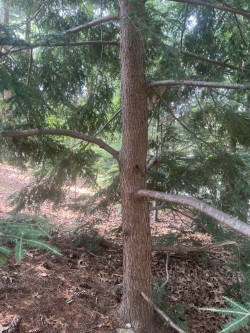
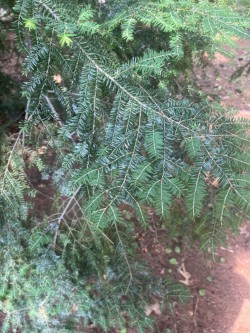
Eastern hemlock is an evergreen coniferous overstory tree with symmetric branching. It has small needles that grow relatively flat and roughly parallel to the ground. Its bark tends to be a bright brown and somewhat scaly.

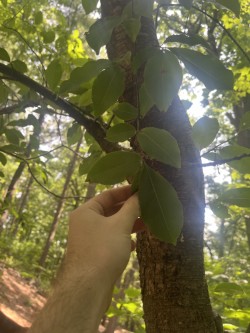
Ulmus americana
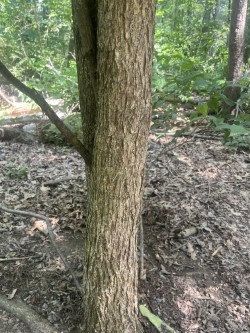
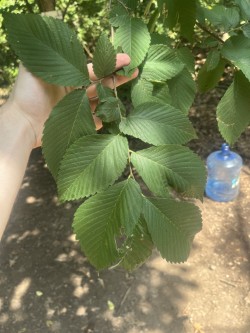
American Elm was a tree I did not know how to identify. According to the US Forest Service, it a deciduous overstory tree with alternate branching. The leaves are double toothed, 2-5 inches long, and 1-3 inches wide. Notably, the leaves are also very rough. The USFS says the bark is dark grey and deeply furrowed, though the bark on this individual is lighter. That may just be due to it still being young.

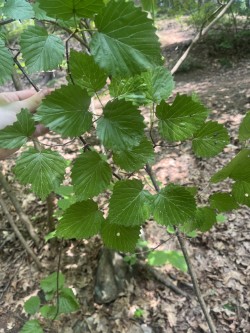
Viburnum dentatum
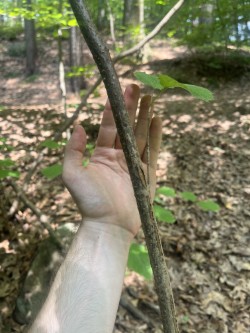
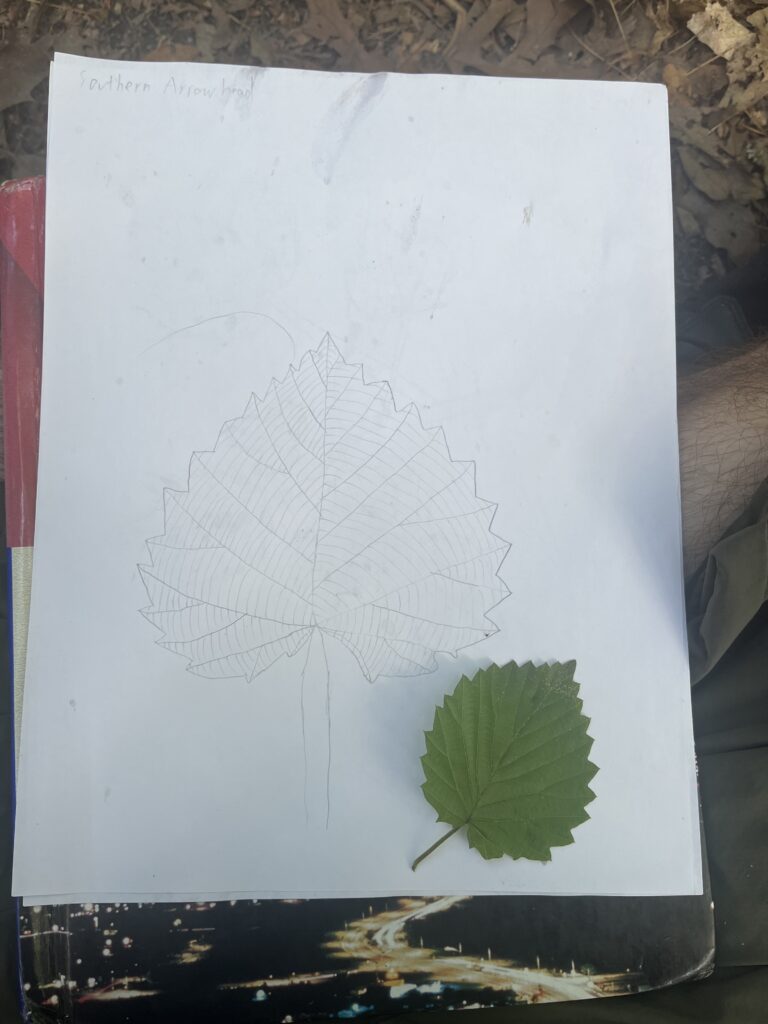
Southern arrowwood is a deciduous understory shrub with opposite branching. It is easily identified by its leaves. They have the shape of an arrowhead and a prominent lattice of veins that look like a web.

Non-Native Species

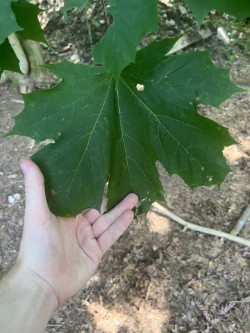
Acer platanoides
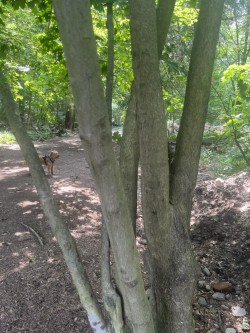
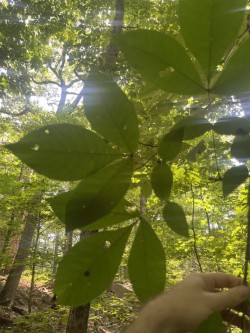
Norway maple is a deciduous overstory tree with opposite branching. It has enormous leaves with 5 – 7 lobes. It has long furrows in its bark. It is easily confused with sugar maple, though it has larger leaves, sugar maple leaves do not have 7 lobes, and mature sugar maple bark forms plates while Norway maple bark does not. According to the US Forest Service, it is native to continental Europe and Western Asia, having been introduced to North America in the mid 1700s.

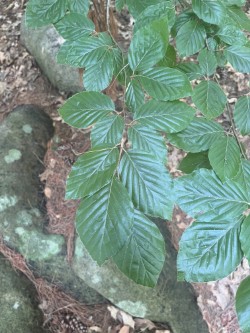
Fagus sylvatica
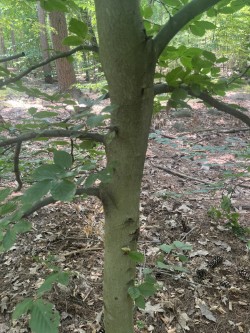
European beech is a deciduous overstory tree with alternate branching. It has very similar bark to the American beech – light grey and smooth. According to the Wisconsin Department of Natural Resources, it is also affected by beech bark disease, resulting in the same dark boils in the bark as on American beeches. The main difference is the leaves, which are rougher, glossier, not as obviously toothed, and rounder than American beech leaves. According to Yale University, it is native across much of continental Europe and Southern England.

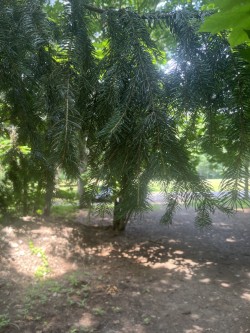
Picea abies
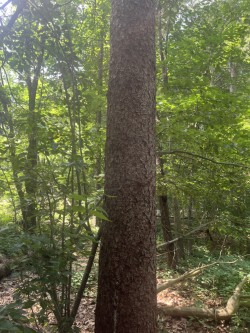
Norway Spruce is an evergreen coniferous overstory tree with symmetric branching. It has thick bunches of needles forming an ovate shape – not quite cylindrical. The canopy is typically pyramidal and reaches almost to the ground. Its bark is brown and scaly. According to the US Forest Service, it is native to Northern Europe, as well as several mountainous regions in Central Europe.

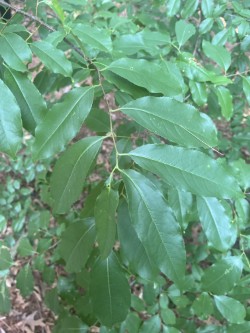
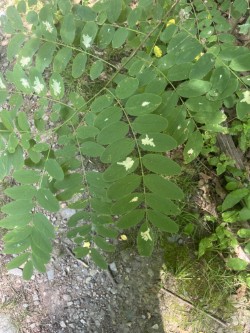
Robinia pseudoacacia
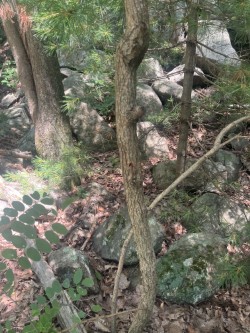
This was another species I did not know how to identify. It is a deciduous overstory tree with alternate branching. It has pinnately compound leaves with larger but fewer leaflets than the honey locust. According to the US Forest Service, the mature bark is “thick, deeply furrowed, scaly, and dark brown.” The only individual I found was still very young. Its native range is debated, and the USFS has a very detailed breakdown of the native range, but the general consensus, according to the USFS, is that there are two regions to which it is native: Central Appalachia and further West in Arkansas and Oklahoma.

Conclusion

This was a lot of fun to put together. I got to practice my identification skills of trees and shrubs I already knew, and found several that I did not know. I wish I could have included pictures of the buds and gone into detail about them, but it is the wrong season for that.

References

14, K. W. on A., & 19, K. W. on A. (2019, February 6). Yale University. European Beech | Yale Nature Walk. https://naturewalk.yale.edu/trees/fagaceae/fagus-sylvatica/european-beech-95

Beech Bark Disease. Beech Bark Disease | | Wisconsin DNR. (n.d.). https://dnr.wisconsin.gov/topic/foresthealth/beechbarkdisease#:~:text=Species%20impacted%20include%20American%20beech,Oriental%20beech%20(Fagus%20orientalis).

Picea abies. (n.d.). https://www.fs.usda.gov/database/feis/plants/tree/picabi/all.html#:~:text=DISTRIBUTION%20AND%20OCCURRENCE,-SPECIES%3A%20Picea%20abies&text=GENERAL%20DISTRIBUTION%20%3A%20Norway%20spruce%20is,in%20northern%20Russia%20%5B50%5D.

Prunus pensylvanica L. (n.d.). https://www.srs.fs.usda.gov/pubs/misc/ag_654/volume_2/prunus/pensylvanica.htm

Robinia pseudoacacia. (n.d.). https://www.fs.usda.gov/database/feis/plants/tree/robpse/all.html

Species: Acer platanoides. (n.d.). https://www.fs.usda.gov/database/feis/plants/tree/acepla/all.html

Ulmus americana. (n.d.). https://www.fs.usda.gov/database/feis/plants/tree/ulmame/all.html#:~:text=In%20the%20South%2C%20American%20elm,in%20river%20bottoms%20and%20terraces.
Wonder Blog #3 – photography

2 July 2024
2 – 3pm
Clear Skies, 79F, 35% humidity

I deviated from the rubric for this entry slightly. It asked me to spend at least 15 minutes exploring my site, then find something to ask an in-depth question on, and then find 5 things to take high quality photographs of. Instead, I decided to roll all three parts into one and just spend an hour looking around for interesting things, photograph those I find, and consider each interesting thing in an attempt to come up with a good question. Because of this approach, it makes more sense to attach a few sentences or a paragraph to each photograph rather than a few paragraphs followed by the photographs separately.

I would also like to address my takeaways from this photography exercise now so I can end on a more poetic note. I obviously took away the knowledge of the species that I found from going out today, but that is not explicitly linked to the photography – I would have found them from exploring anyway. Honestly though, there is not much more I think I took away from this exercise; I noticed far more specific details from sketching, as it forced me to look for them in an effort to recreate them. With these photographs, despite making an effort to find interesting and effective lighting, angles, and distances, I don’t feel that those helped me attain a deeper understanding of anything I photographed. The one exception to this may have come from crouching in a swamp for 10 minutes waiting for what I think was a frog – you’ll see later. This time waiting and watching helped me notice that the swamp water is actually rather clear. I assume this is a function of it being still and allowing the sediment to settle, but we always think of swamp water as muddy and dark; this water just looked muddy and dark because the sediment under it was dark mud, the water itself was clear. Despite feeling that I did not learn much from these photographs as opposed to sketching, I still enjoy the end product much more; I think some of these images are very pretty.

Now, without further ado, I present my findings:

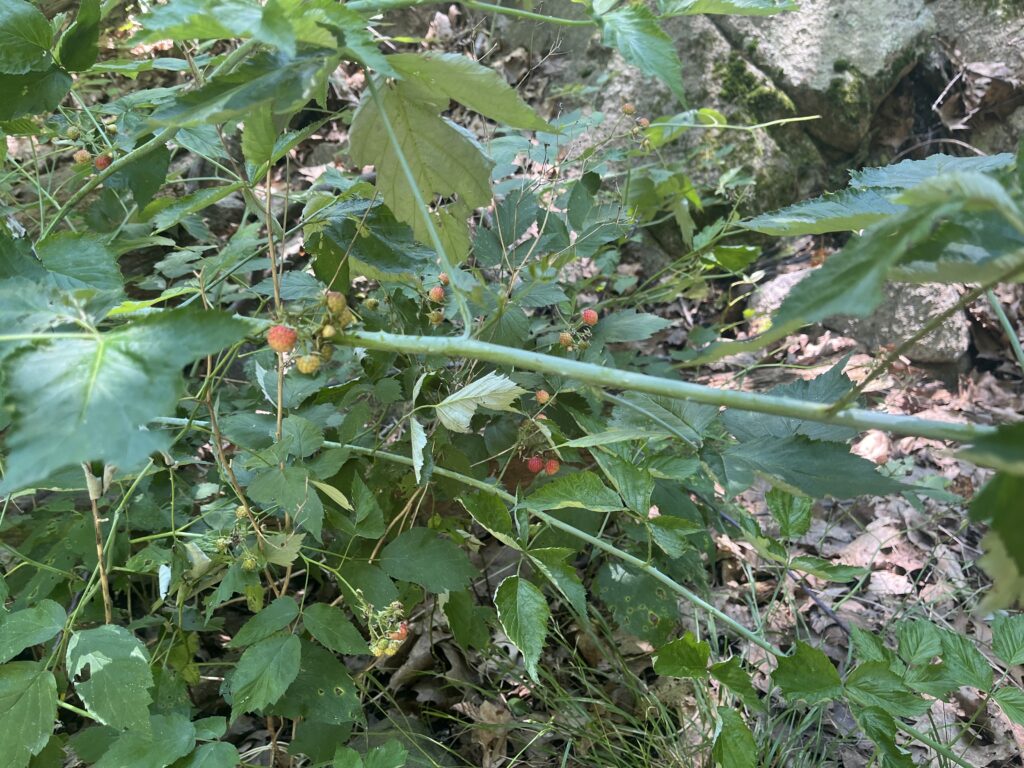
This is a wild Red Raspberry – Rubus idaeus – that I found on the slope above the swamp. While there are some berries, there are very few. Maybe it’s still too early in the season, maybe the site quality is poor for raspberries. Regardless, I chose to take a photo of this plant for two reasons: first, I had not observed a raspberry plant in this park; second, they can be an important food source for many animals, so I wonder how much of a food source they are in this park. As I have only identified the one bush, I find it unlikely that they are a major source of food in the area, but I am not sure if there are more in areas I have not explored.

This is just a large Red Oak – Quercus rubra – I found. It is about 2 feet in diameter at breast height. While I have seen much larger trees, even just a few miles away in the Blue Hills, this is the largest tree I have found in this area. I really appreciate the mottled lighting in the leaves.

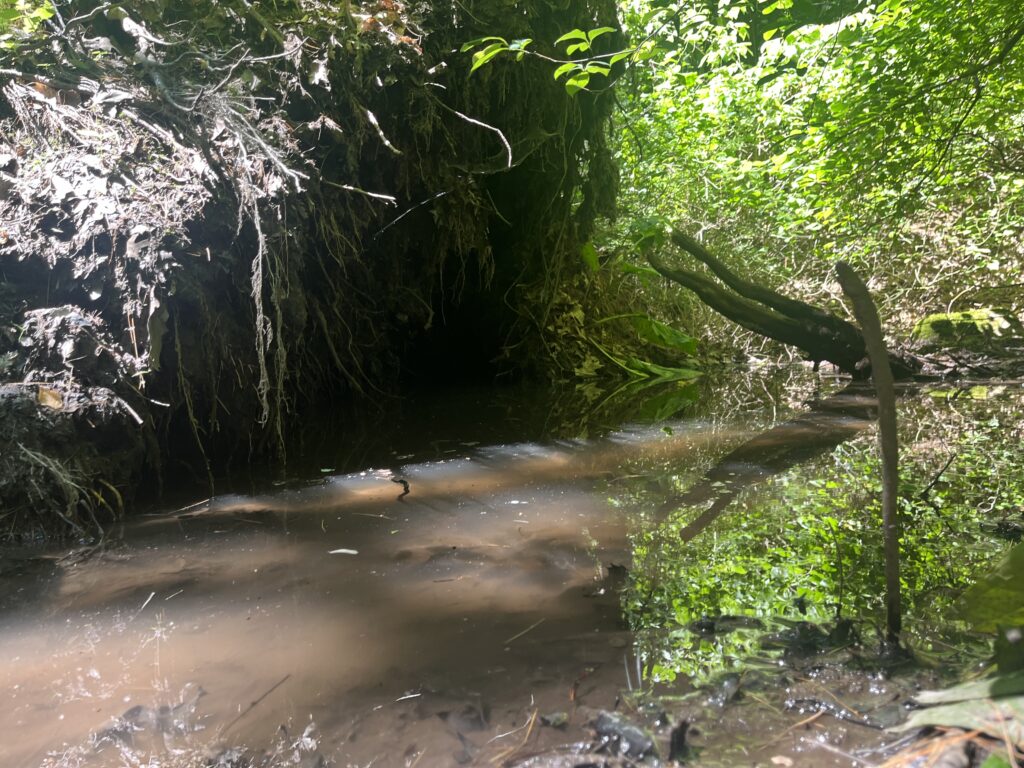
This is a pool in the swamp, formed by the tip-up mound of a tree – one I just realized I didn’t identify. I had noticed movement and a few splashes in this pool, so I decided to investigate. Unfortunately, even after waiting about 10 minutes crouching in the mud, I did not notice any more movement. My best guess is that it was a frog or turtle that proceeded to hide in the shadow of the tip-up mound. I say this as I say no movement fleeing the area so I do not think it was a bird or small mammal, leaving a frog or turtle as the most likely options. Despite not finding what I was looking for, I think the photograph came out beautifully.

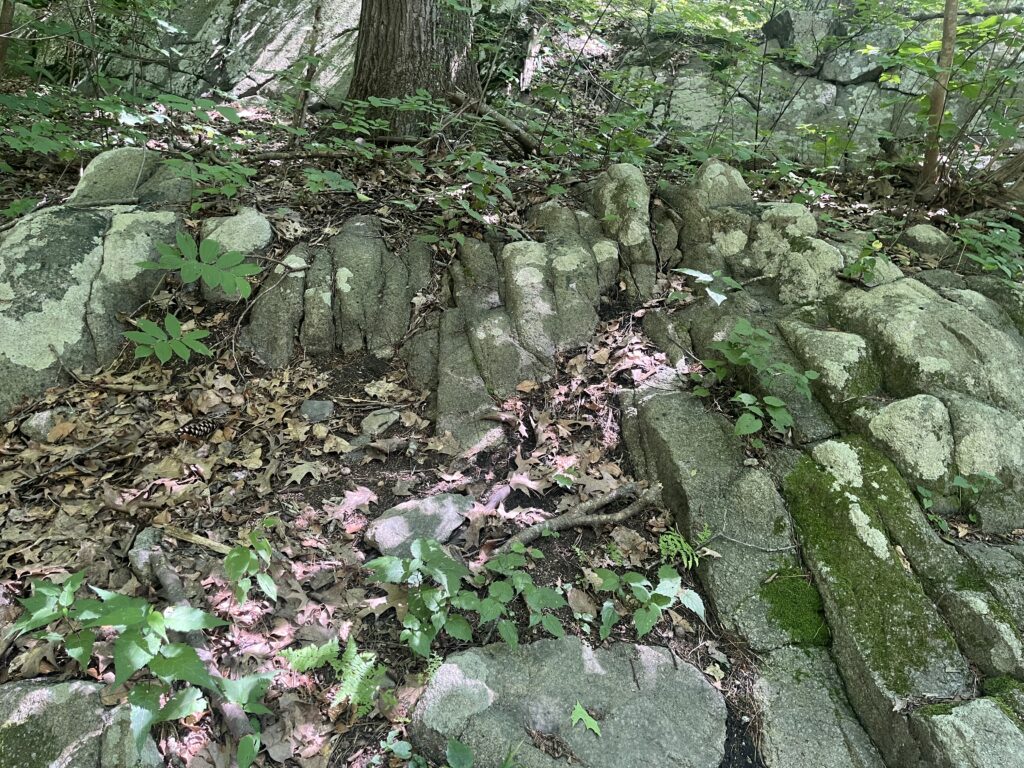
Stepping away from ecology for just a moment, I noticed the layered pattern to this rock. I assume this is glacial till deposited at the end of the last Ice Age – which would explain how layered rock this large could find itself on its side. What I find curious though, is that this does not appear to be sedimentary rock – it appears to be granite. Why would granite be layered like this? Also of note is that the layers are not parallel. Could they be gouges left by the glacier? If so, why are they so sheer in places? Could the rock have been fractured while being carried by the glacier? If so, why didn’t it break apart under the glacier or fall apart during deposition? After doing a little research, they could be gouges left by the glacier, but they do not look like the examples I have seen.

Finally, this is the most exciting find to me: a young American Chestnut! Castanea dentata is a threatened species throughout the United States that used to be an ecologically very important species. Nearly all mature trees were killed in the early 20th century by a disease known as Chestnut Blight. While this individual will most likely not reach reproductive age, I am glad to have found it, and I am curious how it got here. The nearest chestnut I have seen is several miles away and I have never seen a reproductively mature individual. Surprisingly, given the attention the American Chestnut has seen over the last several decades in an attempt to restore it, finding information on the reproduction of the species was quite difficult. According to the Chesapeake Bay Program, the American Chestnut rarely self-pollinates, so there would have to be at least 2 mature trees relatively close (I could not find anything on pollination range) if this were to be the result of a new seed. As I have not seen a single mature tree anywhere nearby, I find this an unlikely scenario. The only other article I could find that gave specifics on regeneration was a series of scientific abstracts that would not let me access the whole articles. This is the latest in the series. Fortunately, it states in the abstract that the furthest seedling they identified from the parent trees was 370 meters. Thus, if this this came from a chestnut seed, I would expect to find a mature tree within a quarter mile. I obviously did not search an entire quarter mile radius, but I have been through much of this area on many occasions and not noticed a mature chestnut.

That left me in a bit of a stump – which, given what comes next, is not a bad pun: I called the American Chestnut Foundation. I know they have planted chestnuts before and I know they keep track of large individuals, so I asked them if they had any insight into how this tree may have gotten here. They explained that they have not done any plantings there in recent years and that seeds almost always sprout the year after the fall. That ruled out intention planting (by them anyway), as well as it being a very old seed that happened to sprout. They also did not have record of any mature individuals near my site. This does not mean there aren’t any, it just means it is very unlikely. They also explained that a seed would be very unlikely to survive ingestion, so dispersal from far away was ruled out. Not to worry however; they explained that many naturally regenerating American Chestnuts are stump sprouts, even if the stump is so old it is unrecognizable or buried. This seems the most likely option to me – sometime between 80 – 120 years ago (probably closer to 120 given that the blight was introduced in New York) a large chestnut was killed, almost certainly by the blight. About a century later it is still trying to sprout. If that is not a story about the struggle to survive, I don’t know what is.

May you be as persistent as this chestnut,
Ben Malisheski

Wonder Blog #2 – Sketching!

27 June 2024
3:45 – 5:30pm
Clear Skies, 81F, 46% humidity

I returned to my spot in the back trails of Cunningham Park today. Beginning my visit, I spent some time looking specifically for unusual things or those I missed upon first inspection. I first noticed a swarm of flies and ants around a particular patch of ground, though I could not find any indication of what they were after; I searched through the leaf litter and found nothing. Before I begin discussing trees (as I spent most of my time there looking at our arboreal friends), I met an older man who claimed that in the 1960s and 70s trucks used to drive out to this area and dump a metallic blue and green liquid into the swamp – though in a brief search online I have found no evidence of this. That brings me to trees, of which I found quite a few that I had not yet identified at this park: a sassafras tree about 6 inches in diameter at breast height (DBH), both black cherry and fire cherry (I had noticed a cherry species before but had forgotten which it was), a copse of witch hazel (though arguable whether it’s a tree, it is most definitely a large woody plant), and two young black birches about 3 inches DBH. The sassafras tree was especially notable to me as I have never seen one matured past the stage of being part of the ground cover. I also noticed a diseased red maple that I will return to later. There were many herbaceous plant species that I was unable to identify, though with the help of the internet I was able to identify those which caught my eye. Of particular note is Ground Elder.

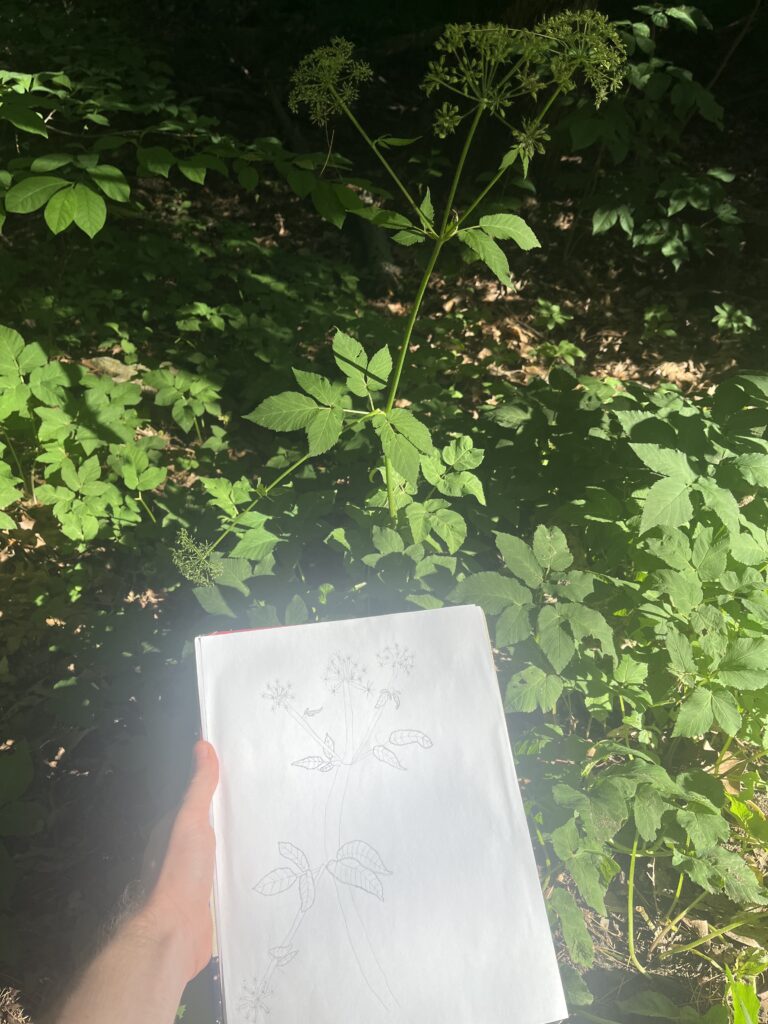
Ground Elder – Aegopodium podagraria – was not a species I was familiar with until today. It has many common names, though the most common seems to be Bishop’s Goutweed. I first identified it using the app Seek, before confirming based on photos and descriptions of habitat, range, and physical characteristics from Go Botany. It is native to Europe and invasive in the United States. Interestingly, it is edible and some people use it to treat a variety of illnesses – especially gout and arthritis – though I am skeptical on the effectiveness as I cannot find any reliable medical sources claiming its benefits. Below is an image of the plant and a sketch of it that I made.

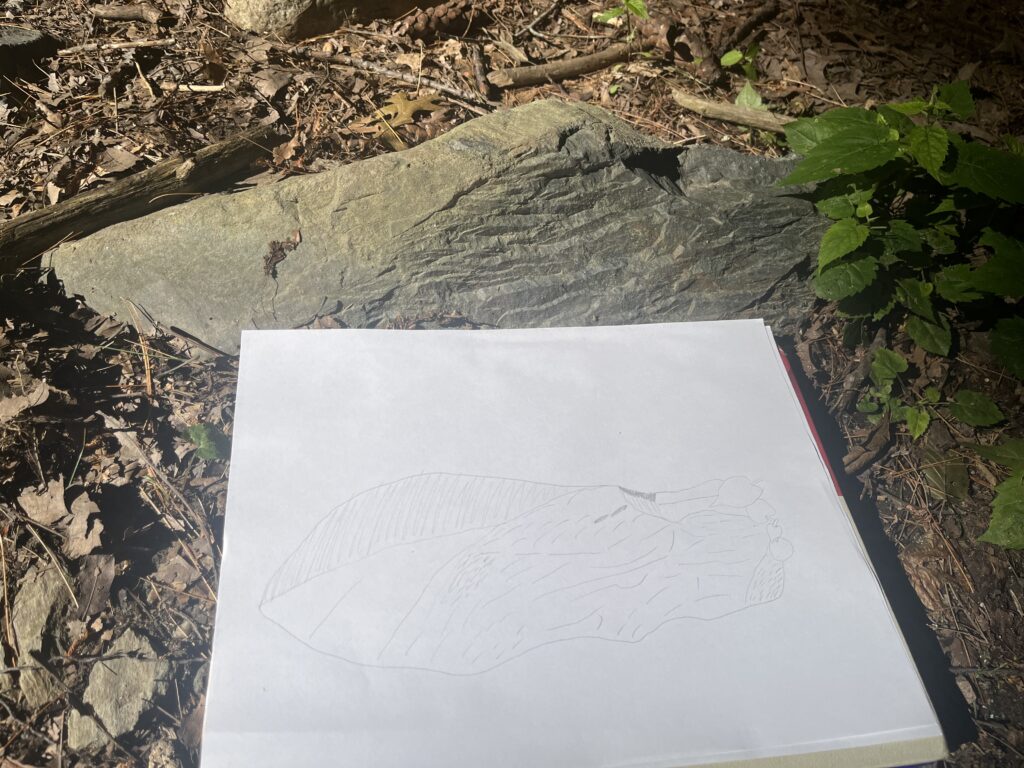
As for the rest of my time at my site today, I spent it sketching 3 other interesting things (I’m not a very practiced or quick artist). The first is a rock I found embedded in the path but with a face fractured off to reveal what I think is very slightly metamorphosed shale. I say this because it still strongly resembles shale yet there are slight waves to the layers. My sketch is from about a 45 degree angle from the layering, and I am not a very good artist, so it does not look properly layered at all in the sketch, but that is due to me trying to capture to fractured face. If you imagine looking down on it, you may have a better understanding of the layering.

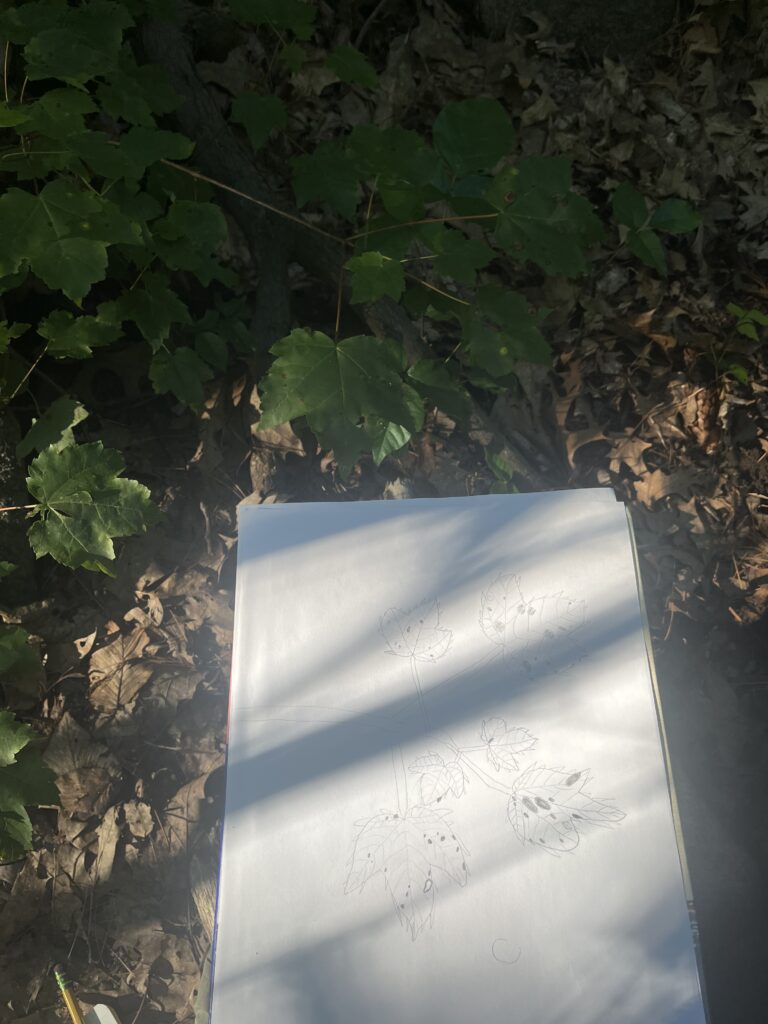
Next was a patch of diseased red maple. The leaves I drew were from a sprout out of a larger red maple – perhaps 4 inches DBH – though the whole tree was afflicted. I chose to sketch these as they were the easiest to get a good look at.

Finally, after getting splashed a bit by a passing dog, I sketched the leaf of a Southern Arrowhead – a large woody shrub than can resemble a small tree. Particularly interesting is the obvious vein pattern throughout the leaf.

Overall I enjoyed my visit today, though the sketching took me quite a while. I am very glad to have identified a number of new tree species I had not previously noticed in this park, as well as learned about this rumor of dumping waste. Perhaps I will contact the town and see if they have records of any industrial dumping in the area. Regardless, I hope that when I visit again next week the Bishop’s Goutweed will be in bloom.

Thank you for reading,
Ben Malisheski

Wonder Blog Question Marathon

21 June 2024
4:15pm
Entry #1

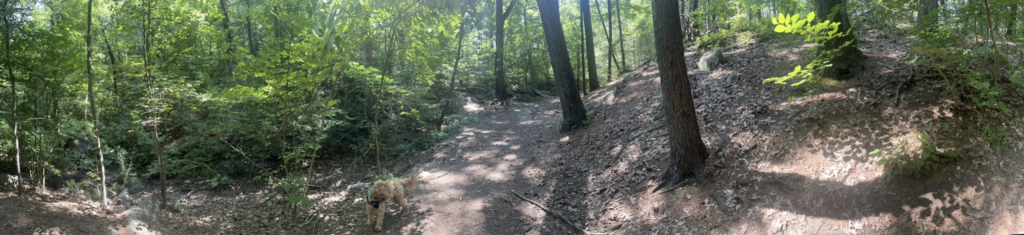
This is the most diverse section of the trail network of Cunningham park, so I figured it would be the best place to analyze. This image is a 270 degree panorama. I would have preferred a full 360 but I was limited by my technology. You can see in the image my research assistant (service dog) Frodo, who will be joining me on my deeper exploration of this place I have walked though so many hundreds of times. To begin a brief description, this is a network of trails that pass by a small swamp, a small ridge, a larger slope, and several flatter but dry forest sections. It smells of your typical northeastern forest, but the illusion of nature is broken by the noise. There are commercial flights that pass directly over the area every few minutes that drown out the sounds of nature. That said, as you get used to them, you can learn to listen during the time between planes. It was a lovely day to be out too: 74 degrees Fahrenheit, sunny, and 85% humidity, though about 3-5 before we are expecting a storm.

In terms of the species around here, we are sadly far more limited than I would like to see. For mammals we have little more than rodent species: certainly plenty of squirrels and mice but little else. Even other small mammals like skunks, rabbits, groundhogs, or raccoons are fairly rare in this park, and I would attribute that to the abundance of dogs. In the hour I was out there today I saw at least a dozen dogs walk past. Deer are also fairly rare in this area – potentially due to the dogs but I am less convinced and I imagine there are other significant factors. In terms of birds, there is a good diversity but I am not well educated on birds. I do know a pair of great horned owls nest in the park, I have seen a peregrine falcon perched just at the edge on a few occasions, and I saw a red-tailed hawk on the edge once, but I encountered none of those today. There are plenty of songbirds out there but I am not able to identify them. For reptiles, the only one I have ever seen is a garter snake. I have never seen an amphibian in this park – though I imagine there could well be some in the wetter parts. That leaves – for reasonably observable creatures anyway, invertebrates, fungi, and plants. I have seen quite a few invertebrate species over the years here, but I would not be able to identify most of them. That said, I have seen several beetles, bee species, spiders, ants, flies, and of course mosquitos. I have not examined aquatic invertebrates. I am also not an expert on fungi but I saw at least two species of mushrooms growing out of standing trees today. Finally, we have plants. I am studying Forestry and Environmental Science, so I have more of a background identifying plants. There are numerous understory species though I find these less interesting, so I will not list them. For tree species, I have seen Red Pine, Eastern White Pine, Eastern Hemlock, White Oak, Black Oak, Northern Red Oak, American Beech, a cherry species that I am forgetting, Pignut Hickory, Red Maple, Sugar Maple, and Paper Birch.

The assignment this week was to come up with a “Question Marathon”. I have chosen to classify my questions into 3 basic groups, though there is some overlap: Geology, Ecology, and Culture.

Geology
1. The parent material of the soil is likely glacial till, but I am not sure, so what is it?
2. What is the general mineral composition of the parent material and soil?
3. Where did the parent material come from?
4. If the parent material is not glacial till, why so many exposed boulders?
5. What is the bedrock?
6. Does the bedrock have any impact on the parent material here?
7. If the parent material is glacial till, how deep is that layer?
8. How deep is the entire soil layer?
9. How deep is each soil horizon? Is this typical of what we would expect given site conditions?
10. What effect has the history of clear cutting and agriculture had on the soil here?
11. What effect does the significant human & canine foot traffic have on the soil here?
12. How does the soil differ in the various natural communities throughout the park?
13. How do the soil characteristics impact species richness, diversity, and health in each of the natural communities?

Culture
14. Does/did this land have significance to indigenous people?
15. Are there remaining descendants of that indigenous population?
16. If there are, what are their feelings on this land being privately owned but open to the public from dawn to dusk?

Ecology
17. What is the species richness, diversity & evenness throughout the park for each kingdom of life?
18. Within the kingdom Animalia, how do those factors breakdown for each of the 6 major groups (Mammals, Reptiles, Amphibians, Fish, Birds & Invertebrates)?
19. How do questions 17&18 change when you look at smaller communities?
20. How many natural communities have been identified in the park? What are they? Are there any rare ones?
21. Have any rare species been identified in the park?
22. Are there any active conservation efforts in the park?
23. Does the park have a conservation easement?
24. How long has it been since the last full-stand-replacement disturbance?
25. Was that a clear cut like I assume?
26. If it was a clear cut, was it for agriculture like I assume?
27. What succession stage is the forest currently in?
28. What is the description of the stand age?
29. Are there any plans for future active Forest Management?
30. Specifically: any plans to deal with pathogens, invasive species & climate change?
31. What is the overall site index for each tree species?
32. How does that change by species and natural community?
33. I often hear about deer browse being a major issue in this area, but regeneration looks fine at a glance; is it an issue right here?
34. Are we regenerating the species we want?
35. Is there sufficient disturbance to maintain structural diversity?
36. Is the human & dog activity enough to significantly impact animal species?
37. There is a popular spot for high school students to party in the middle of the park – and they litter quite a lot; how does this impact the species in the park? How does this impact the soil right there?
38. What is the current stocking level of the trees?
39. How significant of an impact does domestic cats have on wildlife here?
40. How would beavers change everything if allowed to flourish here?
41. Does the noise pollution of near constant planes affect wildlife? How? What about the air pollution of them?
42. Has pollution had a significant impact on species in the park?
43. How have earthworms impacted soil ecology here?

I cannot answer all of these questions, but one that sticks out as possibly reasonable to answer while getting some of the most important information would be the question pertaining to Earthworms. UMass Amherst put out an article on the history, benefits, and concerns about Earthworms in Massachusetts, and it would be reasonable to assume most of this information would apply to this park. The main takeaways are that they increase the decomposition rate of organic material, but increase soil erosion and make it easier for invasive plant species to flourish.

Finally, something that caught my eye today was that this was the first time I noticed a hickory species in this park, so I would like to see if I could find even more tree species that I have not yet seen in the park.

Thank you for reading,
Ben Malisheski

Wonder Blog Introduction

This is the start of a series of posts in which I will visit a natural area near my home and explore it. The place I have chosen is the network of back trails in Cunningham Park – a park in Milton, Massachusetts. I have been walking in this park since I was an infant in a backpack up to nowadays walking my dog there regularly when I am living here in Milton. This means I know the area very well, but I am certain there is plenty to be learned, as I will explore in my first major entry…

Skip to toolbar