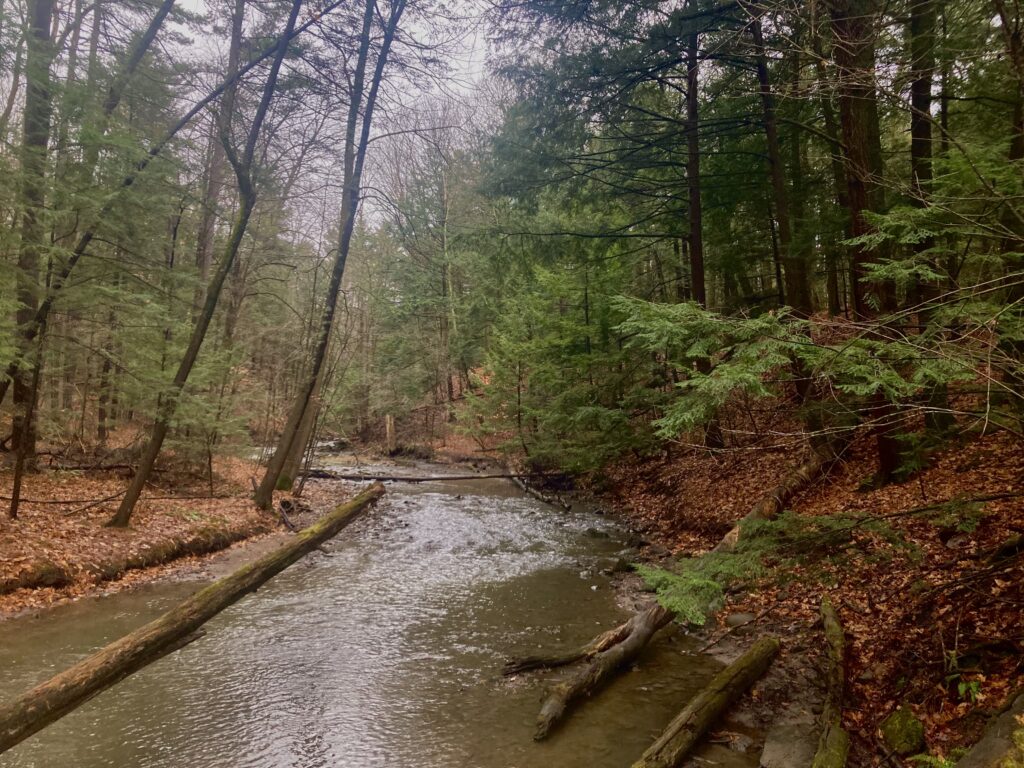

My Phenology site is located along Potash Brook within the East Woods Natural Area in South Burlington. To get there, head south from the main UVM campus down Spear Street for about two miles, then take a right onto Swift Street. Continue straight for another half a mile until you reach a pull-off on the right where you can then enter at the East Woods Trailhead. Alternatively, you can keep going strain down Swift Street for another .3 miles until you see Klinger’s Bread Company on the right just before the intersection with Farrell Street, where there’s then another access to the woods behind the building. You can also take the South Burlington recreation path from the UVM athletic complex down to Farrell Street and then get to either of the trailheads that way. Once in the East Woods, my site is located about half a mile upstream into the forest from the trail access behind Klinger’s Bread. Follow the trail up along the stream, over a hill that takes the path away from the water for a couple minutes, back down, and finally around a wide bend in the brook. You’ll know that you’ve reached the specific spot when you see a couple of large fallen trees that span over the water with a subtle natural pool that’s formed just below them in the stream. Additionally, the land area adjacent to the brook’s edge is relatively flat before it gradually transitions into a hill farther into the forest, while the opposite side is a large, relatively steep, embankment.
I chose this site primarily because of the stream. I wanted a body of water to be a relatively significant part of my site, and after the lab at Potash Brook I wanted to go back and explore that area further anyways. The forest is also full of large old trees, both deciduous and coniferous, making it a beautiful spot to study in the fall. Furthermore, although it’s roughly a 45 minute walk away from my dorm, the recreation path gives me a direct and easy way to get there on my bike.
Descriptively, the brook is a small yet active stream about 20 to 30 feet in width with a rocky bottom. There are many modest cascades along its course, as well as various quiet pools that breakup the water’s otherwise steady flow. The surrounding forest full of medium to large trees that form a dense canopy, with a comparatively spare understory beneath. The overstory is mainly made up of mature Eastern White Pines, Norway Spruce, Red Oak, Sugar Maples, and Norway Maples. The understory is composed of a scattered collection of young Norway Spruce, small birches, some very small Basswoods saplings with only a few leaves, and patches of ferns growing out of the base of downed trees.