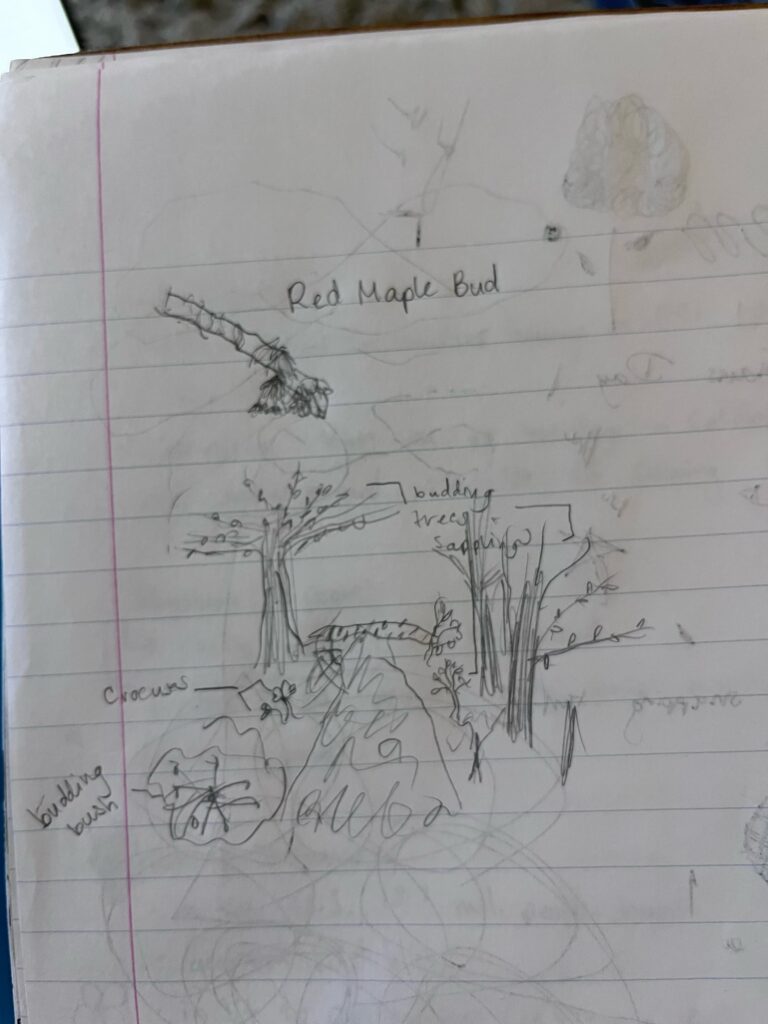
Last Phenology Post :(
By: Amelia Weeden
4/24/2023
Over the course of the semester, my phenology spot has changed substantially. When I first visited it in January, there was a large amount of undergrowth and a thick layer of snow covering the ground. However, the snow began to thaw and seasonal changes such as bud growth started to occur. My phenology spot was also altered by human activity as much of the understory ended up being cleared out in early March.
There are a few major and minor landmarks I’ve become familiar with. Firstly, there is a very distant divot in the ground, where a larger chunk of earth is missing. Secondly, there is a clearing surrounded by trees, almost making up a ring shape. Nature and culture intertwine here due to the land’s complex and deep history. The land was originally inhabited by the Abenaki people and was then taken over by colonists. Later, the land was abused as a medical-waste dumping site. This land’s rich and complex history makes it the place it is today, although it is now still owned by a predominantly white institution instead of the Indigenous people to who it belongs. I don’t consider myself part of Centennial Woods, I was never at Centennial Woods for hours at a time, and left no trace other than my footprints. While I did visit my spot numerous times, I was never a permanent fixture but rather a guest.