Hi! This weekend, on Friday, October 14th (yes, this took me almost a month to finish writing), I took some time out of my day to visit my phenology spot. I did not end up at my spot until pretty late in the day, so I did not have long until dark. But, there was still plenty to observe and learn about! My primary purpose for this visit was to identify the various trees, woody plants, and herbaceous ground cover, but along the way I found plenty to observe.
Jewelweed
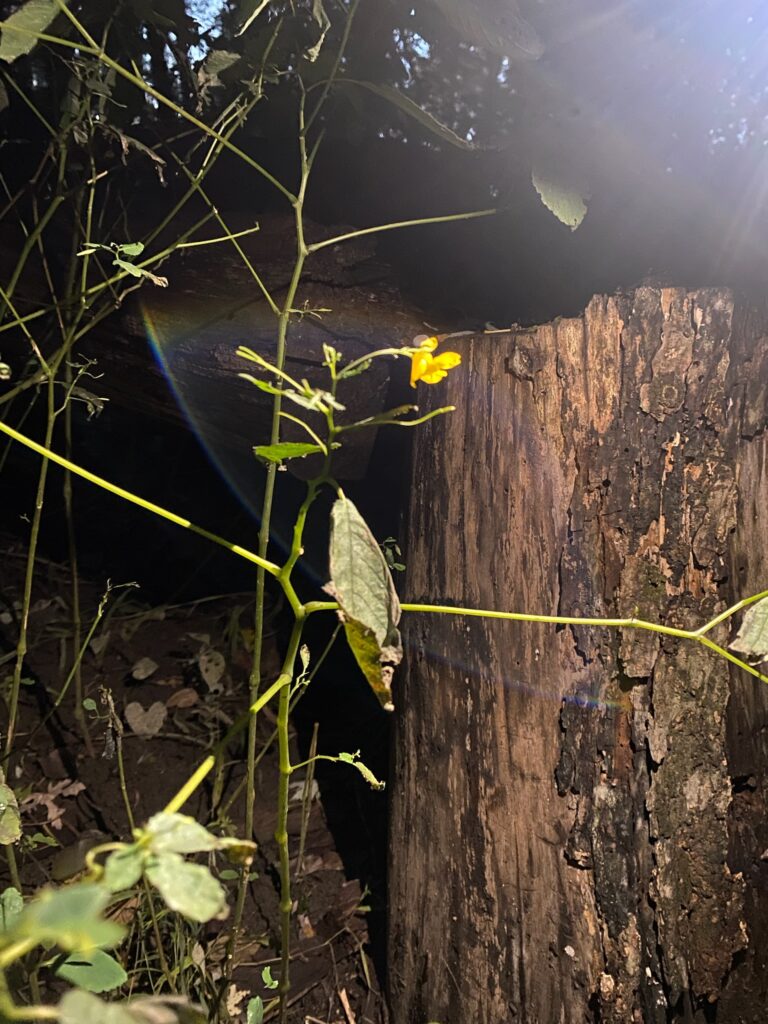
After only about an hour of identifying plants at my phenology spot, the sun had set. This did not deter my work, especially because I had a friend to shine a flashlight whenever it was needed. What I quickly discovered, though, was that tree and plant identification becomes significantly harder when it is dark out. It was during one of my slow-going identification processes that I discovered a welcome surprise. As I fumbled along the leaves of a plant, I quickly found myself recoiling at the feel of something distinctly alive jumping from the plant. My immediate thought was a bug of some sort, such as a spider or grasshopper, but upon closer inspection I instead realized that I was surrounded by jewelweed! Jewelweed (Impatiens capensis), which is often commonly referred to as ‘touch-me-not’, is known for its rather creative seed-spreading strategy. When jewelweed flowers are ready to reproduce, their seed pods become so swollen with seeds that the slightest brush can cause them to explode, sending the outside of the pod curling back up into the plant and the seeds up to several feet away. Throughout the next hour, I was captivated by the jewelweed pods, and only left them due to my friend pretty much dragging me away.
Jewelweed is very prevalent in my phenology spot. It borders the entire side of my trail that is farther from the water, and is also found in a few of the small groves of trees throughout the area. Jewelweed prefers moist, shady areas, which seems to fit considering the impressive amount of jewelweed in my spot, which borders the Winooski River. The plant blooms in midsummer, and the flowers stay until a frost kills them which, for Vermont, seems to be pretty much anytime with no warning at all. Jewelweed flowers can be red-orange to yellow, both of which I have found in my phenology spot, although the yellow jewelweed (Impatiens pallida) seems to be more common. The plant is native to the area, and is a rather competitive plant, meaning that it can often successfully outcompete other plants, even the occasional invasive one.
Cool Creatures
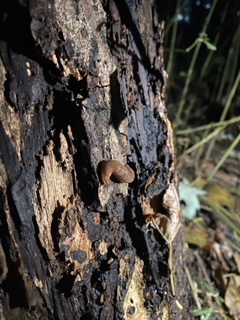
During my nighttime escapade I also saw plenty of cool little critters! Although I am sure plenty went unnoticed, I saw a few slugs and even a snail! The slugs I saw and successfully identified were marsh slugs (Derocereas laeve), also known as brown slugs or meadow slugs, and they are apart of the Agriolimacidae family. The slug, like jewelweed, prefers moist, marshy areas and can be a variety of colors from yellowish to deep browns. The few I saw seemed to learn more towards a chestnut brown, although this could be slightly inaccurate since it was dark out. I also saw a frog, but was unfortunately not able to get a picture of it.