Feeds:
Posts
Comments

For my last official phenology blog post (although I hope to continue to update this blog, both with my spot here in Burlington and at home in western PA), I am going to spend some time talking about the City Nature Challenge that happened last weekend. This challenge made for a very chaotic weekend. Originally, my friend and I had no plans of contributing to the challenge. However, after an evening spent wandering around Centennial Woods (and taking a few vibey photos) we realized that we were essentially doing everything the challenge was asking – just without documenting any of it. So, we decided to contribute. Chaos ensued.

Map of my iNaturalist observations

We spent the next few days roaming Burlington and Winooski, traveling from Centennial Woods to the Intervale and down to the waterfront, and what seemed like everything in between. I ended up making a total of 515 observations, including 228 different species. While the experience was definitely unique, I don’t think that I would want to be a part of the challenge again. While I understand the importance of citizen science (and also see how this challenge could get some people outside and interacting with nature if they don’t normally do so), I found that I was not appreciating the beauty of these places as much as I normally would have. While, yes, I do identify plants and animals that I come across and am unfamiliar with, there was something different about identifying nature just for the sake of a challenge. And so, although the City Nature Challenge was exciting at the time, I was relieved to be done with it and just be able to go for a walk in Centennial Woods.
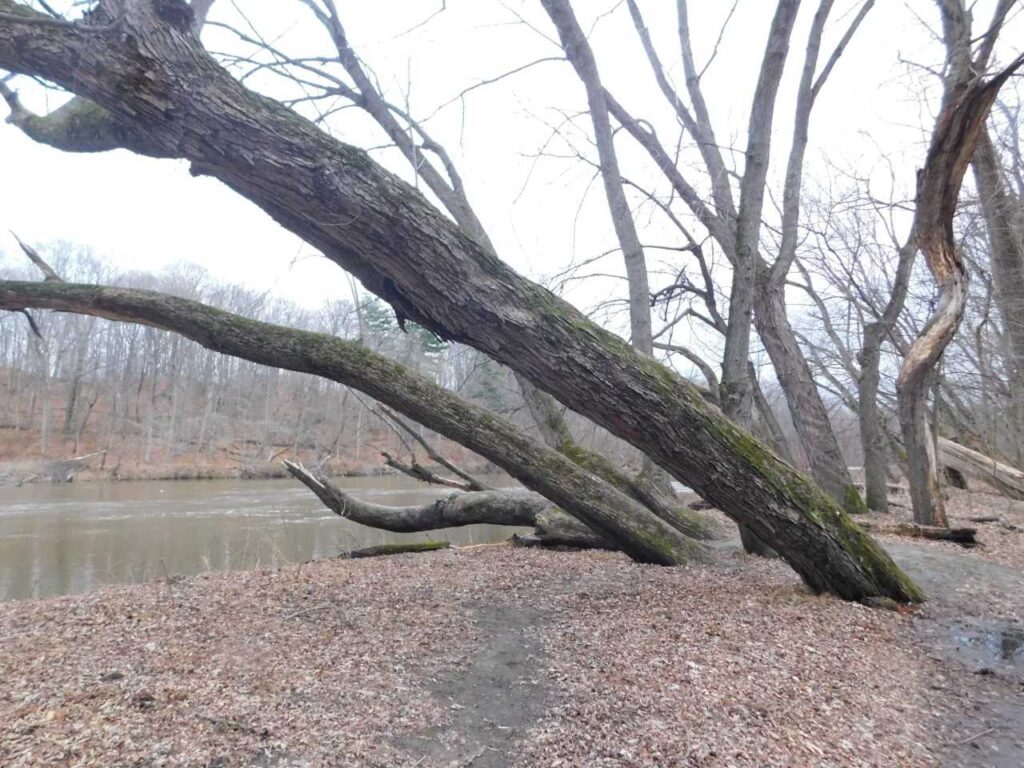
This will be my last blog post that is specifically formatted for class. However, I hope to continue to post about my phenology spot in the Intervale every now and then (as well as my spot at home), although updates will likely be less frequent. Overall, I have truly enjoyed this project in so many different ways, whether it be from exploring more of Burlington, becoming familiar with a specific area that I may not have under other scenarios, or just updating this blog. I can’t wait to see what changes will happen to the grove of silver maples by the Winooski River during the months I am gone.
4/16/2023

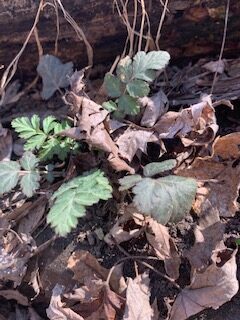
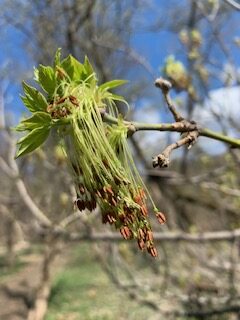
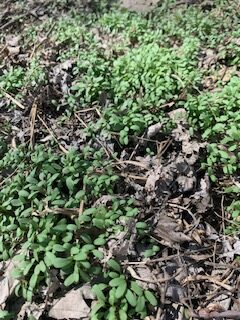
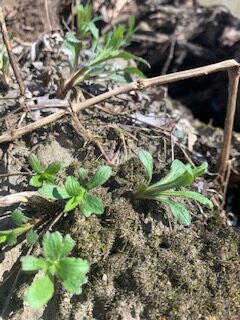
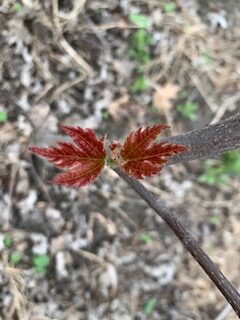
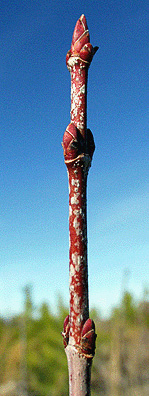
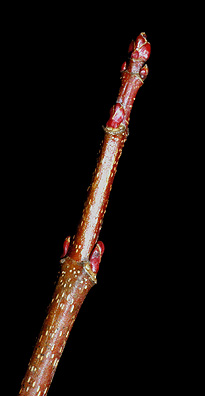
This weekend, I had the opportunity to visit my phenology spot once again (or more like 2.5 weeks ago, as I am very much not writing soon after the 16th of April). The Intervale was becoming much more green, with so many plants just starting to sprout out of the ground, and it made me so excited for spring and summer. It also seemed to be prime time for boxelder buds – they looked so cool!

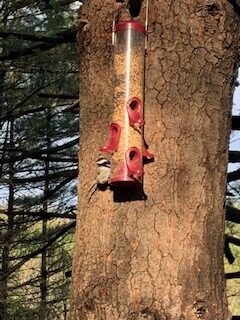
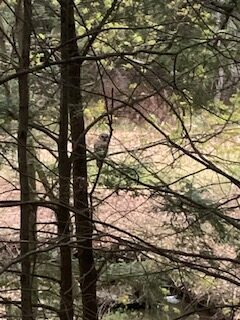
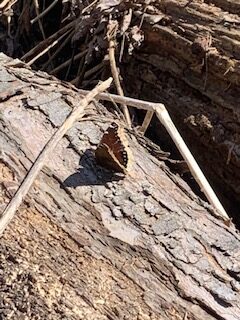
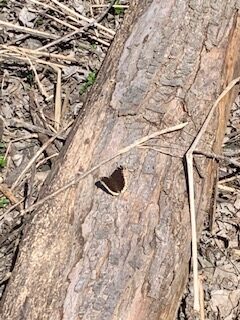
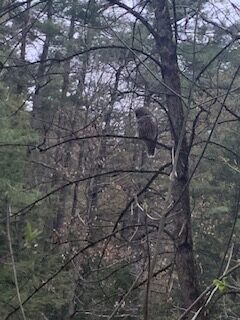
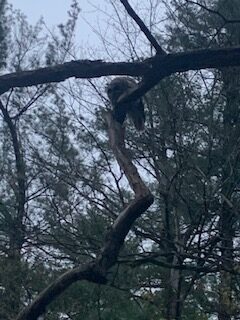
I was also thrilled to be able to spend some time identifying several birds. The birds that I successfully identified are as follows: pileated woodpecker (Dryocopus pileatus), tufted titmouse (Baeolophus bicolor), American goldfinch (Spinus tristis), black-capped chickadee (Poecile atricapillus), song sparrow (Melospiza melodia), red-bellied woodpecker (Melanerpes carolinus), and northern cardinal (Cardinalis cardinalis). I also spotted an eastern gray squirrel (Sciurus carolinensis), and eastern chipmunk (Tamias striatus), although I was regrettably unable to get photos of them. But, I was able to catch a photo of what I think is a mourning cloak butterfly (Nymphalis antiopa).

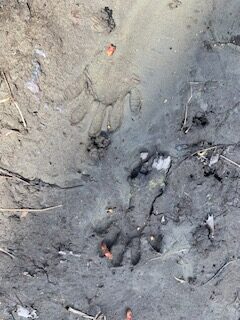
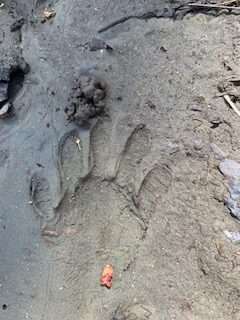
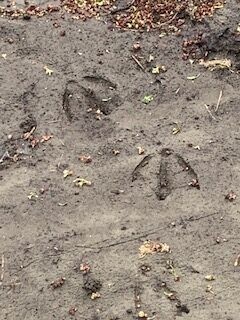
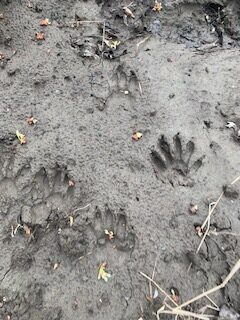
Additionally, the conditions at the Intervale were perfect for some mud tracking! While the dog tracks tend to obscure the large majority of tracks at my phenology spot, I was able to spot just a few tracks that I believe are from a common raccoon (Procyon lotor)! Unfortunately, in my excitement I forgot to add something to show the scale of the tracks…oops.

4/22/2023

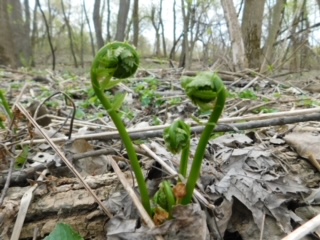
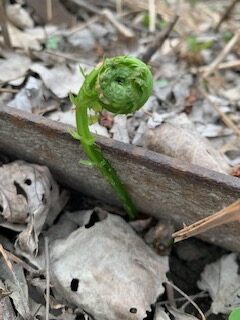
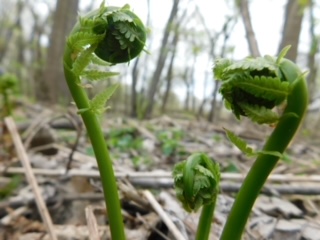
This weekend, I found the time to visit my phenology spot down at the Intervale again. Walking to my spot along the Intervale trail was a wonderful experience, as you could truly tell it was spring, with all the chirping birds and greenery. I was surprised to note that, within just 6 days, the area had become much more green. However, my specific spot was not quite as green as some of the other areas, likely due to the fact that the jewelweed (which makes up the majority of the groundcover in my spot) has not begun growing significantly yet. However, I was super thrilled to see that the ostrich ferns (Matteuccia struthiopteris) had begun to bloom, and some were even beginning to unfurl! This was especially exciting as, since most of the groundcover has not returned to anywhere near its full power yet, the ostrich ferns were super easy to spot, and I got to spend several minutes in awe over just how cool they are. Here are some photos of these odd little ferns, the first and third of which were taken by my friend with their super cool camera (thanks Naomi)!
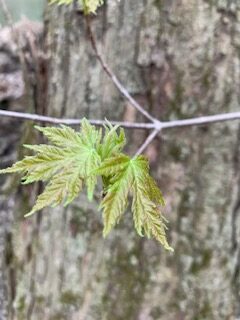
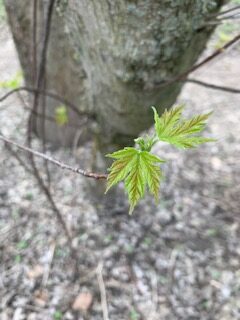
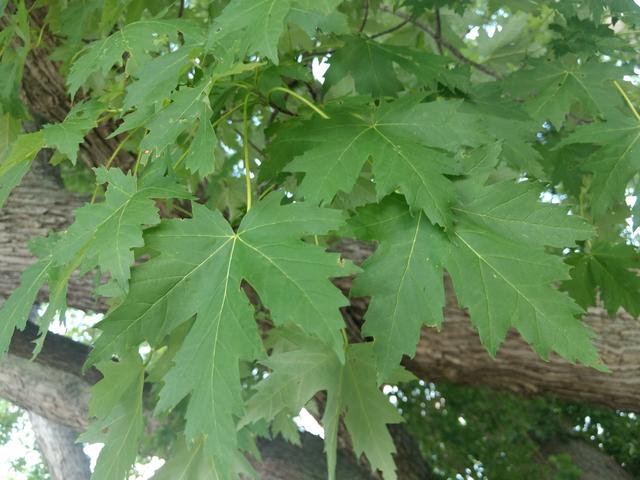
While at my phenology spot, I was also able to identify the calls of some of the nearby birds. Some of these birds include the pine warbler (Setophaga pinus), American crow (Corvus brachyrhynchos), common raven (Corvus corax), black-capped chickadee (Poecile atricapillus), red-bellied woodpecker (Melanerpes carolinus), and American goldfinch (Spinus tristis). I also believe I spotted a blue jay (Cyanocitta cristata), however I was unable to snag a photo of it or hear its call. Another new appearance at my spot was the beginnings of silver maple leaves! All around my spot, the silver maples that, just last week, had still been carrying buds, were now showcasing the most adorable little leaves.
Although I hope to find time to visit my spot in the Intervale again before the end of this semester (and am therefore back in PA for a few months), I want to spend some time reflecting on my experience maintaining this phenology blog. My site has not changed much over my time observing it, but, now that I am more familiar with my spot and how the phenological changes impact it, I am excited to visit it again next year (and hopefully continue to update this – although probably less frequently)! I have become much more familiar with my spot, as I now know some of the small quirks of this beautiful area, such as where the old scrap metal is, where to look for new fungi after a rainy day, where the one pileated woodpecker liked to search for food in one of the silver maples, or even where the best spot to sit and read a book in a tree is. I feel like I have definitely grasped a better understanding of this magnificent bit of the Intervale and, although I definitely do not consider myself a ‘part of my place’, I do feel more connected to it than I do other parts of the Intervale and nature in general. The Intervale is truly a wonderful area, providing trails for bikers, walkers, runner, and cross-country skiers, all the while providing a habitat for a diverse range of creatures, from marsh slugs to raccoons to red-tailed hawks, and everything in between. And, as an added bonus, every time I visit, I know that I am almost positive to find the opportunity to pet at least one adorable dog.

4/4/2023

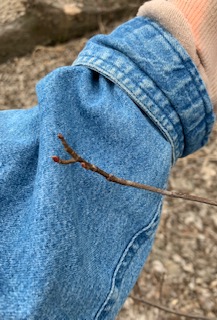
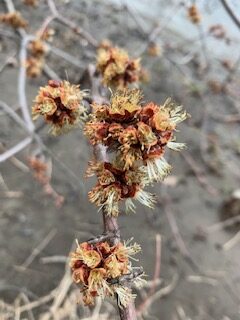
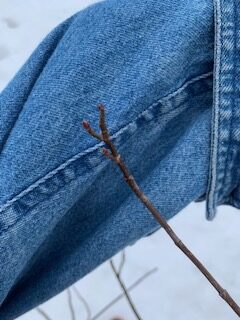
Despite the chaos of the week, I found myself visiting my phenology spot in the Intervale again this week. It was a beautiful day, and it really felt like spring was on its way. While at my spot, I took some time to check in on my tree and see how it was doing. Being a young tree, it does not have many branches or buds, and not much had seemed to change on it, but I am hopeful that I will get to see it when the buds begin to burst!

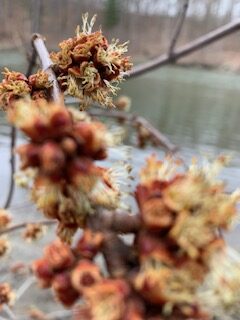
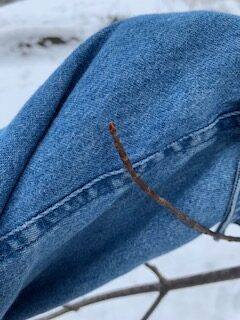
The buds of my silver maple tree

But checking in on my tree wasn’t all I did. I took some time to wander around my spot, looking for any new changes. I noticed that the water level was higher than normal, and so the bank that I normally stand on to look out at the water was submerged. This is seen in the below photos with the silver maple buds, because the branch that they are a part of was partially submerged. There were also plenty of birds, both that I could see and hear, as well as this cute little bug pictured below. I believe this to be a stonefly (Plecoptera), although I am unsure which specific type of stonefly it is. My friend and I were able to identify the bird calls we heard as a tufted Titmouse (Baeolophus bicolor), black-capped chickadee (Poecile atricapillus), and red-bellied woodpecker (Melanerpes carolinus), although we unfortunately were not able to identify the birds that we saw, as we only glimpsed them very fleetingly.

I am hopeful that, the next time I visit my phenology spot, many more plants will be in bloom. I can’t wait to see the beauty of the Intervale in the spring!

3/5/2023

This week, I found myself down at my phenology spot. Not much has changed, which is to be expected since the area is still covered with a coat of snow. The path at the Intervale was much icier than I anticipated it to be, so it took my friend and I a bit longer to get to our phenology spot. However, the state of the snow did make the dog tracks, which were significantly deeper than any other track we spotted, very noticeable. We did not exactly spot many other tracks, except for the stray mouse track, but the dog tracks were very cool to look at, especially because they all varied in size so much.

My reason for visiting my phenology spot this week was to locate either a red maple, Northern red oak, paper birch, or American beech. However, to my surprise (although I should not have been surprised considering I had already identified all the trees at my phenology spot in the fall), none of these trees were there! Now, I could have wandered the Intervale, looking desperately for one of these trees, but instead I decided to choose a silver maple because, although it is not a red maple, it is still a maple, and I really wanted to choose a tree at my phenology spot. From there, it was pretty easy to choose which tree I would be studying over the next few months, as there are very few that have easily accessible branches.

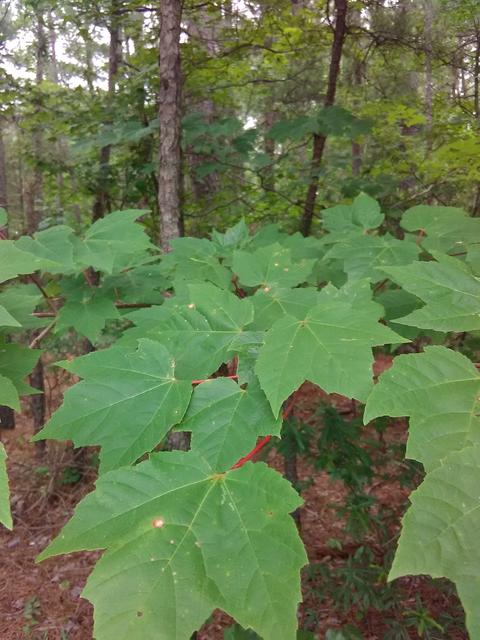
The easiest way to differentiate between a silver maple (Acer saccharinum) and a red maple (Acer rubrum), is their leaves. However, that is obviously not currently possible given that it is winter. Silver maple leaves have much more deeply-cut lobs, and they are also generally larger. The leaves also have a distinct silver underside. I will be sure to post a photo of mine come spring!

The twigs of the silver maple are also more of a chestnut-brown, as opposed to the reddish color often associated with red maple twigs. The twigs of the silver maple also emit an unpleasant odor when broken.

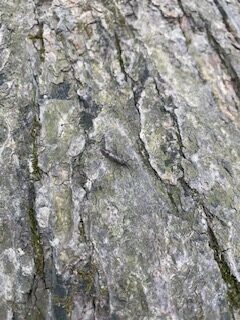
Silver maple trunks are also more likely to grow in an odd, angled way, which is clearly seen in my phenology spot, and sometimes even have several trunks. The silver maple that I chose does not show any of these features but, since it is such a common characteristic at my phenology spot (even seen in the silver maple right next to my chosen tree!) I thought it necessary to include.

Wildlife Signs…?

This week for my phenology blog, I instead took some time to wander around Burlington and document signs of wildlife. I am sure that this would have been a thrilling assignment, except, by the time I was able to make my way into Centennial Woods for an afternoon, there was barely any snow, and almost all of the mud had been trampled, either by the elements or my fellow peers attempting to undergo this same task. So, I unfortunately do not have much to report.

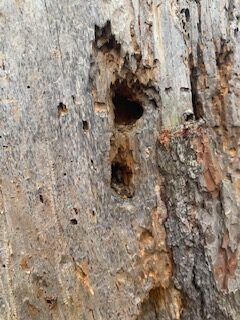
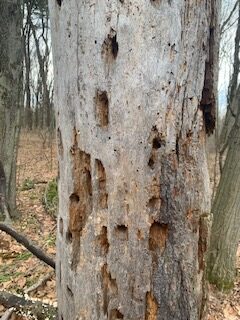
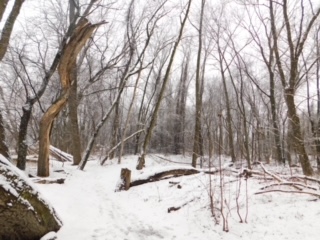
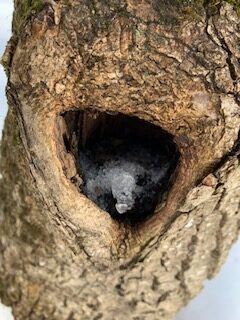
However, despite the disappointment that came along with a lack of snow or fresh mud, I still got to spend a few hours in Centennial Woods. During my expedition, I came across several dead trees lined with dozens of holes that could very well be woodpecker holes, although they are likely not recent.

Along with this, I also spotted a common raven, although I regret to write that I was not able to snap a photo of it before it flew off, and I also believe that I may have heard the call of a black-capped chickadee!

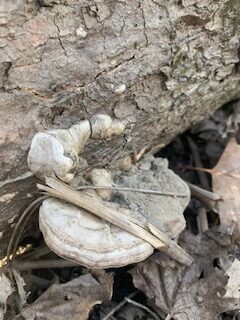
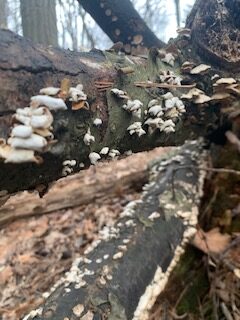
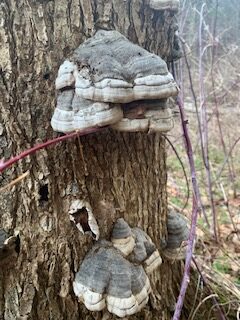
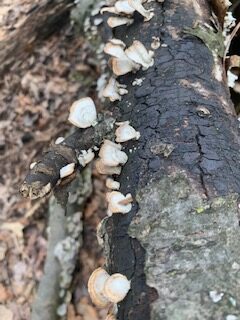
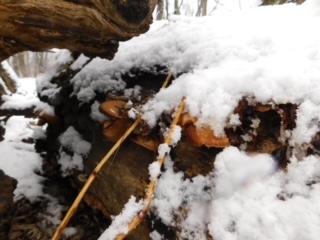
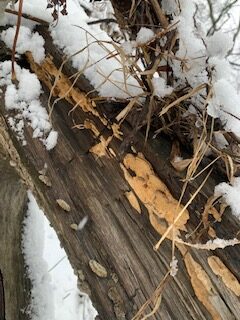
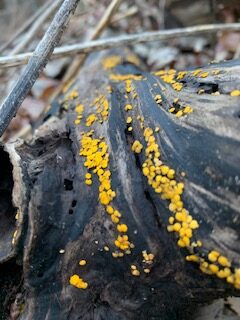
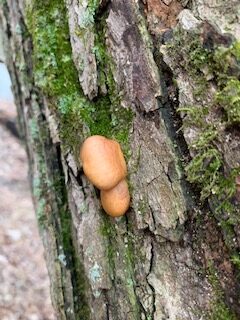
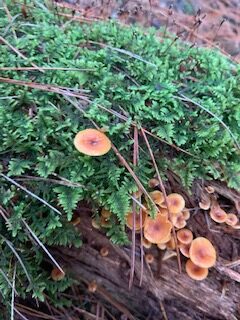
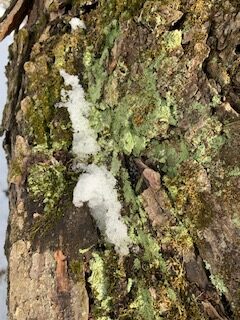
On that note (and with a few photos of cool fungi, the second of which felt almost solid upon touch!), I will end this post, although I hope to find my way back to my phenology spot or Centennial Woods when the snow comes back around!

1/28/2023

After a chaotic first two weeks of classes, I found time to visit my phenology spot this weekend. Unlike my impromptu previous visit due to the snow before break, this time there were no fungi in sight. There was essentially no green left in the area, except for a few spots on the trees. During my visit to the Intervale, the tracks that I could locate were in no way ones that I was capable of studying. While my inexperience in tracking certainly did not help, there was also no fresh snow, and so whatever tracks that were left had been destroyed by a variety of possible factors, such as other travelers, skis, or a wandering, off-leash dog eager to follow an intriguing scent. Unfortunately, there is not much more to note, as my last post also included snow at my phenology spot, although that is not to say that the area was not still exceedingly beautiful. I cannot wait to go back and spend some more time there, although hopefully this time there will be some fresh snow and I can try and figure out what animals have been wandering about.

Creatures!!

This is a list of all the creatures that I have successfully identified so far at my phenology spot. This list will range from slugs to fish to squirrels to birds and everywhere in between (or at least hopefully)! It will also have any photos that I do not have elsewhere on my blog (if I manage to get any…)!

  • Marsh slug (Derocereas laeve)
  • Red-tailed hawk (Buteo jamaicensis)
  • Common raven (Corvus corax)
  • American tree sparrow (Spizelloides arborea)
  • White-throated sparrow (Zonotrichia albicollis)
  • Common raven (Corvus brachyrhynchos)
  • Isabella tiger moth (Pyrrharctia isabella)
  • Pileated woodpecker (Dryocopus pileatus)
  • Northern leopard frog (Lithobates pipiens)
  • Stonefly (Plecoptera)
  • Tufted titmouse (Baeolophus bicolor)
  • Black-capped chickadee (Poecile atricapillus)
  • Red-bellied woodpecker (Melanerpes carolinus)
  • Pine warbler (Setophaga pinus)
  • American crow (Corvus brachyrhynchos)
  • American goldfinch (Spinus tristis)
  • Blue jay (Cyanocitta cristata)
  • Song sparrow (Melospiza melodia)
  • Northern cardinal (Cardinalis cardinalis)
  • Eastern gray squirrel (Sciurus carolinensis)
  • Eastern chipmunk (Tamias striatus)
  • Common raccoon (Procyon lotor)
  • Mourning cloak butterfly (Nymphalis antiopa)
  • and lots and lots of Canis lupus familiaris

12/16/2022

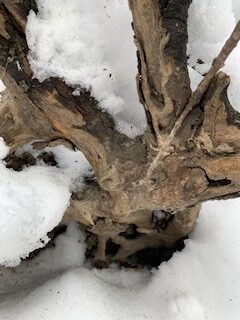
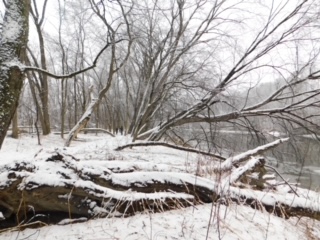
What better way to spend the last day of the semester at UVM then visiting my phenology spot? Today, I got the chance, between the chaos of packing, finals, and goodbyes, to take a trip down to the Intervale. I just had to visit. (Yes, I did forget to post this before I left to go back home…whoops). It looked so beautiful out; snow was falling slowly yet steadily, some of the water was just beginning to ice over, and everyone just had that gleeful feeling that comes with fresh snowfall. My phenology spot was, as expected, absolutely stunning. There was a solid layer of snow over pretty much everything, but the snow was not yet crushed down by footprints. It was super cool seeing the dry spots where no snow fell due to the looming trees above, and those snowless areas also helped me trace just how much the trees at my phenology spot seem to wind and twist about in the oddest directions. There were still a few stubborn fungi holding on, and the contrast between them and the snow that covered the top of them was just so fun to photograph. It was the perfect way to end the semester, and I cannot wait to see what changes will have taken place during my month away!

12/08/2022

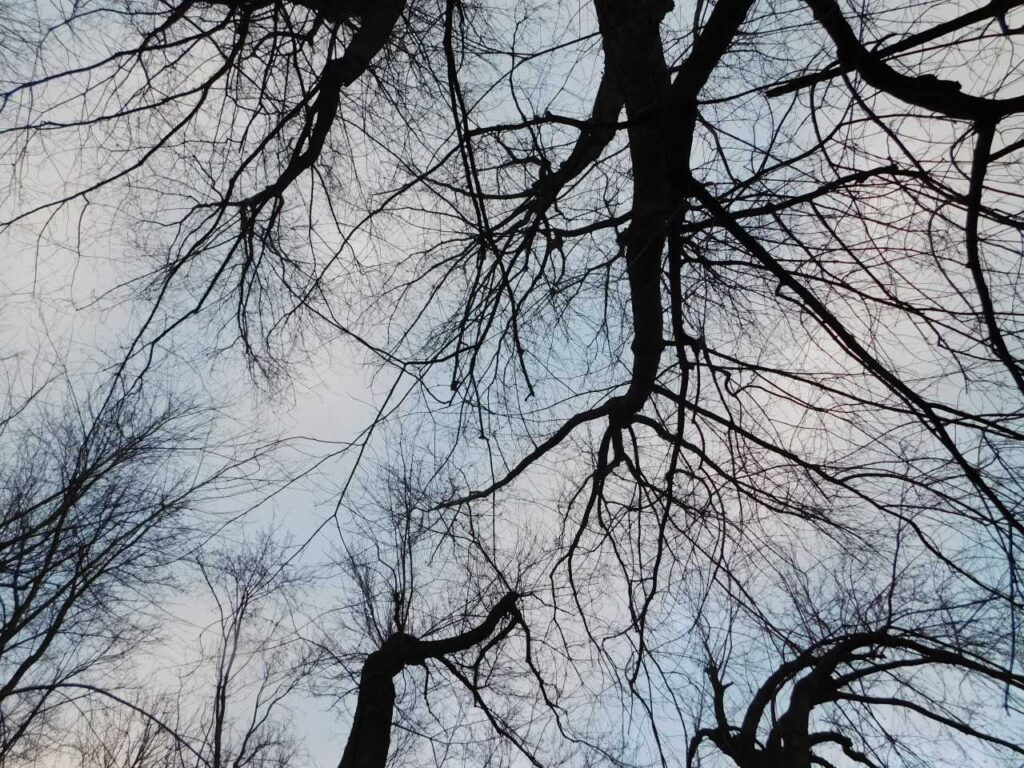
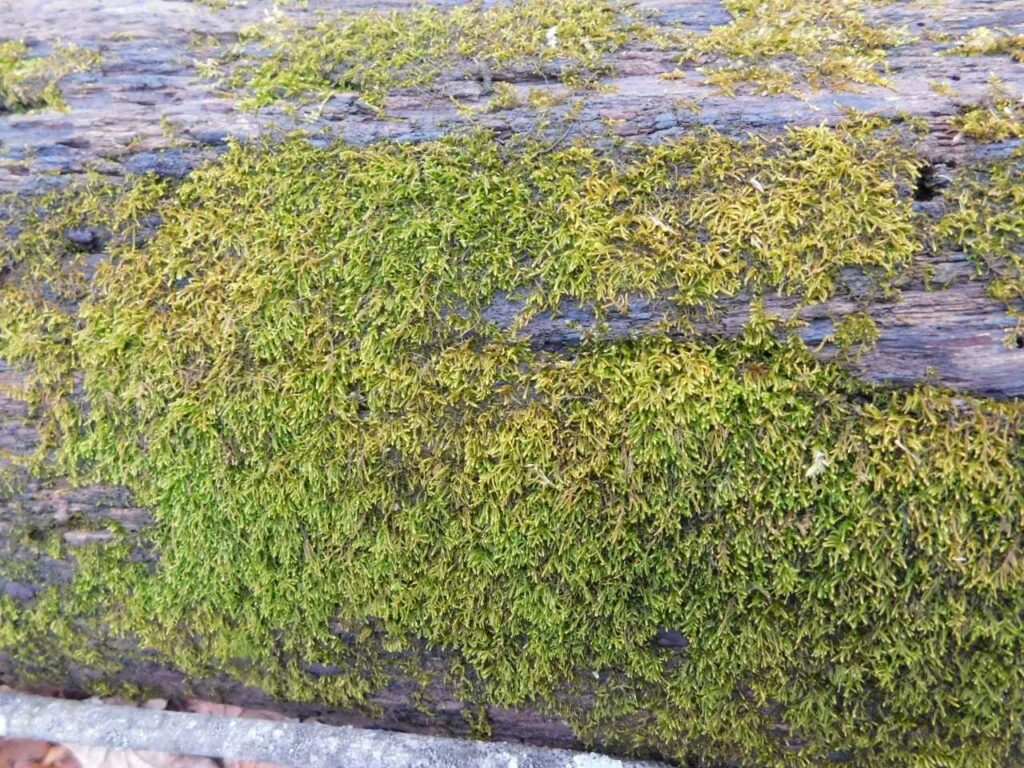
When I visited my phenology spot this last Thursday, it was clear that winter was near. There was barely any green, save for the moss lining some of the dead wood. The leaves were almost completely gone, leaving behind barren branches that just two months ago held dozens upon dozens of leaves in the stunning array of fall colors.

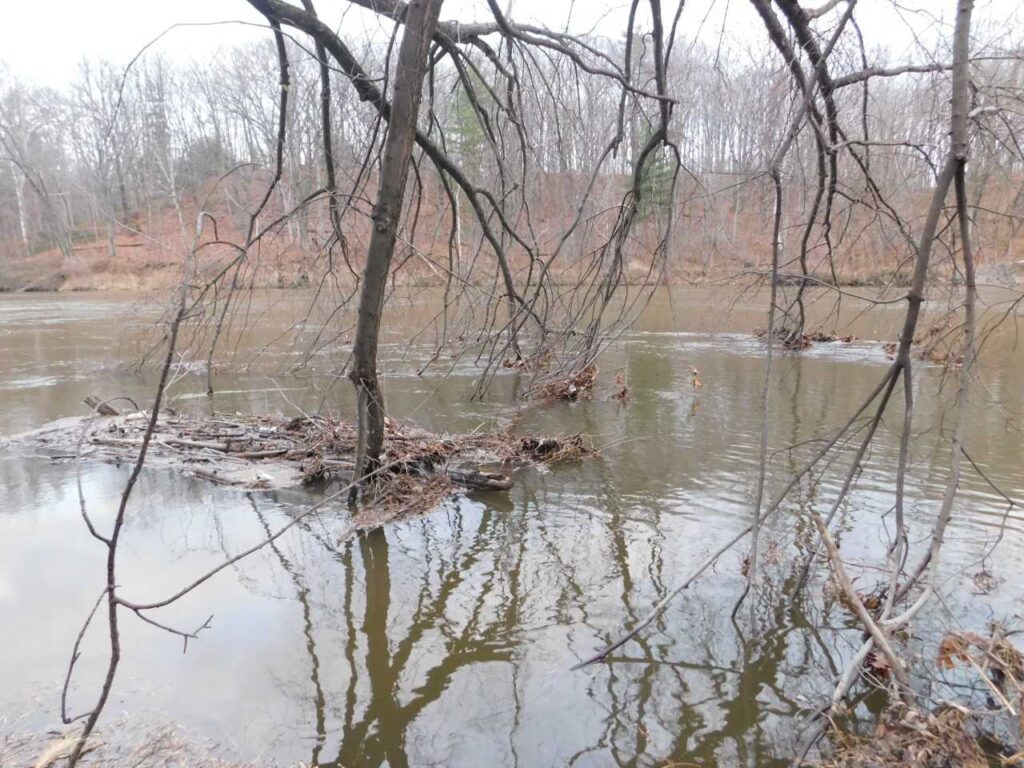
The skies were gray and dreary in the Intervale, and, although it was not raining at the moment, there had been nearly continuous rainfall for the last two days. As a result, the water level, which had been unusually low during my last visit before Thanksgiving break, was now much higher than normal. Several plants and areas of lying dead wood were either fully or partially submerged by the water.

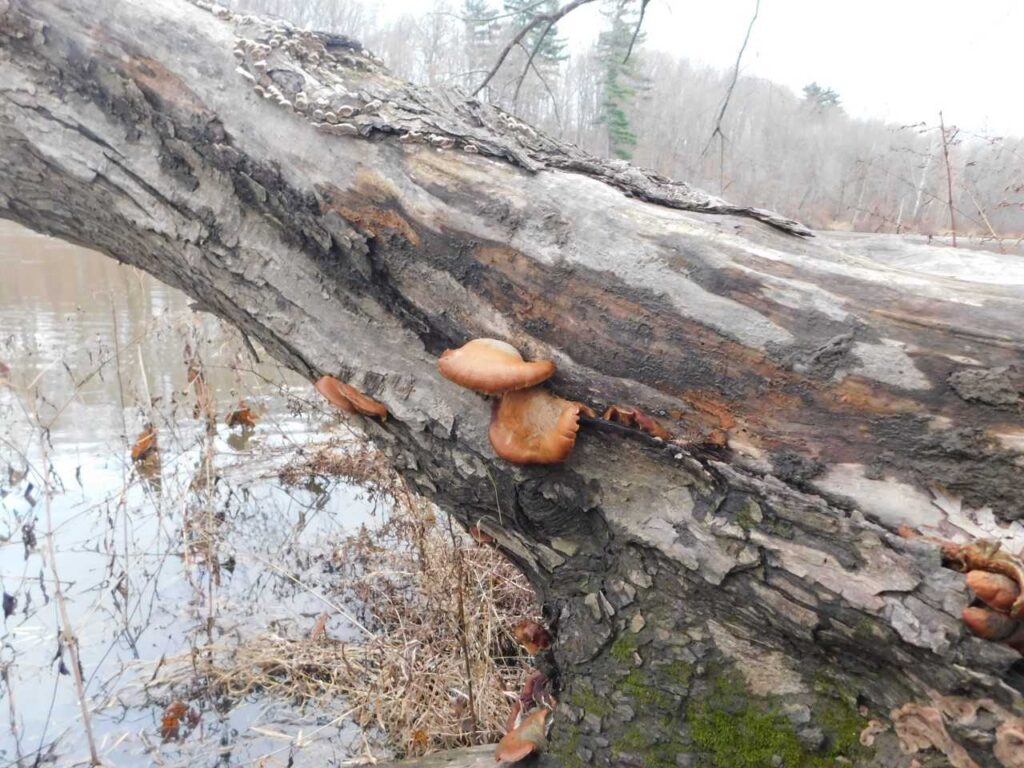
The recent downfall of rain had also led to the appearance of a variety of fungi, some of which were especially interesting. Despite the cold, these organisms were still managing to thrive, and in some spots it even seemed that the fungi were more prevalent than I had noticed in earlier months, although that could just have to do with the fact that there is not much to observe besides the fungi. One especially interesting fungus was found under a leaning branch. Oddly enough, the fungus seemed to be growing inside of several hollowed out portions of the tree. It was super cool to see, and I cannot wait to see how this fungus continues to impact its surroundings, or how the surrounding environment continues to impact how and where the fungus grows.

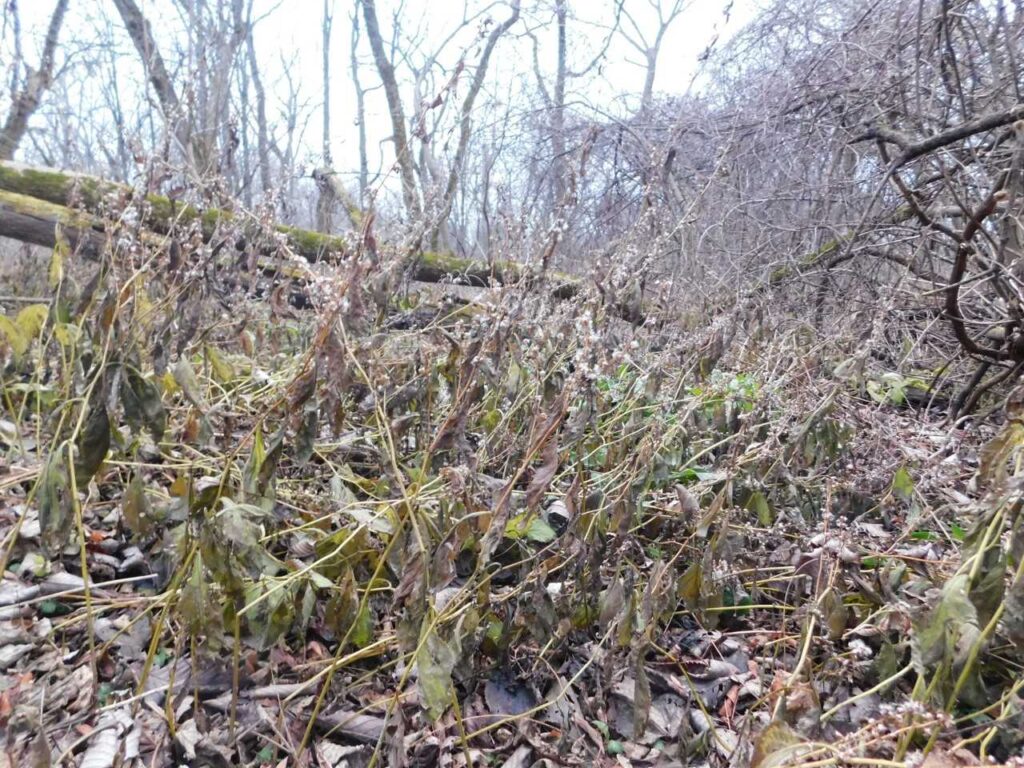
The ground, formerly home to such a large amount of jewelweed that I originally missed some intriguing aspects of my phenology spot, was now almost completely barren, save for a few stubborn, withering plant stalks. The ground was covered in leaf-litter. My phenology spot is also much quieter now, as there are far less birds fluttering around, and the squirrels, frogs, and cool slugs and snails that I previously spoke about are now nowhere to be seen. There were, however, a few scattered bird calls that I did hear, and was able to identify as the calls of American tree sparrows, white-throated sparrows, and the occasional crow.

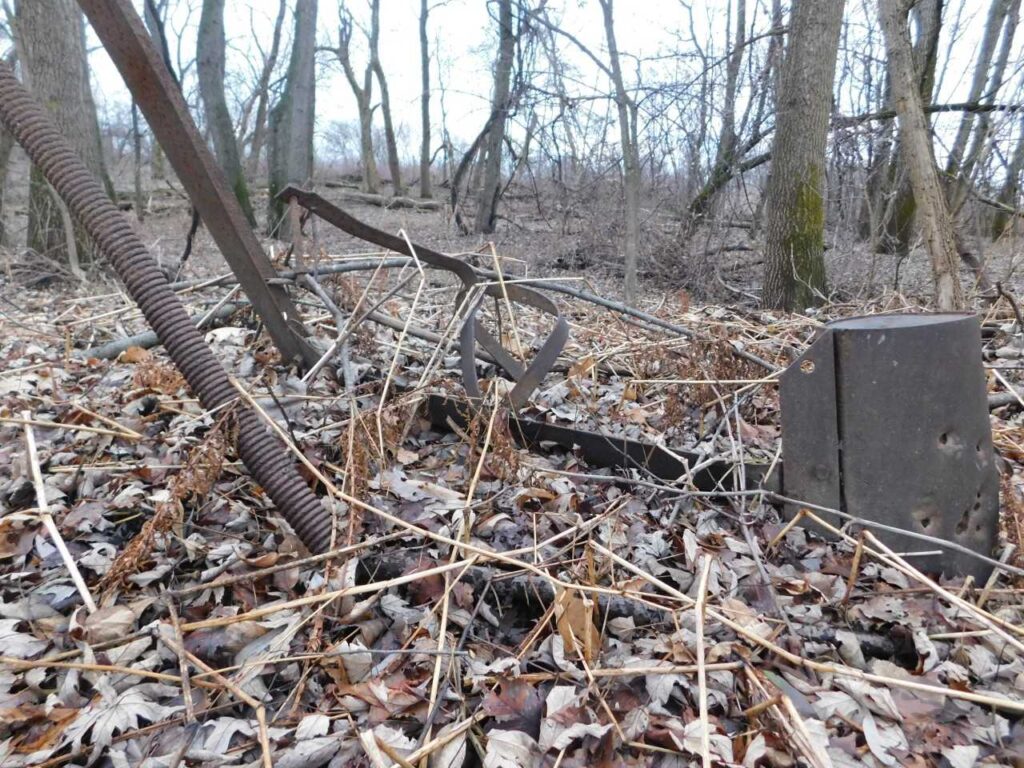
This lack of vegetation, especially jewelweed, led to a rather unexpected discovery. I could now easily see easier into the forest beside the trail, and I was shocked to notice a few pieces of scrap metal lying among the leaf-litter. I am unsure what the scrap metal was originally a part of, but the Intervale was previously used as an unofficial junkyard before it was restored into a floodplain forest, and it is surely not the first piece of oddly placed scrap metal I have located in the Intervale. It is really cool to think that the jewelweed was so prevalent in the late summer and fall that it could obscure my view of the scrap metal though, and I cannot wait to see if I can successfully sight this same scrap metal again in the spring and early summer, when the jewelweed is just beginning to grow again.

This will likely be the last time I visit my phenology spot before mid-January, and I cannot wait to see what changes the snow brings to the area.

Older Posts »

Skip to toolbar