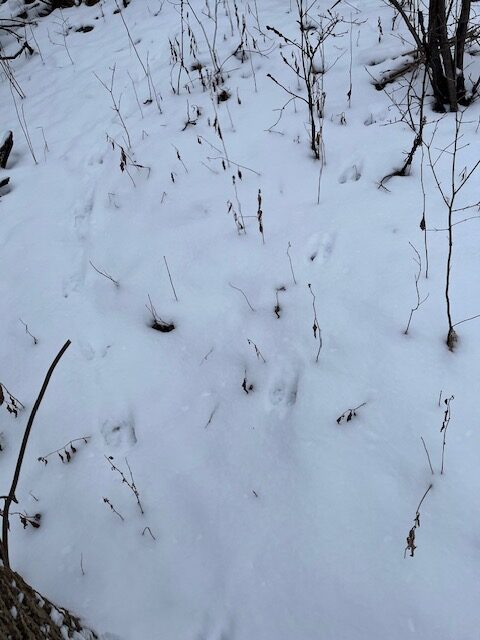
As part of our ongoing phenology project this semester, I got the chance to go out and find some tracks and signs of local wildlife here in Burlington this week! Despite there being so many great urban green spaces to choose from all over the city, a couple of friends and I decided to walk down to the Salmon Hole area along the Winooski River to look for some tracks in the snow on Saturday. While the fresh coat of snow was quite beautiful and will undoubtedly lead to some great tracks in the coming week, we went out right after the snow had stopped, so it was almost too fresh to find many well-defined tracks unfortunately. However, we did still come across multiple signs of wildlife in the Salmon Hole area and did not come up empty-handed. Walking along the snow-covered trail, there were countless dog tracks, and we chose a spot popular with many pet owners. Despite this overwhelming presence of dog tracks in the snow, we did find a few tracks we concluded to be left by Eastern Grey Squirrels (See Attached Image). We came to this conclusion by looking at our track guides and checking the measurements, which often lined up, and also recognizing that we were in an area of heavy tree cover along a slope and the stride pattern of the tracks matched the galloping pattern squirrels have. Although no tracks were found, we came across many signs of beaver activity in the area. We found ample evidence from chewed shoots and plants that beavers either currently or recently inhabited the section of the Winooski River that we were exploring. Knowing that beavers use so much wood from trees and plants along the banks of rivers, and also leave quite recognizable incisions where cuts are made, this conclusion was pretty easy for my friends and I to make. Taking a few pictures of the tracks and signs we found, my group found it pretty easy to upload our findings to the iNaturalist project that our class is currently participating in. With our sightings logged, we are hoping that the findings at Salmon Hole can help in collecting data about the wildlife that inhabit the Burlington area.
Until Next Time!
Abel Murphy