Spring is finally here. The sun is warm and shiny, the green grass is uncovered again, people can be seen all around enjoying the fresh air, and the trees and plants – some of them at least – are starting to wake up after a long winter.
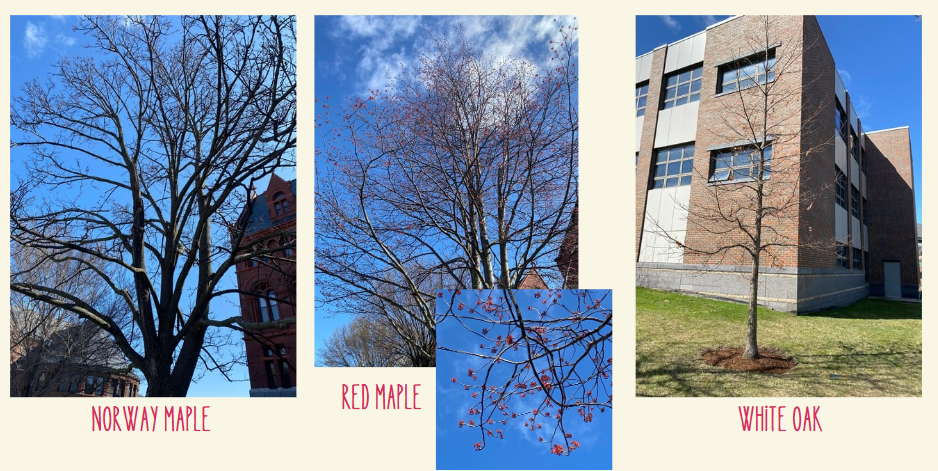
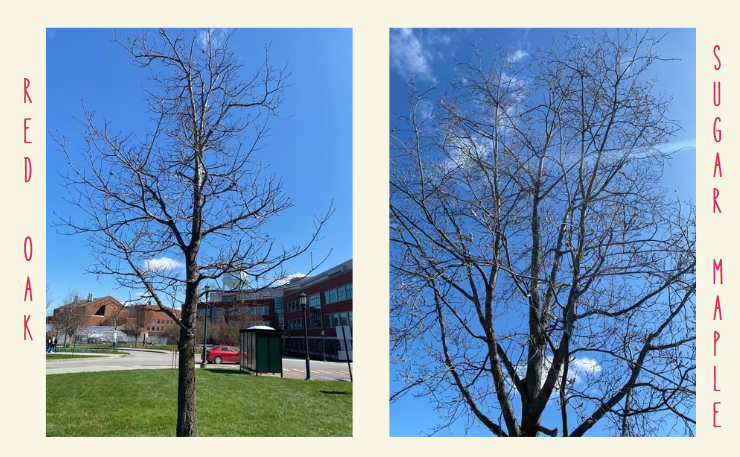
Yesterday, Wednesday 23rd of April, I walked around campus to observe and note the phenology changes different trees were starting to experience. My exploration began with the Norway Maple; most of its buds were breaking, but no flowers or leaves started to appear yet. Then came the Red Maple, this one was a beauty to look at. The whole tree was filled with tiny red open flowers, although I noticed some fallen leaves that likely hung on through the winter. In third, I visited the White Oak, a much smaller tree that showed the beginnings of bud break while still holding on to some dry, yellow leaves. Interestingly, it was also the first of the five trees to show early fruit growth. Getting near the end of my exploration, I approached the Red Oak, which had a lot of similarities with the White Oak – bud break, and dry leaves still clinging. However, its nuts had already dropped, with many of their cap-like cupules still attached to the branches. Finally, the Sugar Maple – similar in size with its previous Maple family – was in a transitional state, beginning to break buds and producing flowers.
It was interesting to see that not all the trees were in the same phenophase. The Red Maple and Sugar Maple were further along in their flowering stages, while the Norway Maple and Oaks were mainly just beginning bud break. This shows how even within the same landscape, species respond to seasonal cues differently.
While exploring the NPN’s website I found an article explaining how different species are adjusting to changing climate conditions at different rates. For instance, plants are responding more strongly to rising temperatures than animals, especially in springtime phenophases like flowering and leaf-out. This is significant because it can lead to phenological mismatches – for example, when a tree flowers earlier due to warmer temperatures, but the insects that pollinate it haven’t yet emerged. These mismatches can disrupt the balance of entire ecosystems.
Overall, this activity made me realize that every observation we make helps researchers understand and prepare for the impacts of climate change on ecosystems in Vermont and beyond.