 <\/p>\n
<\/p>\n
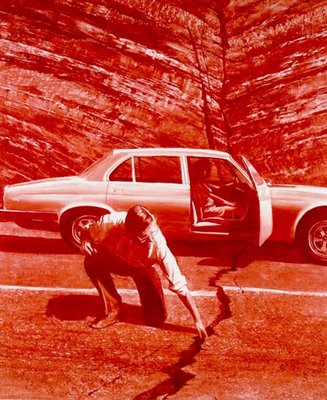
The Biology Blog’s post on shadow biospheres<\/a> intrigued me in part because I’ve been reading Charles Sanders Peirce, for whom semiosis is writ large (and small) throughout all things. Musing philosophically about the search for life on other planets, the author, cyoungbull, writes, “Unless we know how to interpret the signs of such life, we may not be able to distinguish it from the natural background.” For Peirce, signs of life are everywhere. Indeed, signs are everywhere, as are meanings, at least for those equipped to bear them. Just as for Whitehead it’s experience all the way down, for Peirce it’s semiosis all the way down. (There are other parallels between Whitehead and Peirce; more on those in a future post.) Whether we can read them or not is the question — a question made all the more poignant when they destroy homes and topple buildings, as in Haiti recently or Chile this morning.<\/p>\n The Bioblog piece links to an Astrobiology<\/a> article on the signatures of shadow biospheres and to an old Nature article<\/a> by chaophilic scientists and SF writers Jack Cohen and Ian Stewart<\/a>, which includes the following (entertaining) list of “canonical answers” to Enrico Fermi’s 1950 question “if intelligent aliens exist, why aren\u2019t they here?”:<\/p>\n \u25a1 There have been plenty of aliens, but civilizations only moderately more advanced than ours always blow themselves up in nuclear wars.<\/p>\n \u25a1 The lifespan of an alien civilization is only a few million years. They visited us ten million years ago, and will turn up again in ten million years\u2019 time, but there is nobody around right at the moment.<\/p>\n \u25a1 Aliens exist, but interstellar travel is impossible because of relativistic limits on the speed of light, or because living creatures cannot survive it.<\/p>\n \u25a1 Aliens exist, but are not interested in interstellar travel.<\/p>\n \u25a1 Aliens exist and have interstellar travel, but they are not interested in contacting us.<\/p>\n \u25a1 Aliens exist, but galactic law forbids any contact with us because we are too primitive or violent.<\/p>\n \u25a1 Some aliens see it as their duty to eliminate all other forms of life that come to their attention. Any technological civilization will develop radio and TV, attract their attention, and be eliminated. They are on their way now. <\/em>[Earthquake-causing aliens, anyone? Extraterrestrial black magicians? -ai]<\/p>\n \u25a1 They are here already (the preferred answer on the Internet\u2019s UFO pages).<\/em><\/p>\n Cohen and Stewart rephrase the question so that it’s not about intelligence, but about “extelligence.” As they point out, “intelligence not so different from our own can be found in the great apes, cetaceans and the octopus. Pigs are excellent at video games, parrots have a surprisingly good grasp of linguistics, and even sticklebacks and mantis shrimps can solve problems.” (I didn’t know about the pigs.) Extelligence, on the other hand, is “the contextual analogue of individual intelligence. Humanity\u2019s assumption of global dominance is a tale of extelligence: language, permanent archives of information such as books, and communication in all its technological forms.”<\/p>\n The radical xenobiologist’s answer to Fermi’s challenge is that our imagination is too limited to even conceive of the possible forms of intelligent, or extelligent, alienness: we’re not quite sure what to look for. Fermi’s last possibility, that “they are here already,” leaves room for several variations, as it raises the question of what it means to be “here already.” Where exactly is “here”? Even in a universe perfused with signs, as Peirce would have it, no single entity is capable of reading all the signs that are “here,” since each resides in its own umwelt<\/em> of legibilities, its own sub-universe of affordances and effectivities (to use J. J. Gibson’s relational terms for what a thing perceives and what it can do in response; where Gibson is focusing on perception\/action, Peirce’s triadic philosophy insists that meaning is their synthesis, their “thirdness”). These umwelts can expand, and early-21st-century-technology-equipped humans have expanded theirs (ours) dramatically. But then there are still, for instance, the bacterial superorganisms that Lynn Margulis<\/a> has studied and written about, and which New Scientist calls the “real Avatar”<\/a> — “extraterrestrial seas” of communicative life, as Stefan Helmreich<\/a> describes them.<\/p>\n And there are events, singularities, that call for interpretation. Whales attacking<\/a>. Or the whole biogeophysical system striking violently, triggering an inevitable search for meaning. Why this place? Why now? Why us? Has nature gone askew?<\/a><\/em> (And everyday life hits do that<\/a> as well.)<\/p>\n For the Bioblog author, part of the problem of recognizing alien in\/ex\/telligence is that “as a civilization advances they begin to use the available electromagnetic spectrum for communication more fully and efficiently until ultimately their radiative emissions are indistinguishable from blackbody radiation.” That sounds a bit like one might describe Margulis’s\/Helmreich’s seas, and Peirce’s ocean of semiosis: as a civilization advances, there comes to be too much signing going on, too much meaning-making, to the point that if we were to fully open up to another extelligent civilization’s sea of communicative intelligence — as we’re incrementally moving toward with our ability to read radiation waves across light-years of space — it would all be indistinguishable from the thermal “blackbody” background: it would all melt into white noise. We wouldn’t be able to see the signals for the noise.<\/p>\n Or maybe this is just the kind of thought one would<\/em> have as our own mediasphere multiplies over and through itself in infinite directions. As Robert Corrington, who has developed an ecstatic naturalist<\/a> ontotheology out of Peircian semiotics, writes: “world semiosis is the Bacchanalian revel in which each sign moves between death and transfiguration and attains some scope for itself within the innumerable intersections of its life” (p. 41). In the Bacchanalian revel that is the internet, how long does each sign live for? If signs “hunger for participation in innumerable orders of relevance” (p. 67), at what point do the signs come to saturate the available orders such that what emerges is an oceanic din in which the signs no longer reach (or create) their interpretants, and so in which the signs are no longer signs, no longer information, just noise? (For Peirce a thing is only a sign when it comes to mean something for someone. A sign relation requires the sign-vehicle, or representamen<\/em>, the object<\/em> to which it refers, and the interpretant<\/em>, which is the meaning it generates in and for someone.)<\/p>\n Perhaps what’s missing in such a saturated semiosphere is space<\/em>, territory for the signs to spread themselves out against, to smear themselves over, context<\/em> against which they can shimmer and make themselves felt in a way that enters into their observers’ life-worlds surrounded by a spaciousness that renders them legible, meaningful, assimilable. For those who live outside the internet, for instance, and outside of the global economy, what we do here<\/em> (online) may be just noise — just as they <\/em>barely register here. Perhaps the first step to finding alien in\/ex\/telligence may be to step out of our own electronic umwelt and into one of those places where the world’s other humanity<\/a> lives (as Bob Neuwirth does in Shadow Cities<\/a> and Mike Davis in Planet of Slums<\/a>). Or to step, with Brian Goodwin<\/a> and Jesper Hoffmeyer<\/a> (or one of Thoreau’s better descendants) into nature.<\/p>\n And then there are these big quaking signs<\/a> that come along, all too often these days (as in Chile this morning), that bring all these things (the other humanity, the shadow nature) together in one fell swoop, in one signal transmission<\/b><\/em>. Big signs seeking big interpretants. Leaving big tears<\/a> in their wake.<\/p>\n What does this<\/em> alienness, this altarity<\/a>, mean? What do signs like these indicate<\/a>? Have we even begun to make sense of our very own shadow biosphere?<\/p>\n","protected":false},"excerpt":{"rendered":" The Biology Blog’s post on shadow biospheres intrigued me in part because I’ve been reading Charles Sanders Peirce, for whom semiosis is writ large (and small) throughout all things. Musing philosophically about the search for life on other planets, the author, cyoungbull, writes, “Unless we know how to interpret the signs of such life, we […]<\/p>\n","protected":false},"author":99,"featured_media":0,"comment_status":"open","ping_status":"open","sticky":false,"template":"","format":"standard","meta":{"_monsterinsights_skip_tracking":false,"advanced_seo_description":"","jetpack_seo_html_title":"","jetpack_seo_noindex":false,"jetpack_seo_schema_type":"","_jetpack_newsletter_access":"","_jetpack_dont_email_post_to_subs":false,"_jetpack_newsletter_tier_id":0,"_jetpack_memberships_contains_paywalled_content":false,"_jetpack_feature_clip_id":0,"_jetpack_memberships_contains_paid_content":false,"footnotes":"","jetpack_publicize_message":"","jetpack_publicize_feature_enabled":true,"jetpack_social_post_already_shared":false,"jetpack_social_options":{"image_generator_settings":{"template":"highway","default_image_id":0,"font":"","enabled":false},"version":2},"jetpack_post_was_ever_published":false},"categories":[689701,688977,691847],"tags":[16869,4470,16870,431,16871],"class_list":["post-1207","post","type-post","status-publish","format-standard","hentry","category-media_ecology","category-geo_philosophy","category-religion-spirituality","tag-cosmos","tag-nature","tag-peirce","tag-semiosis","tag-theology"],"jetpack_publicize_connections":[],"jetpack_sharing_enabled":true,"jetpack_shortlink":"https:\/\/wp.me\/p4IC4a-jt","jetpack-related-posts":[{"id":6778,"url":"https:\/\/blog.uvm.edu\/aivakhiv\/2013\/07\/01\/preparing-my-peirce-centennial-proposal\/","url_meta":{"origin":1207,"position":0},"title":"Preparing my Peirce Centennial proposal","author":"Adrian J Ivakhiv","date":"July 1, 2013","format":false,"excerpt":"It will be quite an event for Peirce scholars. My proposed paper will be on applications of Peirce to film theory, and in particular the two neo- (quasi-?) Peircian approaches that I present in Ecologies of the Moving Image. The first of these builds on Sean Cubitt's three-part typology of\u2026","rel":"","context":"In "Cinema"","block_context":{"text":"Cinema","link":"https:\/\/blog.uvm.edu\/aivakhiv\/category\/cinema_zone\/"},"img":{"alt_text":"","src":"","width":0,"height":0},"classes":[]},{"id":1288,"url":"https:\/\/blog.uvm.edu\/aivakhiv\/2010\/06\/09\/peirce-whitehead-hartshorne-process-relational-ontology\/","url_meta":{"origin":1207,"position":1},"title":"Peirce-Whitehead-Hartshorne & process-relational ontology","author":"Adrian J Ivakhiv","date":"June 9, 2010","format":false,"excerpt":"The following are some working notes following up on my previous post on the relationship between Charles Sanders Peirce and Alfred North Whitehead, specifically on Peirce\u2019s logical\/relational\/phenomenological categories (firstness, secondness, thirdness) and Whitehead\u2019s notion of prehension and the \u201cactual occasion.\u201d It\u2019s become clear to me since writing that post that\u2026","rel":"","context":"In "Philosophy"","block_context":{"text":"Philosophy","link":"https:\/\/blog.uvm.edu\/aivakhiv\/category\/geo_philosophy\/"},"img":{"alt_text":"triple-cone-p211-english.jpg","src":"https:\/\/i0.wp.com\/blog.uvm.edu\/aivakhiv\/files\/2010\/06\/triple-cone-p211-english.jpg?resize=350%2C200&ssl=1","width":350,"height":200},"classes":[]},{"id":8653,"url":"https:\/\/blog.uvm.edu\/aivakhiv\/2016\/02\/09\/rethinking-the-3-categories\/","url_meta":{"origin":1207,"position":2},"title":"Rethinking the 3 categories","author":"Adrian J Ivakhiv","date":"February 9, 2016","format":false,"excerpt":"I've been struggling with\u00a0how my triadic framework for interpreting art works relates to C. S. Peirce's categories. When I first developed my triadism (fleshed out in Ecologies of the Moving Image) into the non-Peircian terms of materiality, experience, and representation\u00a0-- which I did in the context of teaching a course\u2026","rel":"","context":"In "Philosophy"","block_context":{"text":"Philosophy","link":"https:\/\/blog.uvm.edu\/aivakhiv\/category\/geo_philosophy\/"},"img":{"alt_text":"","src":"","width":0,"height":0},"classes":[]},{"id":1593,"url":"https:\/\/blog.uvm.edu\/aivakhiv\/2010\/12\/13\/agreements-productive-differences\/","url_meta":{"origin":1207,"position":3},"title":"Agreements & productive differences","author":"Adrian J Ivakhiv","date":"December 13, 2010","format":false,"excerpt":"Levi Bryant has proposed a ceasefire on the objects\/relations debate, and followed that up with a nice post calling for self-moderation of our more confrontational urges and for a more affirmative writing (and blogging) style that would render the form of our writing more consonant with its content. I'm all\u2026","rel":"","context":"In "Philosophy"","block_context":{"text":"Philosophy","link":"https:\/\/blog.uvm.edu\/aivakhiv\/category\/geo_philosophy\/"},"img":{"alt_text":"","src":"","width":0,"height":0},"classes":[]},{"id":1262,"url":"https:\/\/blog.uvm.edu\/aivakhiv\/2010\/05\/12\/between-whitehead-peirce\/","url_meta":{"origin":1207,"position":4},"title":"between Whitehead & Peirce","author":"Adrian J Ivakhiv","date":"May 12, 2010","format":false,"excerpt":"The case has often been made -- by John Cobb, David Ray Griffin, and others -- that Alfred North Whitehead's process metaphysics provides an account of the universe that is, or could be, foundational to an ecological worldview. This is because it is an account that is naturalist (or realist),\u2026","rel":"","context":"In "Philosophy"","block_context":{"text":"Philosophy","link":"https:\/\/blog.uvm.edu\/aivakhiv\/category\/geo_philosophy\/"},"img":{"alt_text":"","src":"","width":0,"height":0},"classes":[]},{"id":4794,"url":"https:\/\/blog.uvm.edu\/aivakhiv\/2011\/06\/22\/after-nature\/","url_meta":{"origin":1207,"position":5},"title":"After Nature","author":"Adrian J Ivakhiv","date":"June 22, 2011","format":false,"excerpt":"After Nature, the new blog hosted by process-relational ecophilosophical fellow traveler Leon Niemoczynski, now has an RSS feed. That means that I can enthusiastically recommend that philosophically inclined readers of this blog subscribe to it. Leon is author of Charles Sanders Peirce and a Religious Metaphysics of Nature. The five\u2026","rel":"","context":"In "Philosophy"","block_context":{"text":"Philosophy","link":"https:\/\/blog.uvm.edu\/aivakhiv\/category\/geo_philosophy\/"},"img":{"alt_text":"","src":"","width":0,"height":0},"classes":[]}],"jetpack_featured_media_url":"","_links":{"self":[{"href":"https:\/\/blog.uvm.edu\/aivakhiv\/wp-json\/wp\/v2\/posts\/1207","targetHints":{"allow":["GET"]}}],"collection":[{"href":"https:\/\/blog.uvm.edu\/aivakhiv\/wp-json\/wp\/v2\/posts"}],"about":[{"href":"https:\/\/blog.uvm.edu\/aivakhiv\/wp-json\/wp\/v2\/types\/post"}],"author":[{"embeddable":true,"href":"https:\/\/blog.uvm.edu\/aivakhiv\/wp-json\/wp\/v2\/users\/99"}],"replies":[{"embeddable":true,"href":"https:\/\/blog.uvm.edu\/aivakhiv\/wp-json\/wp\/v2\/comments?post=1207"}],"version-history":[{"count":0,"href":"https:\/\/blog.uvm.edu\/aivakhiv\/wp-json\/wp\/v2\/posts\/1207\/revisions"}],"wp:attachment":[{"href":"https:\/\/blog.uvm.edu\/aivakhiv\/wp-json\/wp\/v2\/media?parent=1207"}],"wp:term":[{"taxonomy":"category","embeddable":true,"href":"https:\/\/blog.uvm.edu\/aivakhiv\/wp-json\/wp\/v2\/categories?post=1207"},{"taxonomy":"post_tag","embeddable":true,"href":"https:\/\/blog.uvm.edu\/aivakhiv\/wp-json\/wp\/v2\/tags?post=1207"}],"curies":[{"name":"wp","href":"https:\/\/api.w.org\/{rel}","templated":true}]}}
\n\u25a1 There are no aliens, and there never have been. Humanity is unique in the Universe.<\/p>\n <\/a><\/p>\n
 <\/a><\/p>\n