
Weather: 60 degrees Fahrenheit and dry, temperature was rapidly cooling during my visit. It has rained for a week prior to yesterday.
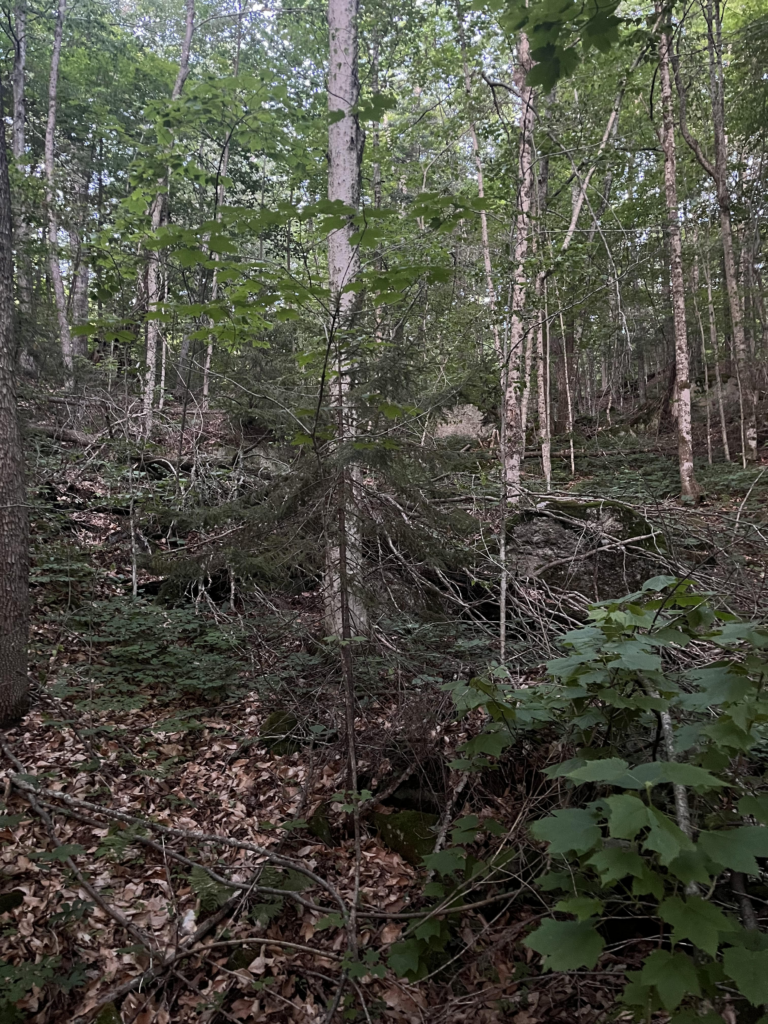
My site is located behind my home about a ten-minute walk from my house. It is not heavily traveled by people. It is situated just below a meadow and immediately below the sharp cliff face of Mount Piscah in Westmore Vermont just outside Willoughby state forest. The site itself is situated next to a seasonal ravine, during the spring there is a decent amount of water flow leaving exposed rocks the size of basketballs. Another unique thing about this site alike the rest of the state forest is the deposited rock that scatters around everywhere from glacial deposits. In my site there was 5 that were about half the size of a compact car and then numerous the size of refrigerators. Each was covered in an inch or dense wet moss. The sit was very buggy and the ground was still slightly damp from the rain the past week. The forest floor was littered in maple, red oak, and beech leaves because of their late shed. This cover was about two inches thick before one could observe the soil. There was a large canopy, dominated by Sugar maple, yellow birch, beech, and what appeared to be white ash. There was 5 or 6 large. trees that took up most of the canopy space with trunks I estimated to be at least 6.5 feet in circumference. The area was generally sparsely grown, there were plenty of new growth trees like small beeches, mountain maples, and fir trees. besides these the ground lay clear besides ferns and other shrubbery I could not Identify. The place I examined was on a slight slope facing westward. The westward side had a recently logged section as well so it has been getting more exposure in the past year. As for wildlife I heard a woodpecker and numerous birds calling. I also saw plenty of chipmunks. Tracks were hard to come by as the leaves were difficult to interpret however there were plenty of small trails where leaves had been upturned leaving their damper underside in a patternlike fashion. This area was hardwood dominated and the wood are labeled as northern hardwood forest. The softwood in this area consisted of mostly small fir but no large growth fir. In this area there was a lot of old large felled trees of natural causes, mostly birch well in the process of decaying with a variety of mushrooms and fungi on them.
- Why are the younger beech dying
- I was unable to find a beech that did not have boils on its bark. Are these trees particularly susceptible for what I am assuming is a disease or parasite?
- Why are there no older growth firs in this area.
- does the increased western exposure from logging have any large impacts on the biodiverity of the area and its health.
- How does the large ammount of leave cover contibute to the dampness of the soil.
- Why do beech, birch and maple dominate the area.
- What species are dependent on the stream and dampness of the soil.
- Is there a reason that birch primarily grew from the tops of the deposited rocks?
- How can you understand levels of log decomposistion.
- How close is the undergound water table?
- Is this seasonal stream vital for some species?
- What effect does the debris of a hardwood forest have on soil composition?
- What bird species live in this area?
- Why were the young beech’s leaves wilting early?”
- How often is this stream in use?
- Does the sudden uprise of the mountain cliffs impact sun exposure?
- Is there increased runoff from the mountain?
- If so do the exposed unique terrain of the mountain carry anything unique or valuable for plant health?
- What is the permeability of the soil in this area?
- What does this permeability mean for the plant growth?
- What specific fungi were on the birch log I examined?
- How do the deposited rocks impact animal and plant life?
- How come only certain sized rocks were deposited?
- What is the soil composition in this area?
- Why does moss thrive on these rocks?
The question I choose to research is, “I was unable to find a beech that did not have boils on its bark. Why are these trees particularly susceptible for what I am assuming is a disease or paracitye ?”
Beech trees are attacked by a disease known as beech bark disease. It is formed by the help of both a invasive parasite and two types of fungi. The insects do the work and bore into the tree weakening the bark and creating lesions. These fungi will get into these holes and it creates these bumps that I saw that cover almost all the surface area on the tree. Beech trees scar very easily so it is very noticeable much like when bears try to get to beech nuts you can see the claw marks years later. While this disease is not directly responsible for beech trees death, it does weaken the tree and creates a great deal of stress and mortality especially around saplings. There is also a beech leaf disease that causes the leaves to prematurely wilt. These are ravaging both American and European beech. Source : (Beech Trees – Stowe Land Trust)
Bibliography:
“Beech Trees.” Stowe Land Trust, www.stowelandtrust.org/work/education-outreach/summer-naturalist/naturalists-journal/post/naturalist-highlight-beech-trees. Accessed 20 June 2023.
Conclusion:
I am glad I choose this spot the ravine provides a unique spot in the woods with different growth and plant presence. The recent logging also gives me a chance to see how it is impacted in the following years. It will be interesting to see how it handles this heat we will have this week. Something that caught my attention during this visit was the thick ground cover of maple, beech, and oak leaves. I am interested in learning more about how this impacts the ecosystem and why these hardwoods lose their leaves later than other trees. The cover was about 2 inches deep I found this interesting as it remains like this year-round, however, I have never really taken the time to notice it until now. Future visits I will pay closer attention to this feature of my area.