
I visited the gap around 10:00 when the sky was clear and sunny, the temperature was 75F, and there was moderate humidity. It was my first visit to the gap when everything wasn’t still releasing latent raindrops.
Today I felt myself drawn to the plants filling up the gap – plants that are crowding the once empty space and appearing to live in harmony with one another. As I looked closer at the tangled mess of young trees and shrubby species, I noticed it was more of a battle scene than a peaceful community. I first saw that the elderberry bushes which were recently filled with red, ripe berries were not stripped of their fruit. It seems as though the wildlife of the park had accepted their offering sometime in the past week. Next, I saw that the pin cherry which was growing upwards in the center of the gap was competing with a strangling vine – i believe some bittersweet nightshade – and it took a lot of restraint to keep from pulling it off of the innocent sapling. I had to remind myself that my opinion and bias are not part of this ecosystem.
Below the pin cherry and bittersweet entanglement, raspberries, elderberry, white ash and striped maple were competing for space – their leaves and branches all trying to occupy the same sunlit space. It occurred to me then the difference in growth form of the plants in the gap. Specifically, i saw that a red maple sapling growing in the gap was already taller than me and was rocketing upwards with a strong and straight, central leader. Just a few feet away from this towering sapling was another of the same species with a completely different shape. Under the shade of the canopy, this other red maple sapling was just a few feet tall and had an umbrella-like shape with a central stem that reached upwards to a flat and wide arrangement of branches. It was likely that these two plants were around the same age but their environment and the microclimate that existed therein drastically changed their appearance and existence – one destined to be a tall and dominant canopy tree while the other a mid-story component always searching for more sunlight.
A mystery I wanted to investigate after this visit was concerned with the timing of things, specifically how long coarse woody debris stuck around on the forest floor and how long it takes for moss to colonize recently exposed sapwood. I was hoping the answer to the second of these questions could help me estimate how long ago the hemlock had fallen down and therefore the age of the gap.
From a few quick searches, I found that in eastern forests it can take anywhere from 57 to 124 years for conifer DWD to decompose and depends on climatic factors (https://doi.org/10.1007/s10021-014-9757-5). I wasn’t able to find much about mosses and their colonization of dead wood but I did find an article from the New York Times in 1992 which talks about the five classes of dead wood. Based on the lack of decomposition and the fact that the hemlock stump still has all of its bark, I believe it is still in the first class of decomposition and can’t be more than a few years old (https://andrewsforest.oregonstate.edu/sites/default/files/lter/pubs/pdf/pub3306.pdf). Some more dominant timber species often have associated growth rate curves from years of research but no such research has been done on pin cherry so its difficult to determine how old the sapling in the gap is. It would make sense that its consistent with the estimation of the hemlock coming down which is a few years.
Below are some pictures I took at the gap and decided were the most intriguing:
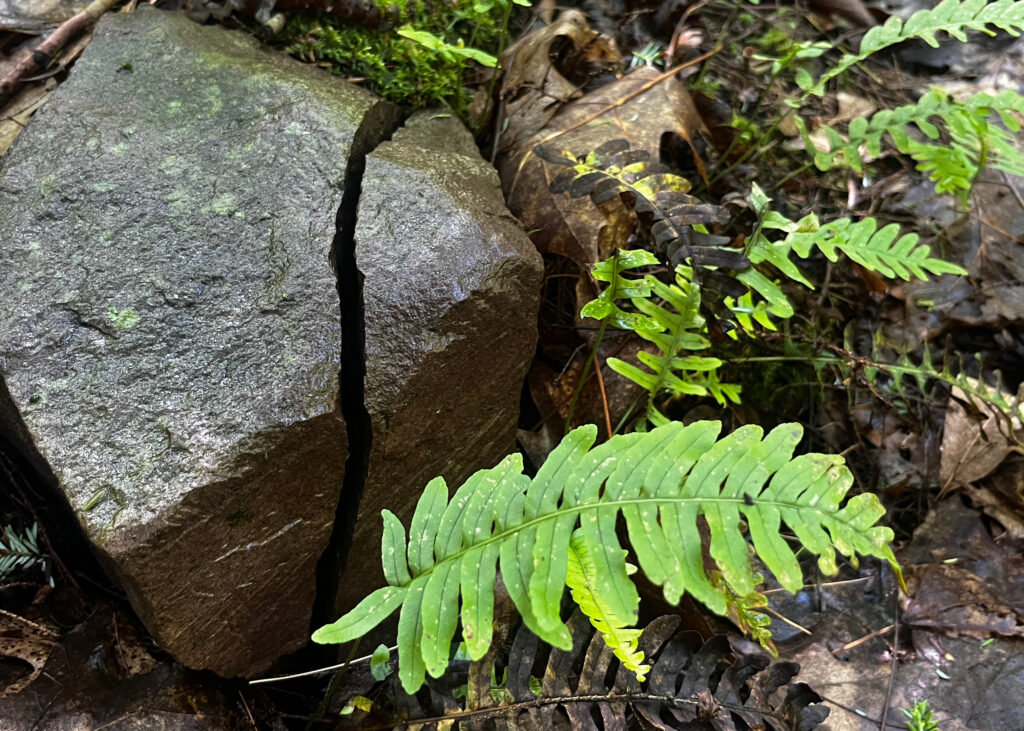
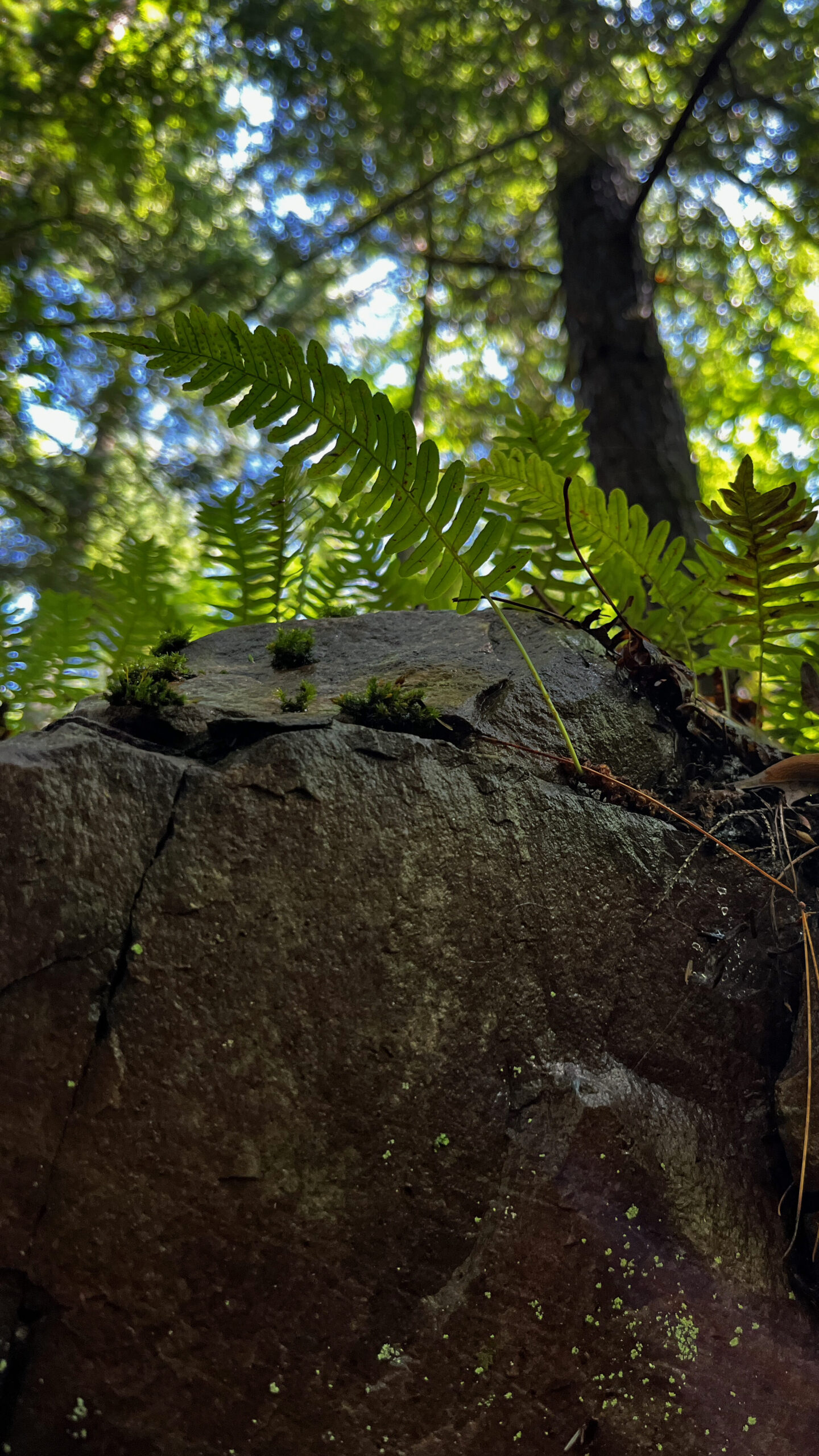
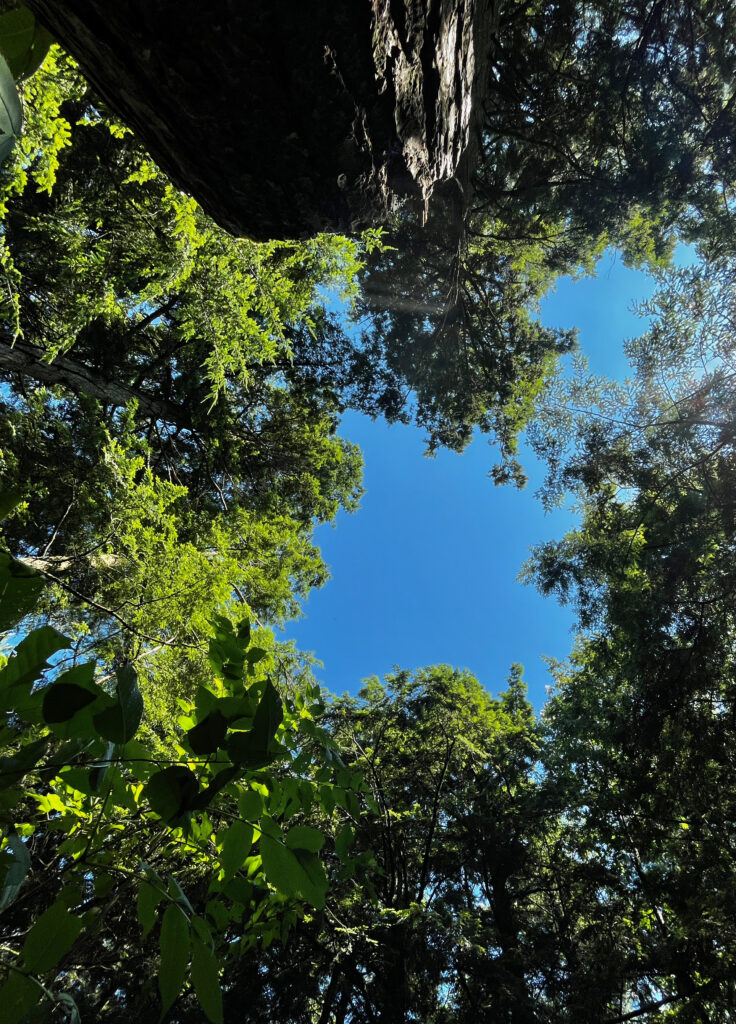
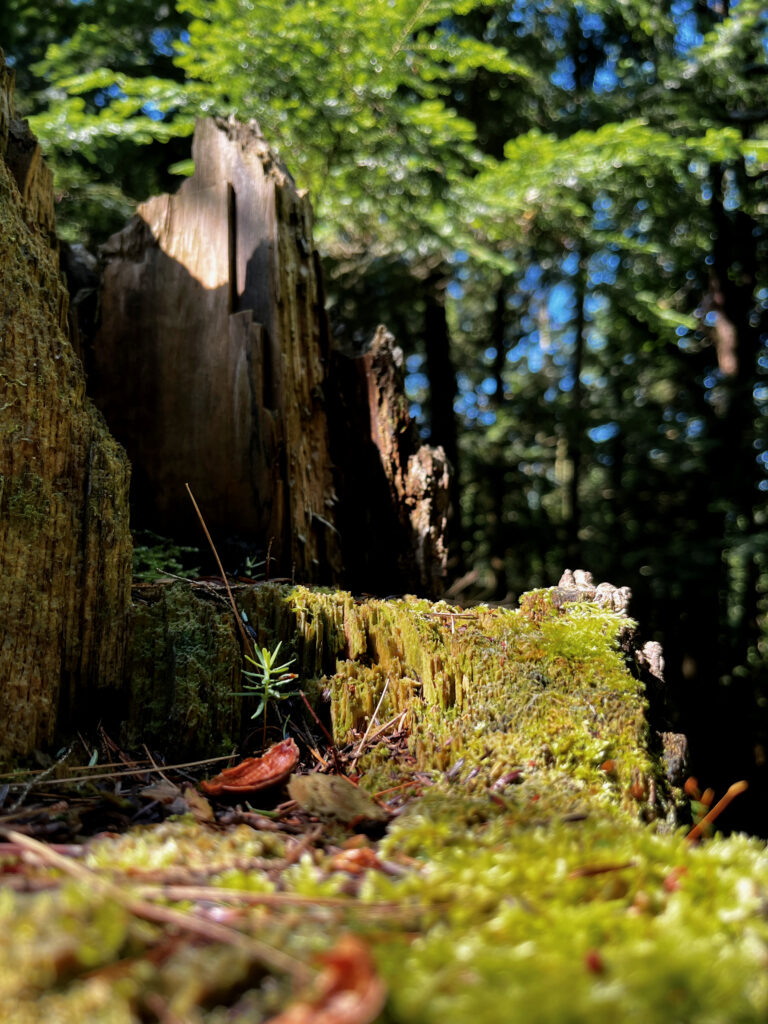
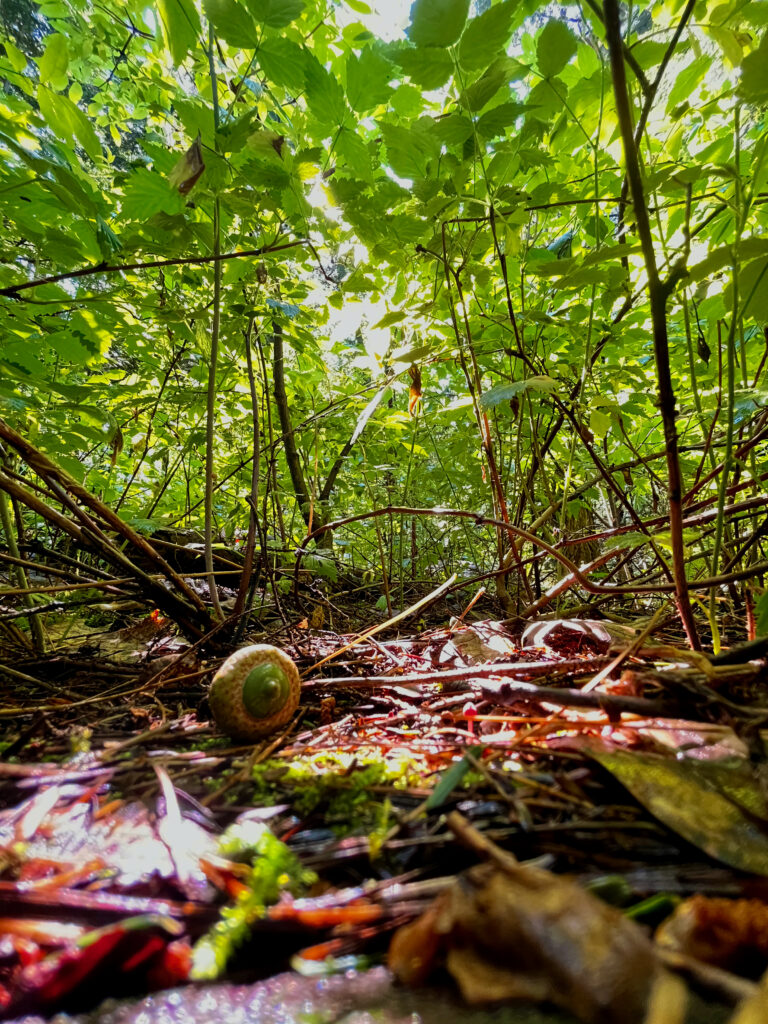
It did feel a little limiting to only have my phone to take pictures. With such a green and complex matrix of plants in the background, i found it difficult to show a subject in a more landscape composition and kept falling back to close-up photography. This macro-style of portrait taking is done very well with the 0.5x lens on my phone which is why I used it so often (pictures 3 and 5).
I’ve always had an interesting relationship with photography. Similar to how we heard in class, i think it can so often take away from the actual experience of being in the place and feeling centered there. On the other hand, if done well, it can tell incredible stories and convey deep emotions. Because I have more experience with photography than sketching, and it’s so difficult to sketch things perfectly, I think I like using photography to capture scenes and information more than sketching. Especially in the age of cell phones, it is very easy to just keep pressing the shutter and gather lots of information in the form of pictures. Additionally, the ease with which pictures are taken means experimenting with each photo to formulate your preferred message is relatively easy. On the flip side, its much easier to look past the details and every part of a scene when taking a picture. When sketching, it is up to me to look and understand each shape and form and relate that to the page.
I think taking pictures will always be my preferred method of capturing a visual of my site but i’m glad to have gotten experience with both sketching and photographing. I’d love to hear how these pictures convey information and emotion about the gap to anyone who reads this blog.