
Hello all! This is the first of many posts highlighting my interactions with Red Rocks park – a Burlington city park located in the south end of town on Lake Champlain. As I walked through the park towards the lake, a lighted section of the canopy caught my eye and drew me in so I decided it would be my location of interest for the next few weeks. Although this space was merely the width of a single tree canopy, I decided to call it “the gap.”
I visited the gap around 6:30PM after a hot and muggy day with scattered showers so the leaves still glistened with lingering rain drops. I could feel the moisture in the air, along with lots of mosquitos, and smell the petrichor of the earth. I heard a few different birds, boats and trucks. As I ventured off the path and into the gap, I stepped over poison ivy and other small herbaceous plants. As I got closer to the hole in the canopy I could see it was where an eastern hemlock once stood and had snapped off around 6ft from the ground. As I looked around, I saw lots of exposed bedrock – reddish in hue with a very plate-like and blocky structure. The rocks were covered with lichen, moss, ferns, herbaceous plants and even trees where there was enough soil to cling to. Nearly all of the ground had some sort of slope to it – undulations in the surface. The closer I got to the hemlock stump in the gap, the denser the vegetation became as each plant battled its way towards the sky to claim as much newly acquired sunlight as possible. I was excited to recognize numerous plants: sugar maple, red maple, Norway maple, striped maple, shagbark hickory, American basswood, eastern hemlock, eastern white pine, pin cherry, choke cherry, staghorn sumac, ironwood, northern red oak, green ash, common buckthorn, elderberry, flowering raspberry, maple-leaved viburnum, wild strawberries, oriental bittersweet, Canada mayflower, partridgeberry, low-bush blueberry, bellwort, dandelion, Virginia creeper, and blue cohosh. Also to my excitement, I saw many plants I did not yet know how to identify such as three different ferns, a species that resembled nettle and some other herbaceous plants. The more I looked around, the more evidence I could see of natural succession and forest dynamics occurring which made me really happy to see so close to home and the developed world.
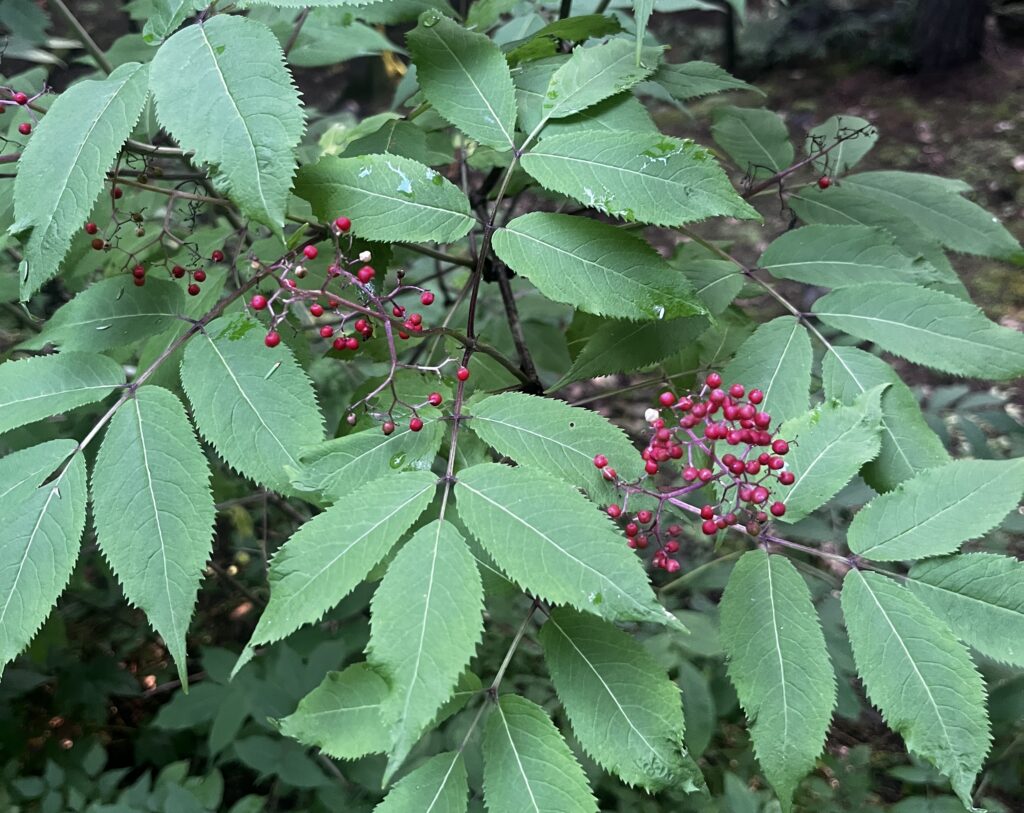
Some questions that came up while I was at the gap:
- How long ago did this eastern hemlock come down?
- When was the last time somebody stood on the ground under my two feet?
- Are there coyotes in Burlington?
- How long does it take for sticks, branches and logs to decompose on the forest floor and how does that differ between species?
- What ecosystem benefits do ferns contribute to their sorroundings?
- What has happened in this spot in the past and how altered has it been by humans?
- What makes trees lose their leaves/needles during the growing season?
- How do chunks of rock end up feet away from bedrock outcroppings?
- What is the underlying hydrology/drainage like in this site?
- What kind of insect is eating this certain kind of plant?
- How long does it take lichen to grow? How long can it live?
- How many species of lichen are there and what are the details of that symbiotic relationship?
- Are there any bats that live in red rocks part?
- What species of ferns have spores on the underside of their fronds and why are some brown and some green?
- Are the brown and orange/red daddy long leg spiders different species?
- When did invasive species (Norway maple, common buckthorn, oriental bittersweet) first colonize this spot and how did they get here?
- How much carbon is held in one square meter of this forest?
- How much water is held in one square meter of this forest?
- Why are there so many mosquitos?
- How many insects are beneath my feet?
- How many of the plants around me are connected through mycelial networks?
- What kinds of birds live in this habitat?
- Why aren’t I seeing any northern white-cedar?
- Did any large mammals (bear, catamount, bobcat) used to live in this spot?
- How and why did poison ivy evolve to excrete an irritating oil?
- How much money does the city expend each year to maintain the park? Does it provide any revenue?
- How important is this space to the people and animals of Burlington?
The question that stuck out to me and made me want to do some research was about lichen as I think they are such an interesting life form. The Vermont Land Trust (VLT) has a cool webpage that shares some interesting facts about lichen (https://vlt.org/2024/01/25/lichens-partners-for-life/). Lichen is a symbiotic relationship between a fungus (which provides structure and protection) and either an algae or cyanobacteria (which photosynthesizes and provides food). There are three main types of lichen: foliose (leaf-like), fructicose (bush-like), and crustose (crust-like). Given that there are numerous types of fungus, algae and cyanobacteria, it makes sense there are at least 18,000 different species of lichens! Back to my original question – some species of lichen can live for over 1,000 years.
I am excited to get to know the gap over the next few weeks as plants fruit, grow and reproduce. Although it’s not a long time, i’m expecting to notice a lot of change as the forest is such a dynamic place. One thing that caught my attention during this first visit is the veracity with which the early successional species in the gap are shooting for the skies and I am looking forward to watching this continue during the peak of the growing season. Hopefully i’ll get to see some more wildlife, too!
Hi, this is a comment.
To get started with moderating, editing, and deleting comments, please visit the Comments screen in the dashboard.
Commenter avatars come from Gravatar.